
What is Heart Rate Recovery?
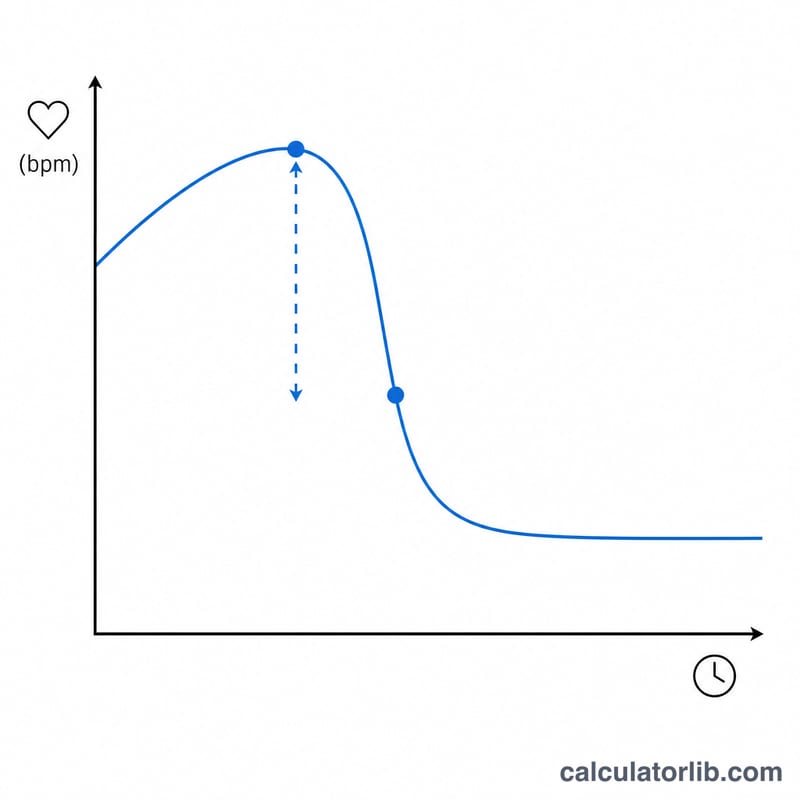
Heart rate recovery (HRR) measures how quickly your heart rate falls after you stop intense exercise. It is calculated as the difference between your peak (maximum) heart rate during exertion and your heart rate exactly one minute after stopping. A faster, larger drop reflects a healthier, better-conditioned autonomic nervous system, while a small drop has been linked in studies to higher cardiovascular risk.
How to use this calculator
Exercise until you reach a hard effort and note your peak heart rate (a chest strap or fitness watch works best). Stop, rest, and after exactly 60 seconds record your heart rate again. Enter both numbers above. The calculator subtracts the recovery value from the peak value to give your 1-minute HRR in beats per minute, plus the recovery as a percentage of peak and a simple fitness category.
The formula explained
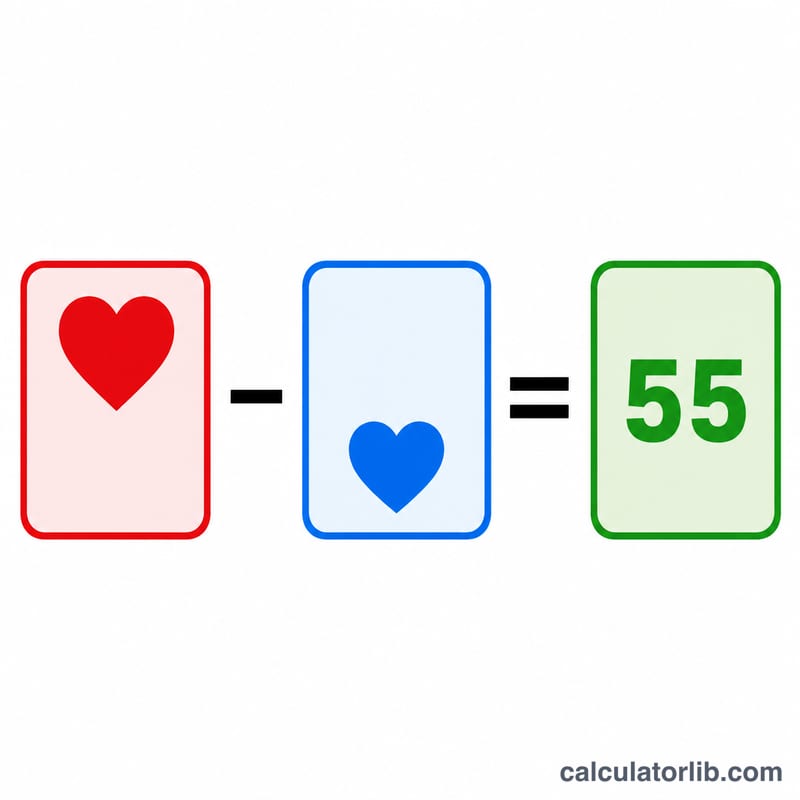
The core equation is simply $$\text{HRR} = \text{HR}_{\text{peak}} - \text{HR}_{\text{recovery}}$$ For example, if your heart rate peaked at 170 bpm and dropped to 140 bpm after one minute, your HRR is \(170 - 140 = 30\) bpm. As a guide: an HRR of 12 bpm or less is considered abnormal, 13–15 is below average, 16–24 is average/healthy, and 25 or more is excellent.
Worked example
Suppose a runner finishes intervals at a peak of 185 bpm. After resting for one minute their watch reads 150 bpm. $$\text{HRR} = 185 - 150 = 35 \text{ bpm}$$ which is \(35 / 185 \times 100 \approx 18.9\%\) of peak — a healthy recovery placing them in the "average/healthy" to "excellent" range.
FAQ
Is a higher HRR better? Yes. A larger one-minute drop generally indicates better cardiovascular fitness and stronger parasympathetic (vagal) tone.
Does cooling down matter? Standardized protocols stop activity then sit or stand still. Walking slowly can change the number, so be consistent each time you test.
Is this medical advice? No. This tool is for general fitness tracking. If your recovery is consistently very low or you have symptoms, consult a healthcare professional.