
What Is the Magic Mile?
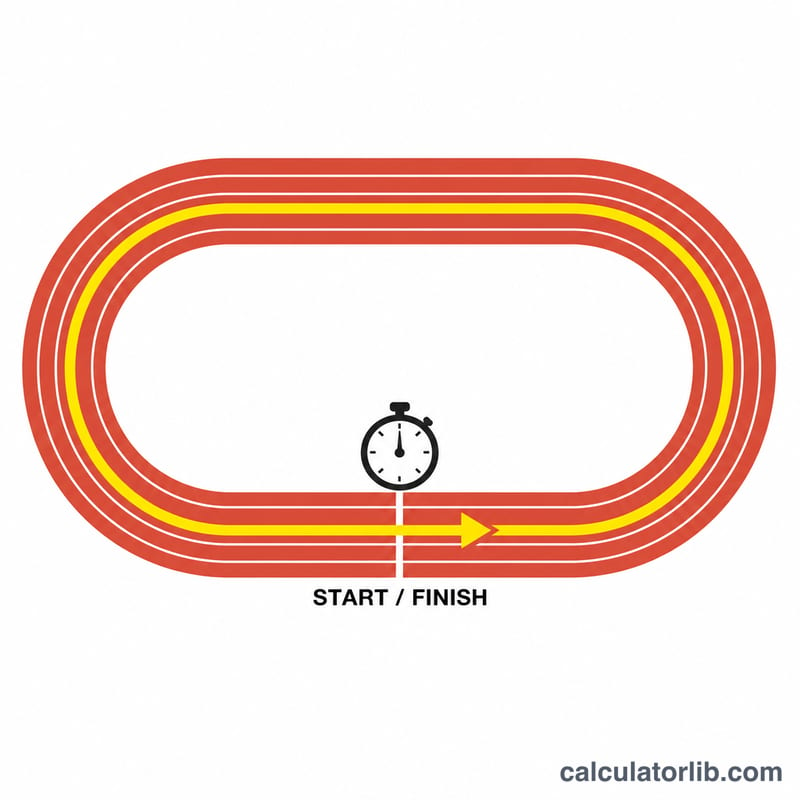
The Magic Mile is a simple time trial popularized by Olympian and running coach Jeff Galloway. You warm up, then run one mile (1,609 m) as fast as you can sustain, and record the time. From that single effort you can estimate realistic race paces for distances from the 5K up to the full marathon — without an exhausting race-day test.
How to Use This Calculator
Run your fastest steady mile and enter the time in minutes and seconds. The calculator multiplies your Magic Mile time by Galloway's factors to give a target pace per mile for each race distance, then multiplies that pace by the race distance to estimate a finish time. Repeat the Magic Mile every few weeks to track fitness.
The Formula Explained
Galloway found that race pace gets slower as distance grows. Starting from your Magic Mile time (\(t_{\text{mm}}\)), pace per mile is:
$$\begin{aligned} \text{5K} &= t_{\text{mm}} \times 1.06 \\ \text{10K} &= t_{\text{mm}} \times 1.15 \\ \text{Half} &= t_{\text{mm}} \times 1.2 \\ \text{Marathon} &= t_{\text{mm}} \times 1.3 \end{aligned}$$ Finish time equals that pace multiplied by the race distance in miles (5K ≈ \(3.107\) mi, 10K ≈ \(6.214\) mi, half ≈ \(13.109\) mi, marathon ≈ \(26.219\) mi).
Worked Example
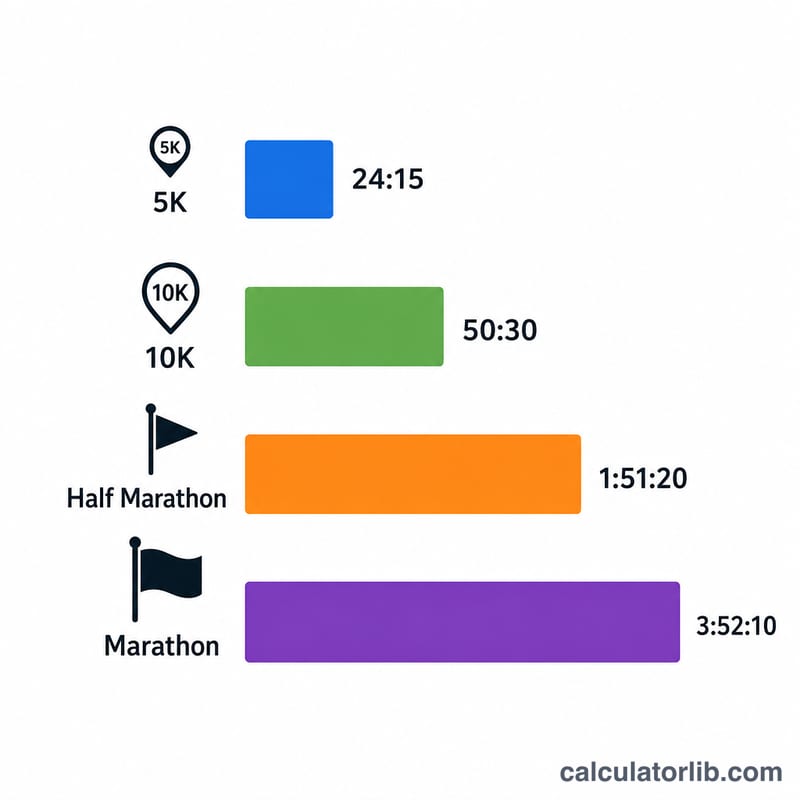
Suppose you run an 8:00 Magic Mile (480 seconds). Marathon pace = $$480 \times 1.3 = 624 \text{ sec/mi} \quad (10{:}24/\text{mi}).$$ Predicted marathon time = $$624 \times 26.2188 \approx 16{,}361 \text{ seconds},$$ about 4 hours 32 minutes. Your 5K pace would be \(480 \times 1.06 = 508.8\) sec/mi (about 8:29/mi).
FAQ
How often should I run the Magic Mile? Galloway suggests every two to three weeks during a training cycle to gauge progress.
Are these predictions guaranteed? No. They are realistic targets assuming proper training and pacing; heat, hills and fueling affect actual race results.
Should I run the mile all-out? Run hard but controlled — fast enough that you couldn't hold the pace much longer, not a flat-out sprint.