
What is the Electrical Resistance Unit Conversion Calculator?
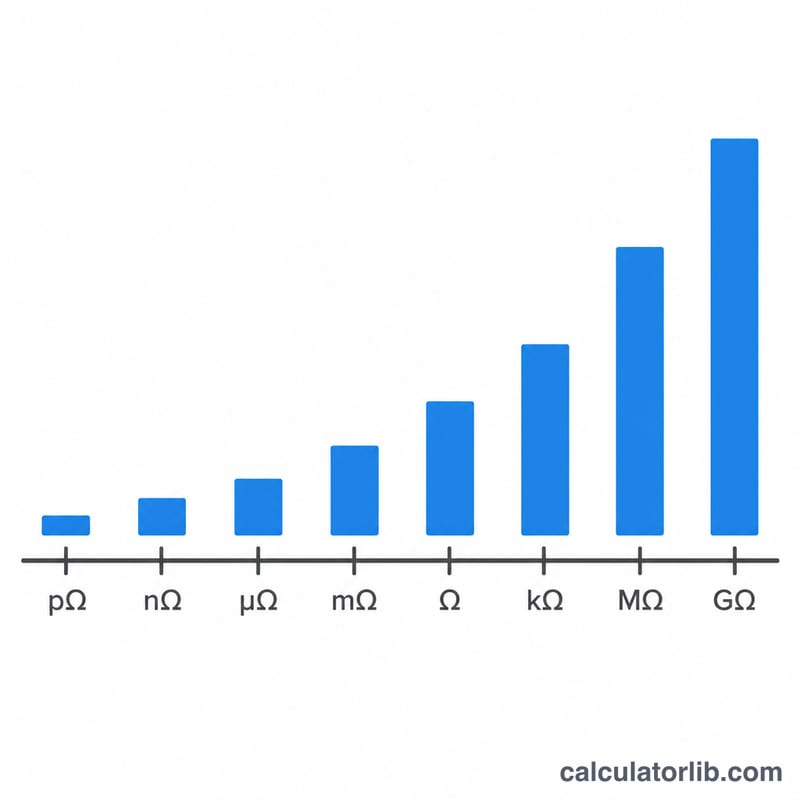
This tool converts a single electrical-resistance value into every common resistance unit at once. It supports the full SI ladder from picoohm to gigaohm, the CGS-emu abohm, and volt per ampere (V/A), which is dimensionally identical to the ohm by Ohm's law. It is a pure physics conversion and works the same everywhere in the world.
How to use it
Enter your resistance value, pick the unit it is currently expressed in, and choose how many significant digits you want to display. Press calculate and all ten unit outputs appear simultaneously. The significant-digits setting only changes how results are rounded for display, never the underlying math.
The formula explained
Every conversion is anchored to the SI base unit, the ohm. First the input is normalized: ohms = resistanceValue x scaleFactor(fromUnit). Then each target unit is produced by dividing by that unit's own scale factor: outputValue = ohms / scaleFactor(targetUnit). The scale factors are constants (1e-12 for picoohm, 1e3 for kiloohm, and so on), so there is never a divide-by-zero. Note that abohm and nanoohm both equal 1e-9 ohm, and V/A equals the ohm exactly.
$$R_{\Omega} = \text{Resistance} \times f_{\text{Input unit}}$$$$R_{\text{target}} = \dfrac{\text{Resistance} \times f_{\text{Input unit}}}{f_{\text{target}}}$$$$\text{where}\quad \left\{ \begin{aligned} R_{\Omega} &= \text{Resistance} \times f_{\text{Input unit}} \\ f &= 10^{-12},\,10^{-9},\,10^{-6},\,10^{-3},\,1,\,10^{3},\,10^{6},\,10^{9} \end{aligned} \right.$$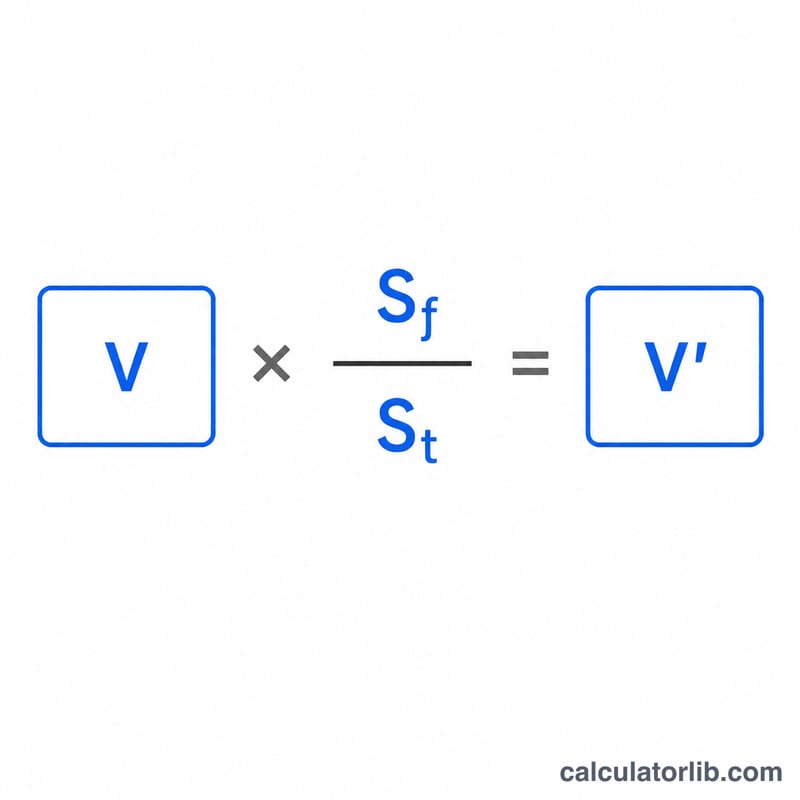
Worked example
Convert 4.7 kiloohm. Normalize: \(4.7 \times 10^{3} = 4700\) ohm. Then milliohm = \(4700 / 10^{-3} = 4{,}700{,}000\) mohm, megaohm = \(4700 \times 10^{-6} = 0.0047\) Mohm, and microohm = \(4{,}700{,}000{,}000\) microohm. Convert 1 ohm and you get \(10^{12}\) picoohm, \(10^{9}\) nanoohm, \(10^{9}\) abohm, and 1 V/A.
FAQ
Why is V/A the same as the ohm? Ohm's law states \(R = V / I\), so a resistance of one volt per ampere is by definition one ohm.
What is an abohm? It is the CGS electromagnetic unit of resistance, where \(1\ \text{abohm} = 10^{-9}\ \text{ohm}\), making it numerically equal to the nanoohm.
Does the significant-digits option change the conversion? No. It only controls display rounding; the conversion itself always uses full double precision.