
What is the Resistor Color Code Calculator?
Resistors use colored bands to encode their resistance value and tolerance. This calculator decodes a standard 4-band resistor into its resistance in ohms (Ω) and shows the tolerance range. It works for any combination of the standard IEC 60062 color codes, including gold and silver multipliers used for sub-ohm and fractional values.
How to use it
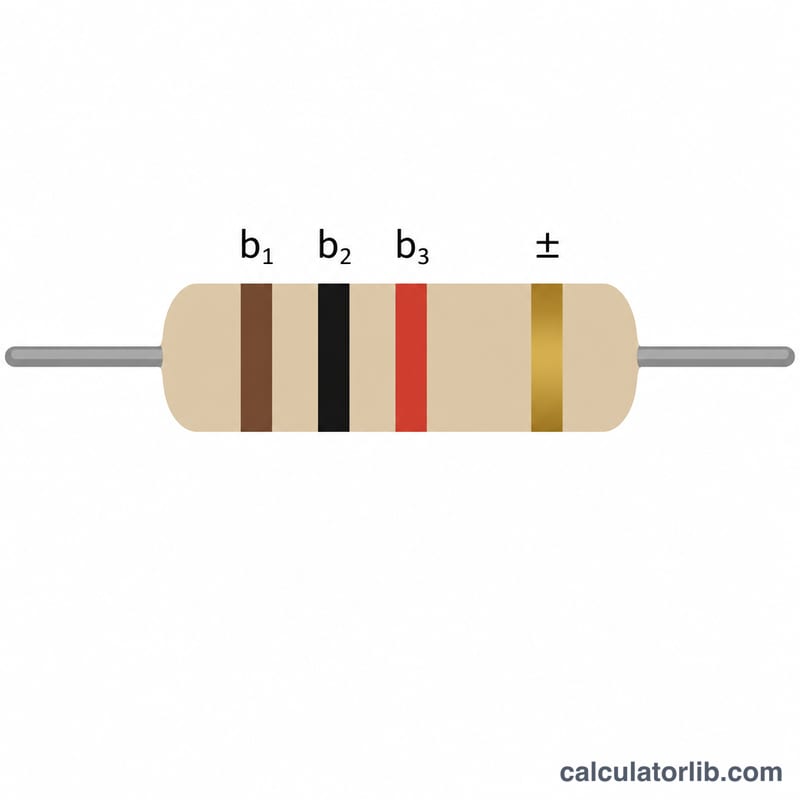
Select the color of each band from left to right: Band 1 is the first significant digit, Band 2 is the second digit, Band 3 is the multiplier (power of ten), and Band 4 is the tolerance. The calculator instantly returns the resistance plus the minimum and maximum values the part may measure within tolerance.
The formula explained
The first two bands form a two-digit number, \(10 \times b_1 + b_2\). The third band is an exponent applied as a power of ten. So the resistance is:
$$R = \left(10 \times b_1 + b_2\right) \times 10^{b_3}$$
The fourth band states a percentage tolerance T. The real value lies between \(R \times (1 - T/100)\) and \(R \times (1 + T/100)\).
Worked example
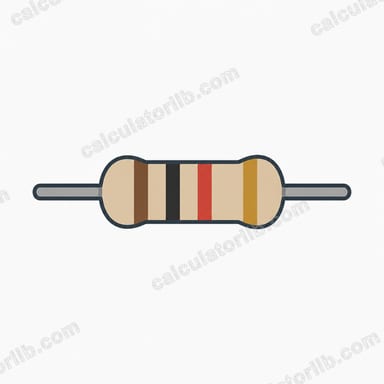
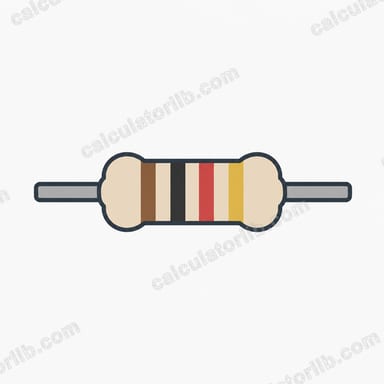
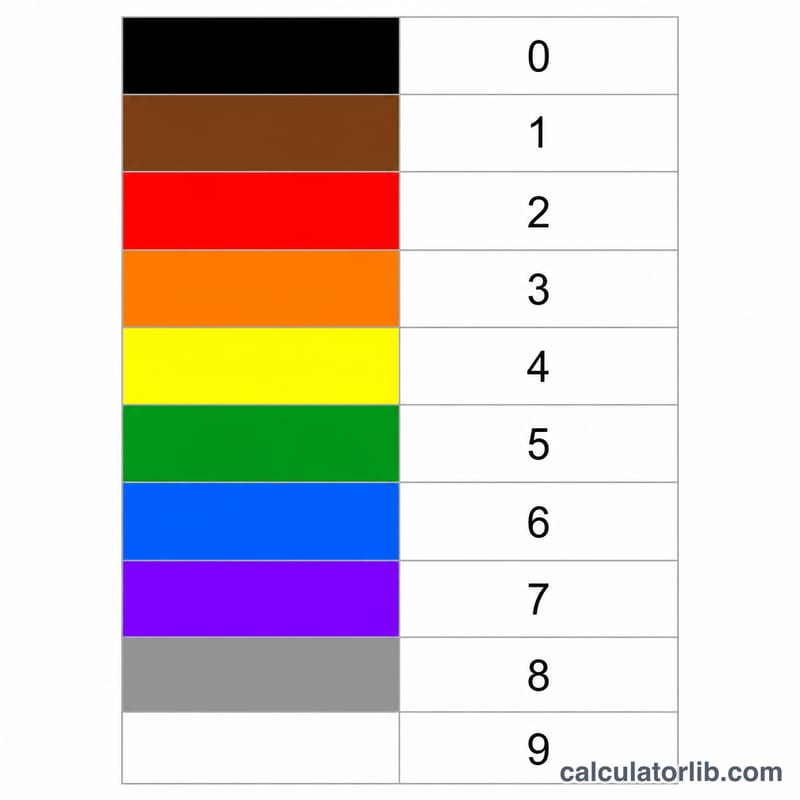
Consider a resistor with bands Brown, Black, Red, Gold. Brown = 1, Black = 0, Red multiplier = \(10^2\), Gold tolerance = ±5%.
$$R = \left(10 \times 1 + 0\right) \times 10^2 = 10 \times 100 = 1{,}000 \ \Omega \ (1 \text{ k}\Omega)$$ With ±5%, the value ranges from 950 Ω to 1,050 Ω.
FAQ
Which band is the tolerance band? On a 4-band resistor it is the last band, usually gold (±5%) or silver (±10%), and often slightly separated from the others.
What do gold and silver multipliers mean? As multiplier bands, gold means ×0.1 and silver means ×0.01, used for resistors below 10 Ω.
Does this work for 5-band resistors? This tool decodes the common 4-band scheme. A 5-band resistor adds a third significant digit before the multiplier.