
What Is the Clamping Force Calculator?
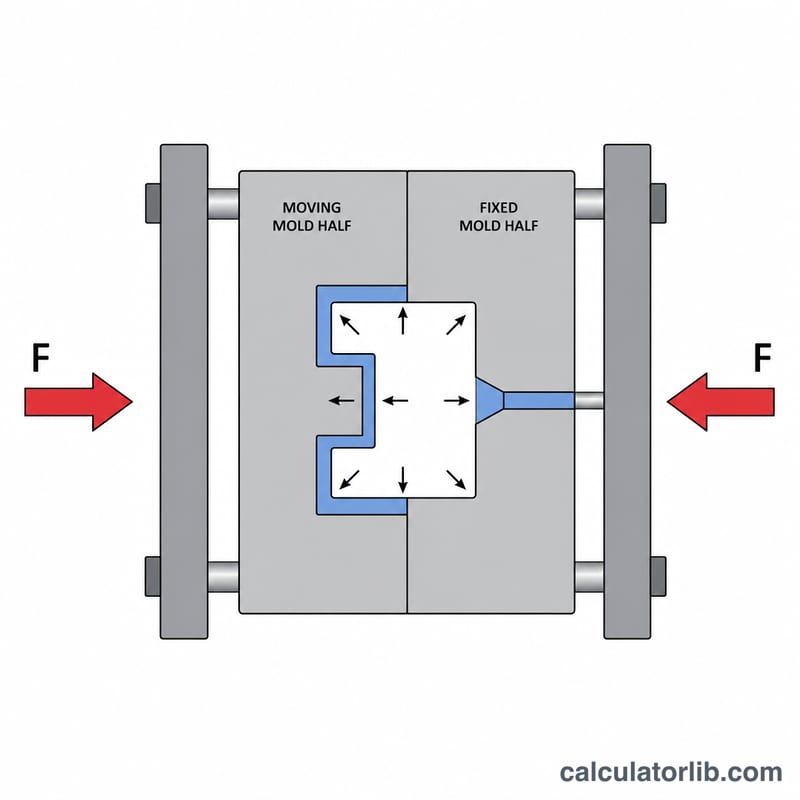
Injection molding machines are rated by their clamping force (tonnage) — the force that holds the two halves of the mold shut while molten plastic is injected under high pressure. If the clamp tonnage is too low, the cavity pressure pushes the mold open and you get flash; if it is far too high you are paying for an oversized machine. This calculator estimates the clamping force needed for a part using its projected area and a material-specific clamp factor.
How to Use It
Enter the projected area — the shadow area of the part (and runners) seen looking straight into the mold opening direction — in square inches. Enter a clamp factor in tons per square inch for your resin, then add a safety margin. The tool returns both the base and the recommended (margin-adjusted) tonnage.
The Formula Explained
The core relationship is simple: \(\text{Tonnage} = \text{Projected Area} \times \text{Clamp Factor}\). The clamp factor represents the cavity pressure required to fill and pack the part, converted into tons per square inch. Typical values range from about 2–3 tons/in² for easy-flow materials (PE, PP) up to 4–5+ tons/in² for engineering resins, glass-filled compounds, and thin-wall parts. The recommended force multiplies the base value by \(\left(1 + \frac{\text{Safety \%}}{100}\right)\).
$$\text{Clamp Tonnage} = \text{Area} \times \text{Factor} \times \left(1 + \frac{\text{Safety \%}}{100}\right)$$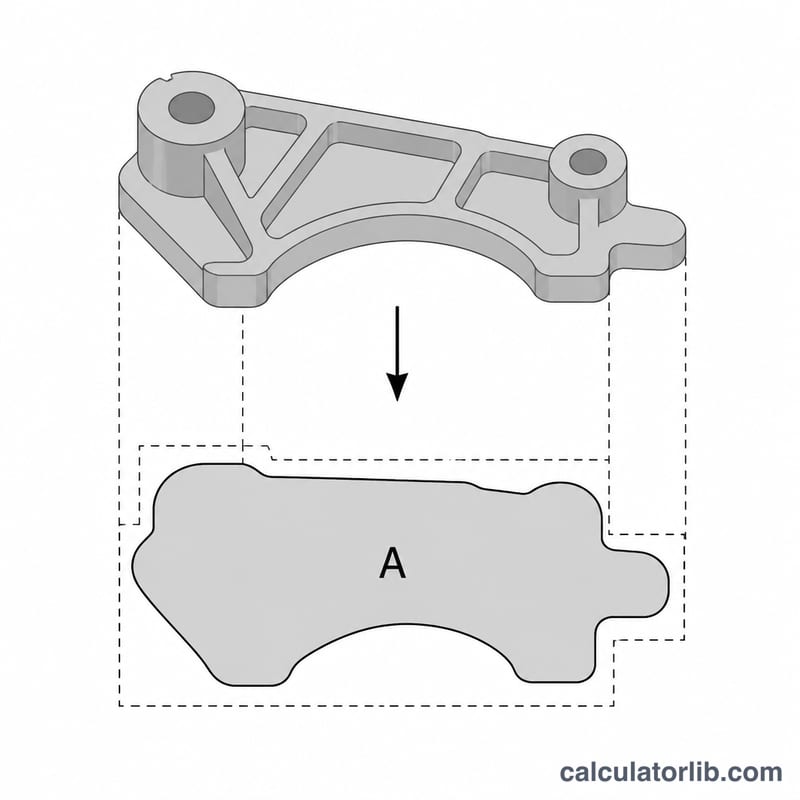
Worked Example
A part has a projected area of 50 in² and uses a clamp factor of 3 tons/in². Base force = $$50 \times 3 = 150 \text{ tons}.$$ With a 10% safety margin: $$150 \times 1.10 = 165 \text{ tons}.$$ You would select a machine rated at 165 tons or higher.
FAQ
What clamp factor should I use? Use your resin supplier's recommended cavity pressure. As a rough guide, 2–3 tons/in² for commodity plastics and 4–5 tons/in² for engineered or filled materials.
Should I include runners in projected area? Yes — cold runners and gates also contribute to the force trying to open the mold.
Why add a safety margin? Real cavity pressure varies with fill speed, wall thickness, and pack pressure. A 10–20% margin reduces the risk of flash and protects mold life.