What Is a Seeding Rate Calculator?
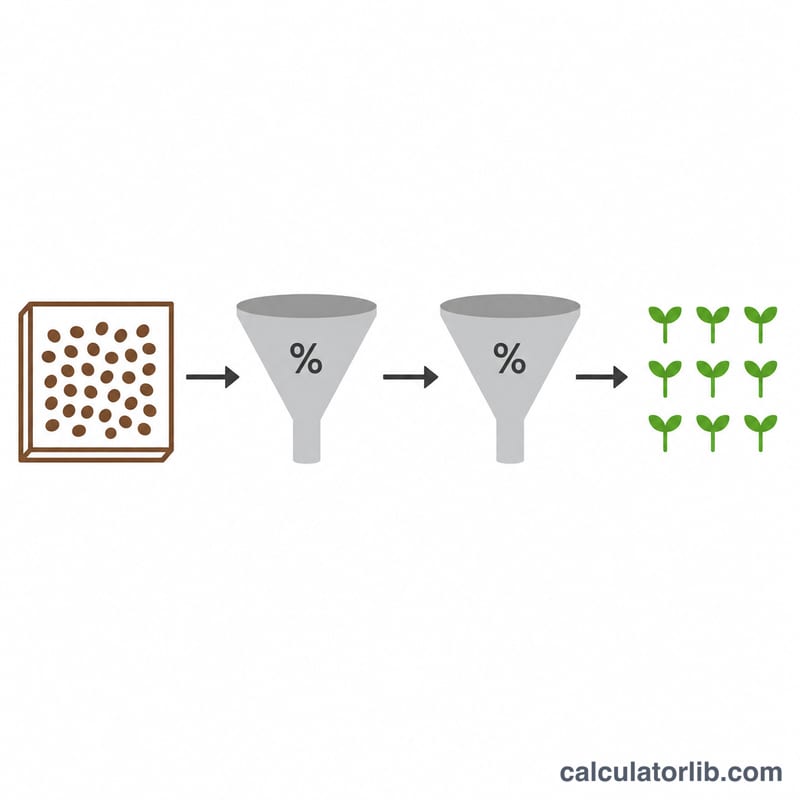
A seeding rate calculator tells you how many seeds you need to plant per acre to reach a specific final plant population. Not every seed you plant becomes a productive plant — some seeds fail to germinate, and some seedlings die before they emerge or establish. To hit your target stand, you must plant more seeds than the number of plants you ultimately want. This tool does that adjustment automatically using your germination and emergence percentages.
How to Use It
Enter three values: the desired plants per acre (your target final stand), the germination rate (the percentage of seeds that sprout, usually printed on the seed tag), and the emergence/survival rate (the percentage of germinated seedlings that successfully establish in your field conditions). The calculator returns the seeds per acre you should plant, plus how many extra seeds you're adding to cover losses.
The Formula Explained
The core equation is simple division:
$$\text{Seeds per Acre} = \frac{\text{Desired Plants per Acre}}{\dfrac{\text{Germination \%}}{100} \times \dfrac{\text{Emergence \%}}{100}}$$
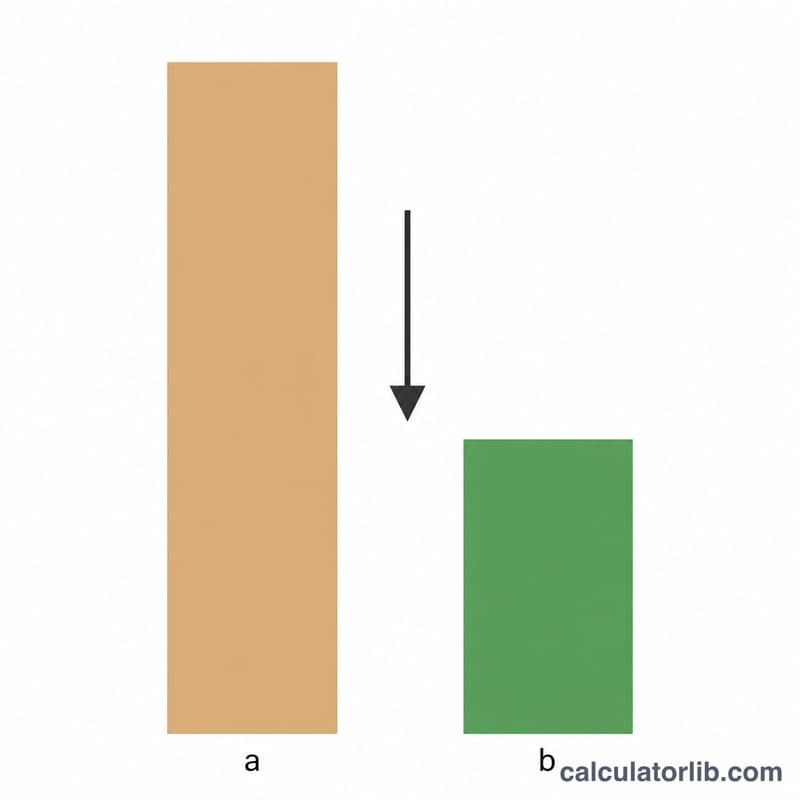
Both percentages are converted to decimals (e.g. 90% becomes \(0.90\)). Multiplying them gives the overall establishment rate — the fraction of planted seeds that become plants. Dividing your target by this fraction inflates the seed count to compensate for the losses.
Worked Example
Suppose you want a final stand of 30,000 plants per acre. Your seed has a germination rate of 90% and you expect 95% emergence. The establishment rate is $$0.90 \times 0.95 = 0.855 \ (85.5\%).$$ Seeds needed = $$30{,}000 \div 0.855 \approx 35{,}088 \text{ seeds per acre}.$$ That means you plant about 5,088 extra seeds per acre to absorb the losses.
Typical Target Plant Populations by Crop
The table lists commonly published target final plant populations (plants per acre) for major crops, mainly from North American (US/Canada) extension guidance, where acres are the standard unit. This is the number you enter as the desired plants per acre. The calculator then adjusts it for germination and emergence losses to give the seeds you need to plant.
| Crop | Typical target population | Notes |
|---|---|---|
| Corn (grain) | about 30,000–36,000 plants/ac | Depends on hybrid and yield environment; drier regions are usually at the lower end. |
| Soybean | about 100,000–140,000 plants/ac | Row spacing and planting date shift the optimum. |
| Spring wheat | about 1.0–1.4 million plants/ac | Roughly 23–32 plants per square foot (1 acre = 43,560 ft²). |
| Cotton | about 28,000–50,000 plants/ac | Wide range because of irrigation, variety and region. |
| Sunflower | about 20,000–24,000 plants/ac | Lower in dry conditions, higher with good moisture. |
| Canola | about 5–8 lb/ac seeding rate equivalent | Usually given as a seeding rate in pounds rather than a plant count. At roughly 100,000 seeds/lb this is about 500,000–800,000 seeds/ac, so check the seed lot. |
Important: These ranges vary by region, hybrid or variety, planting date, row spacing, soil type and soil moisture. Local extension or agronomist recommendations and the seed company's guidance take precedence over this general table.
FAQ
Where do I find germination rate? It's printed on the seed bag or tag from the supplier, based on a lab germination test.
What emergence rate should I use? Field emergence is usually lower than lab germination because of soil temperature, moisture, depth, and pests. Many growers use 85–95% under good conditions and adjust down for tough seedbeds.
Does this work for any crop? Yes — the math is crop-agnostic. Just enter the right target population and rates for your crop, whether corn, soybeans, wheat, or vegetables.