
What Is the TCP Throughput Calculator?
This tool estimates the maximum theoretical throughput of a single TCP connection based on the TCP receive window size and the network round-trip time (RTT). Because TCP can only have one window's worth of unacknowledged data "in flight" at a time, the window size and RTT together cap how fast data can move — regardless of the raw link bandwidth. This relationship is the famous bandwidth-delay product constraint.
How to Use It
Enter the TCP window size in kilobytes (KB) and the round-trip time in milliseconds (ms). The calculator converts the window to bits and the RTT to seconds, then divides to give throughput in Mbps, Kbps and bps. A larger window or a lower RTT both increase achievable throughput.
The Formula Explained
The core equation is simply throughput = window size ÷ RTT. To get consistent units we convert: 1 KB = 1024 bytes = 8192 bits, and RTT in milliseconds is divided by 1000 to get seconds. So throughput in bits per second is $$\text{Throughput (bps)} = \frac{\text{Window (KB)} \times 8192}{\text{RTT (ms)} / 1000}$$ Dividing by 1,000,000 yields Mbps.
$$\text{Throughput (Mbps)} = \frac{\text{Window (KB)} \times 1024 \times 8}{\text{RTT (ms)} / 1000} \times \frac{1}{10^{6}}$$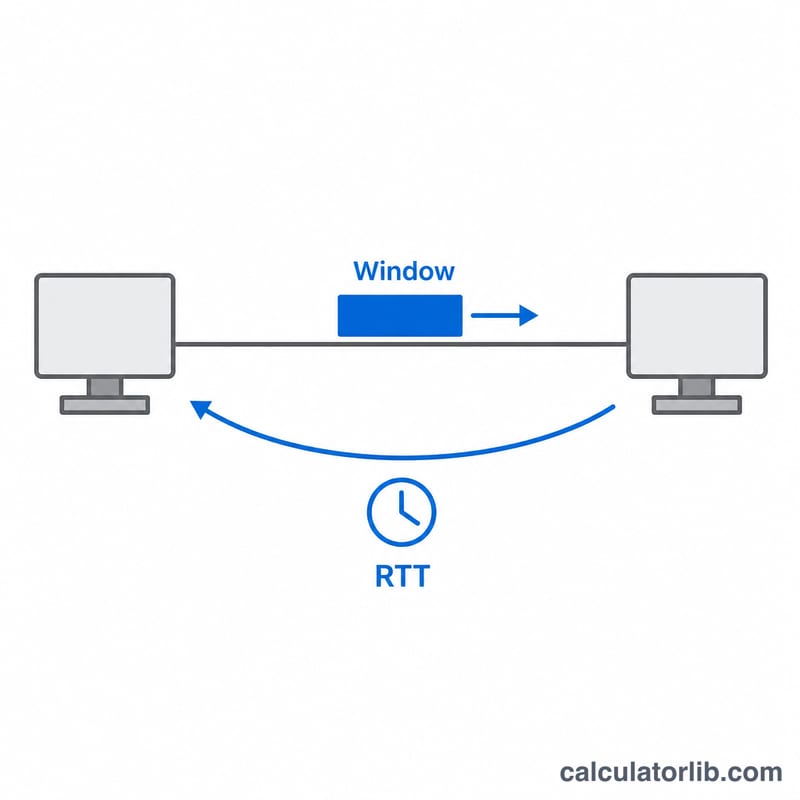
Worked Example
Suppose the TCP window is 64 KB and RTT is 50 ms. Window in bits = $$64 \times 1024 \times 8 = 524{,}288 \text{ bits}$$ RTT in seconds = $$50 / 1000 = 0.05 \text{ s}$$ Throughput = $$524{,}288 / 0.05 = 10{,}485{,}760 \text{ bps} \approx 10.49 \text{ Mbps}$$ To fully use a faster link you would need a larger window (TCP window scaling).

FAQ
Why doesn't my throughput match my link speed? Because a small window over a high-RTT path limits how much data can be in transit. This is why long-distance links often need window scaling.
What window size do I need for a target speed? Rearrange: \(\text{Window (bits)} = \text{Throughput} \times \text{RTT}\). This product is the bandwidth-delay product, the ideal buffer size.
Does this account for packet loss? No — this is the loss-free maximum. Real throughput on lossy links is lower and better modeled by the Mathis equation.