What is the Laminate Flooring Calculator?
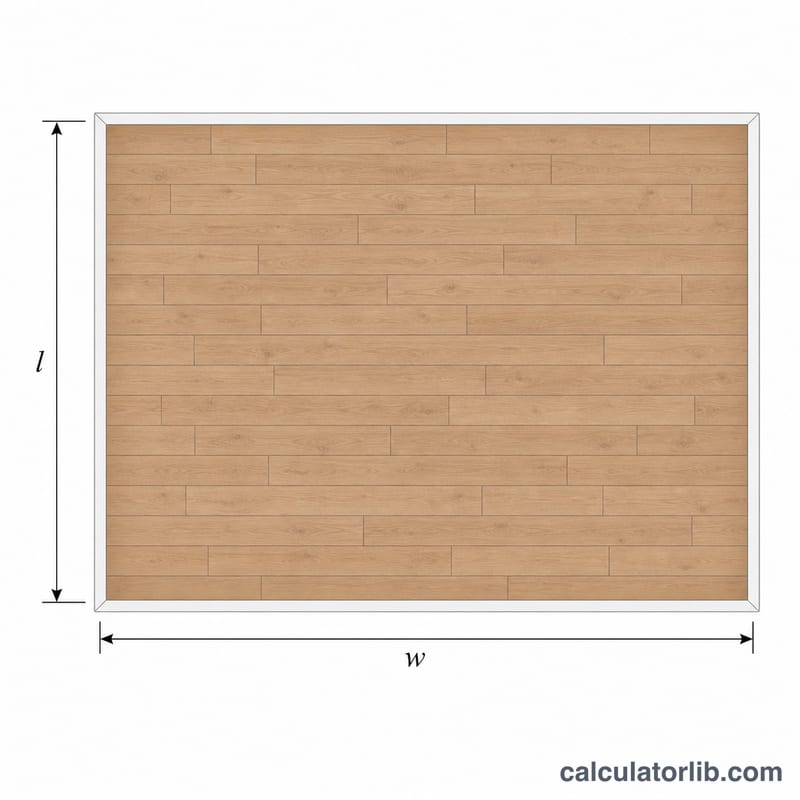
This calculator tells you how many boxes of laminate flooring to buy for a room. You enter the room's length and width, a waste allowance to cover cuts and mistakes, and the coverage (square feet) printed on each box. The tool computes the floor area, adds the waste, and rounds up to the next whole box — because you can't buy a fraction of a box.
How to use it
Measure your room in feet and enter the length and width. Choose a waste allowance — 10% is typical for straight-lay installations, while diagonal patterns or rooms with many corners may need 15%. Enter the coverage per box from the product label (often 18–24 sq ft). The result shows the number of boxes plus the underlying areas.
The formula explained
First the room area is length × width. Multiplying by (1 + waste) adds the extra material for offcuts. Dividing by the coverage per box gives the raw box count, and the ceiling function rounds it up so you never come up short.
$$\text{Boxes} = \left\lceil \frac{\text{Length} \times \text{Width} \times \left(1 + \frac{\text{Waste \%}}{100}\right)}{\text{Coverage per Box}} \right\rceil$$For example, a 12 ft × 10 ft room is 120 sq ft. With 10% waste that is 132 sq ft. At 20 sq ft per box that is 6.6 boxes, which rounds up to 7 boxes, covering 140 sq ft.
$$\left\lceil \frac{12 \times 10 \times \left(1 + \frac{10}{100}\right)}{20} \right\rceil = \left\lceil \frac{132}{20} \right\rceil = \lceil 6.6 \rceil = 7$$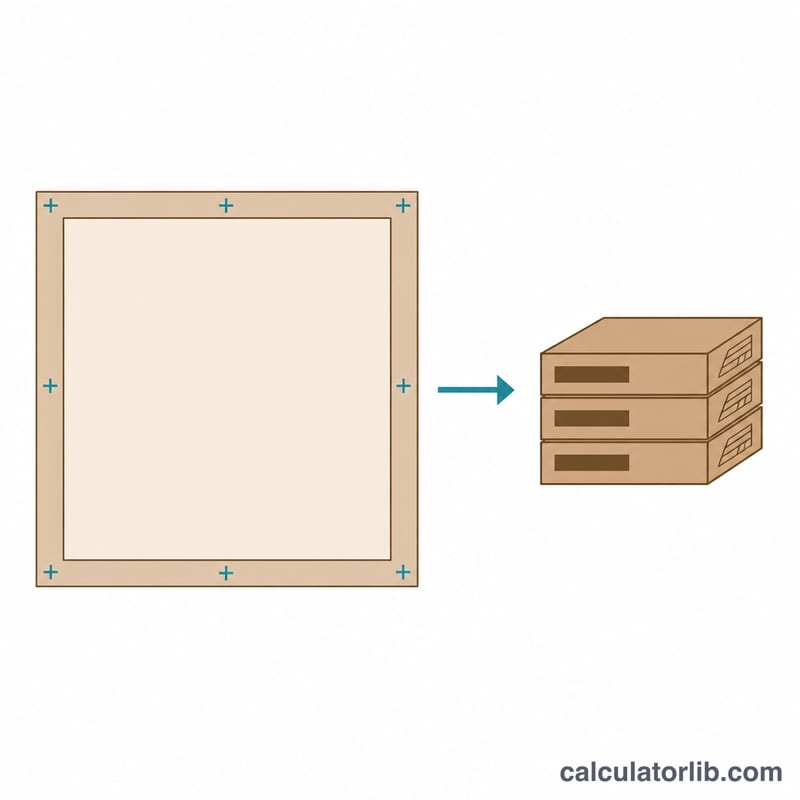
Typical Waste Allowance by Layout and Room Type
Waste covers cut-offs at walls, doorways and obstacles, plus the occasional damaged or unusable plank. The percentages below are common installer rules of thumb, not fixed standards. The flooring manufacturer's own guidance and warranty instructions take precedence if they recommend a different allowance.
| Layout / room type | Typical waste allowance |
|---|---|
| Straight lay in a simple rectangular room | 5–10% |
| Room with several cuts, doorways or a closet | about 10% |
| Diagonal or herringbone pattern | 15–20% |
| Complex room with many angles, alcoves or curves | 15% or more |
Laminate is usually sold in boxes that cover roughly 18–24 sq ft each, though the exact figure varies by product, so always use the coverage printed on the box you are buying. Enter that number as Coverage per Box (sqft_per_box) in the calculator.
If you may need to repair the floor later, consider buying one extra box from the same production batch, since colors and patterns can vary slightly between batches.
Metric to Imperial Conversion for Room Size and Box Coverage
The calculator works in feet and square feet. If your room measurements or box coverage are in metric units, convert them first using 1 m = 3.281 ft and 1 m² = 10.764 sq ft.
Room dimensions: meters to feet
| Meters | Feet |
|---|---|
| 2.5 m | 8.20 ft |
| 3 m | 9.84 ft |
| 4 m | 13.12 ft |
| 5 m | 16.40 ft |
| 6 m | 19.69 ft |
Box coverage: square meters to square feet
| Square meters per box | Square feet per box |
|---|---|
| 1.7 m² | ≈ 18.3 sq ft |
| 1.9 m² | ≈ 20.5 sq ft |
| 2.0 m² | ≈ 21.5 sq ft |
| 2.2 m² | ≈ 23.7 sq ft |
Example: a box covering 1.9 m² is 1.9 × 10.764 = 20.45, or about 20.5 sq ft.
Boxes Needed for Common Room Sizes
The table assumes 20 sq ft per box. Area with waste = room area × (1 + waste ÷ 100). The raw box count is that area divided by 20, and you must always round up to whole boxes, since boxes are not sold in fractions.
| Room (ft) | Room area (sq ft) | Waste | Area with waste (sq ft) | Raw boxes | Boxes to buy |
|---|---|---|---|---|---|
| 10 × 10 | 100 | 10% | 110 | 5.5 | 6 |
| 15% | 115 | 5.75 | 6 | ||
| 12 × 10 | 120 | 10% | 132 | 6.6 | 7 |
| 15% | 138 | 6.9 | 7 | ||
| 12 × 15 | 180 | 10% | 198 | 9.9 | 10 |
| 15% | 207 | 10.35 | 11 | ||
| 15 × 20 | 300 | 10% | 330 | 16.5 | 17 |
| 15% | 345 | 17.25 | 18 |
Worked example (12 × 15 ft room, 15% waste, 20 sq ft per box): \(\lceil 12 \times 15 \times 1.15 \div 20 \rceil = \lceil 207 \div 20 \rceil = \lceil 10.35 \rceil = 11\) boxes.
Notice how a higher waste percentage only changes the box count when it pushes the raw figure past a whole number. The 12 × 15 ft room needs one extra box at 15% waste, while the 10 × 10 ft room needs the same 6 boxes at either setting.
FAQ
How much waste should I allow? Use 10% for simple rectangular rooms, and 15% for diagonal layouts or rooms with alcoves and many cuts.
Should I buy an extra box? Keeping one spare box is wise for future repairs and to ensure dye-lot matching, since later batches may differ slightly in shade.
Can I use metric measurements? This tool uses feet and square feet. Convert meters to feet (1 m ≈ 3.281 ft) before entering, or ensure your box coverage is also in square feet.