
What This Flooring Calculator Does
Buying flooring — hardwood, laminate, vinyl plank, or tile — means buying it by the box, not by the square foot. This calculator turns your room dimensions into the number of full boxes you need to purchase and the total material cost. It works for any unit system as long as your room measurements and the box coverage use the same unit (the labels assume feet and square feet).
How to Use It
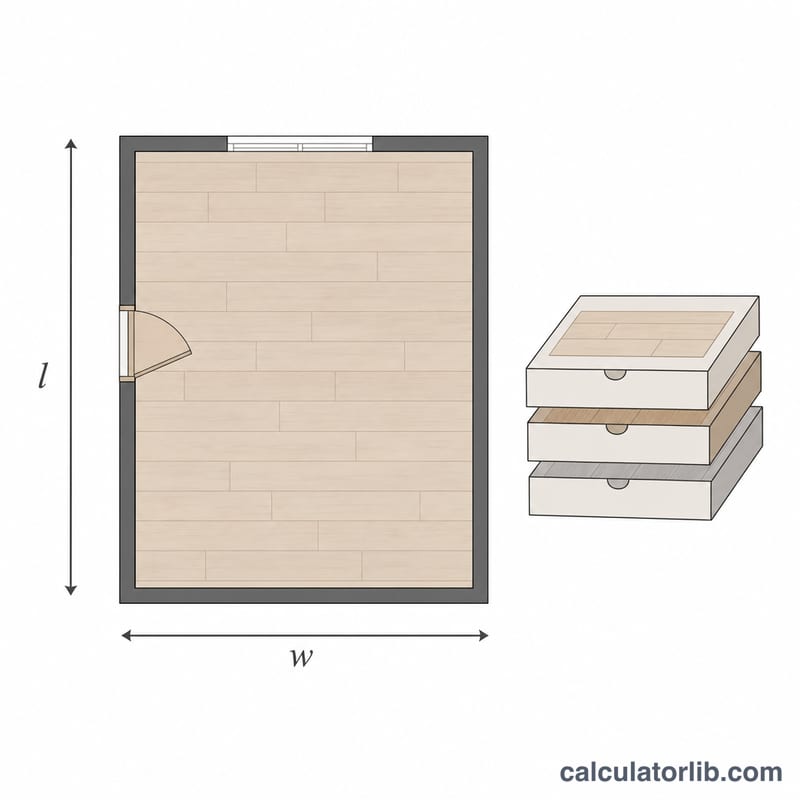
Enter the room's length and width to define the floor area. Add a waste allowance — extra material for cuts, mistakes, pattern matching, and future repairs. Then enter how many square feet one box covers (printed on the product) and the price per box. The calculator computes the area, pads it with waste, divides by box coverage, and rounds up to whole boxes because you can't buy a partial box.
The Formula Explained
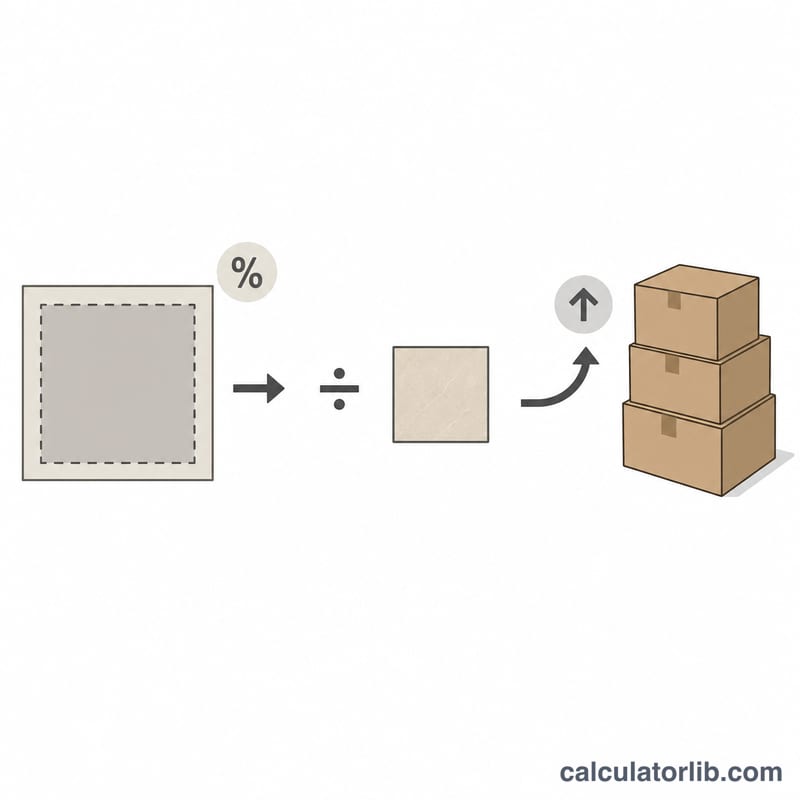
First, room area = length × width. Next, the padded area = area × (1 + waste% / 100). Boxes needed = padded area ÷ coverage per box, rounded up to the next whole number. Finally, total cost = boxes × price per box. The rounding step is why your purchased coverage is usually a little more than the padded area — that surplus is normal and useful for repairs.
$$\text{Boxes} = \left\lceil \frac{A \cdot \left(1 + \frac{\text{Waste \%}}{100}\right)}{\text{Coverage/Box}} \right\rceil \qquad \text{Cost} = \text{Boxes} \times \text{Price/Box}$$
$$\text{where}\quad A = \text{Length (ft)} \times \text{Width (ft)}$$
Worked Example
A 12 ft × 10 ft room is 120 sq ft. With a 10% waste allowance, you need \(120 \times 1.10 = 132\) sq ft of material. If each box covers 20 sq ft, that's \(132 \div 20 = 6.6\) boxes, rounded up to 7 boxes. At $35 per box the total cost is \(7 \times \$35 = \$245\), giving you 140 sq ft of coverage.
FAQ
How much waste should I allow? A typical range is 5–10% for straight, simple rooms and 15–20% for diagonal layouts, busy patterns, or rooms with many corners and obstacles.
Why does it round up? Stores sell whole boxes only. Rounding up guarantees you have enough, and the leftover is handy for future repairs.
Can I use this for tile? Yes — just enter the square-foot coverage per box of tile and your room dimensions; the math is identical.