
What Is Food Yield Percentage?
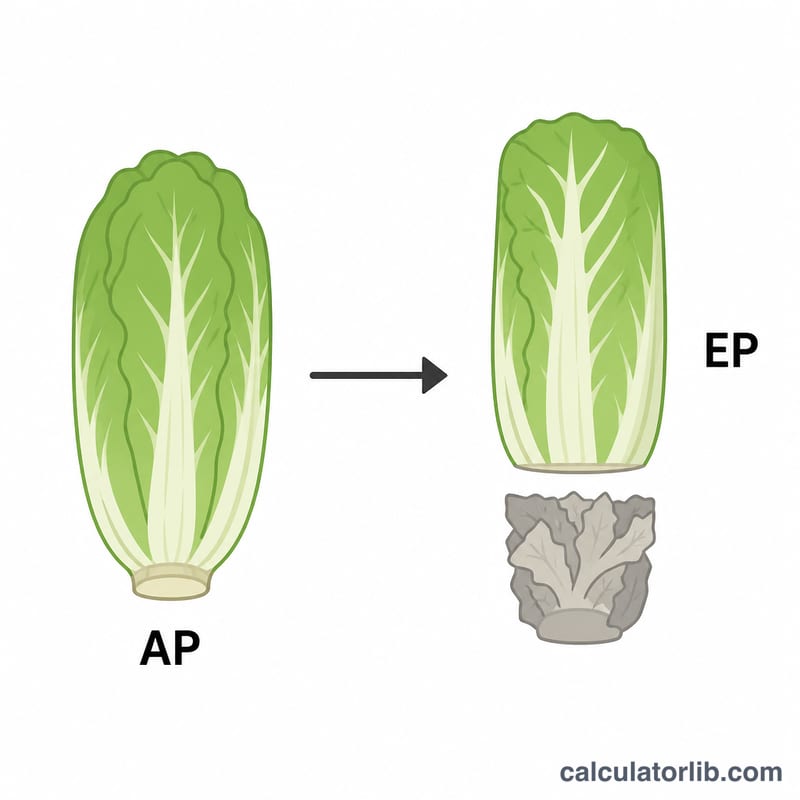
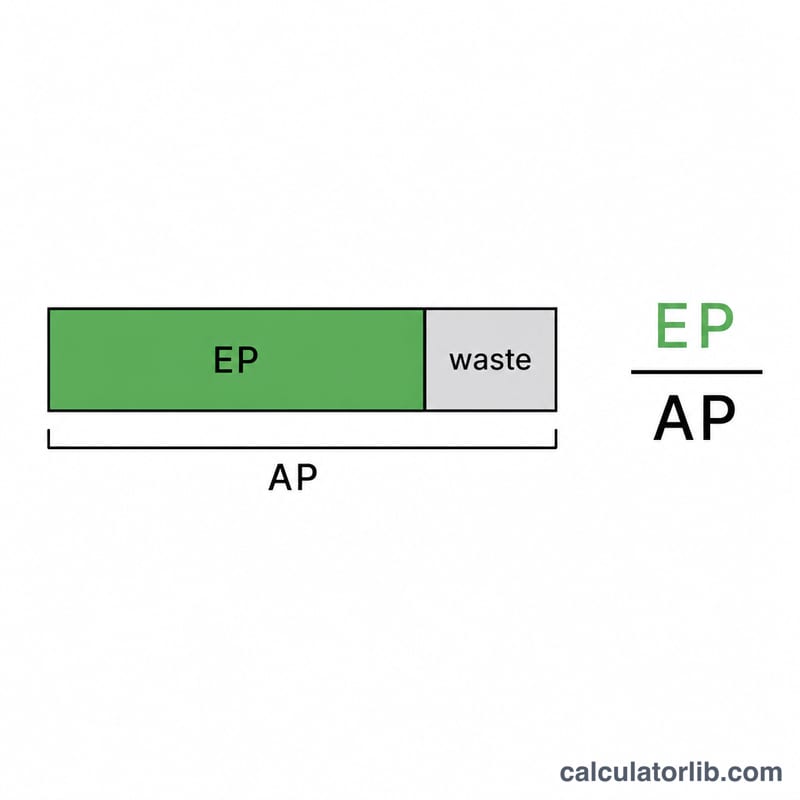
Food yield percentage measures how much of a purchased ingredient is actually usable after trimming, peeling, deboning or cleaning. It compares the Edible Portion (EP) weight — what remains after prep — to the As Purchased (AP) weight you originally bought. Chefs, caterers and food-cost managers use it to price recipes accurately, plan purchasing quantities and reduce waste.
How to Use This Calculator
Enter the As Purchased Weight (the total weight or cost-weight you bought) and the Edible Portion Weight (what is left after preparation). Use the same unit for both — grams, kilograms, ounces or pounds. The calculator returns the yield percentage, the trim/waste percentage, and the actual waste weight.
The Formula Explained
The core equation is $$\text{Yield \%} = \frac{\text{EP Weight}}{\text{AP Weight}} \times 100$$ A higher percentage means less waste and better value. Waste percentage is simply \(100 - \text{Yield\%}\), and waste weight is \(\text{AP} - \text{EP}\). Knowing your yield lets you scale up: to serve a given amount of edible food, divide the required EP weight by the yield percentage (as a decimal) to find how much to purchase.
Worked Example
You buy 10 kg of whole carrots (AP). After peeling and trimming, you have 8 kg of usable carrots (EP). $$\text{Yield \%} = \frac{8}{10} \times 100 = 80\%$$ Waste% = 20%, and waste weight = 2 kg. If a recipe needs 4 kg of prepped carrots, you must purchase \(4 \div 0.80 = 5\) kg.
FAQ
What is a good yield percentage? It varies by ingredient — leafy greens and bony cuts have low yields (50–70%), while pasta or rice can exceed 100% after cooking. Compare against your own historical data.
Can yield be over 100%? Yes — for items that absorb water during cooking (dried beans, grains), the cooked edible weight can exceed the purchased dry weight.
Does this work for cost? Yes. Dividing the AP cost by the yield percentage gives the true cost per usable unit, which is essential for accurate menu pricing.