

What Is the Corn Yield Calculator?
The Corn Yield Calculator estimates grain corn production in bushels per acre using the widely used Yield Component Method (also called the "yield estimation" or "ear-count" method). It is a fast, field-ready way for farmers and agronomists to forecast harvest before combining, helping with marketing, storage, and crop-insurance decisions. The method is most reliable about three weeks after pollination, once kernel set is established.
How to Use It
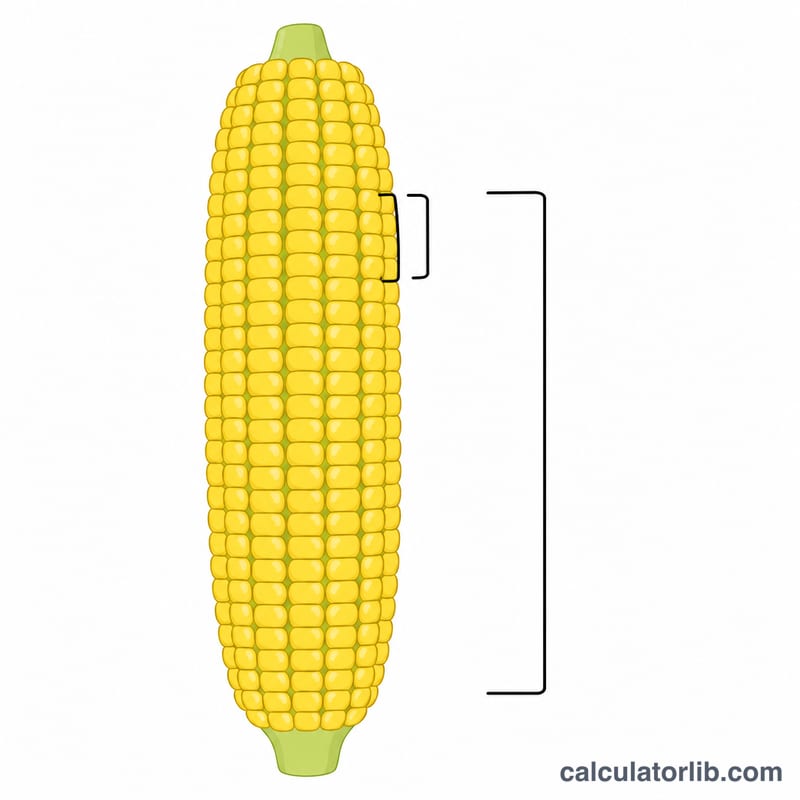
Walk a known length of row, count the number of harvestable ears, and scale that up to ears per acre based on your row spacing. Then pull a few representative ears, count rows of kernels times kernels per row to get kernels per ear, and average them. Enter both figures and a kernel-weight factor, then read your estimated yield.
The Formula Explained
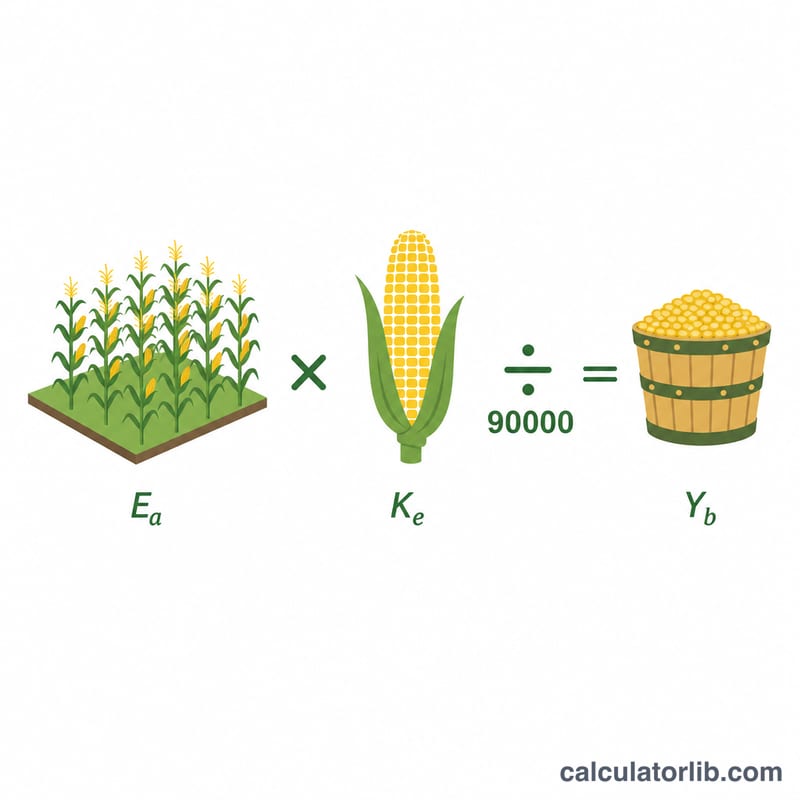
The equation is:
$$\text{Yield (bu/acre)} = \frac{\text{Ears per Acre} \times \text{Kernels per Ear}}{\text{Kernels per Bushel Factor}}$$The factor is expressed in thousands. A factor of 90 means 90,000 kernels make up one 56-pound bushel — a good average. Use a lower factor (about 75–80) in excellent grain-fill conditions where kernels are large and heavy, and a higher factor (95–105) under drought or stress that produces smaller, lighter kernels.
Worked Example
Suppose you measure 28,000 ears per acre, with an average of 550 kernels per ear, using the standard 90 factor:
$$\text{Yield} = \frac{28{,}000 \times 550}{90{,}000} = \frac{15{,}400{,}000}{90{,}000} \approx 171.1 \text{ bushels per acre}$$FAQ
What factor should I use? Use 90 as a default. Drop toward 75 in great conditions and raise toward 100 under stress, since kernel size drives the kernels-per-bushel count.
How do I get ears per acre? Count ears in 1/1000th of an acre (e.g., 17 ft 5 in of row at 30-inch spacing) and multiply by 1,000.
Is this exact? No — it is an estimate. Actual yield depends on kernel weight, harvest loss, and moisture. Sample multiple sites and average for accuracy.