What Is the Plant Population Calculator?
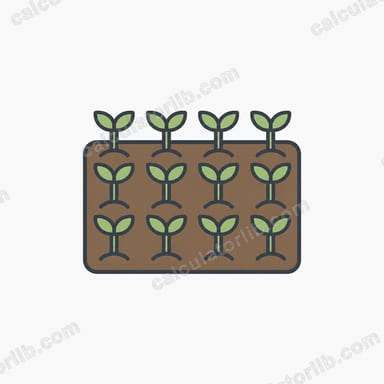
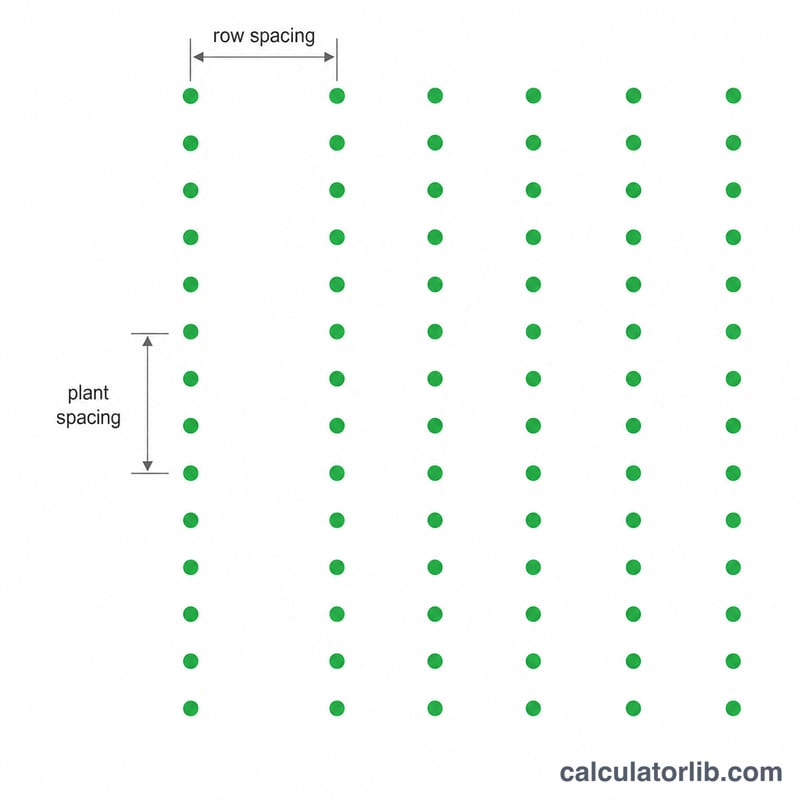
The Plant Population Calculator estimates how many plants you can grow in a field based on your row spacing and the spacing between plants within each row. It reports the plant density (plants per acre) and the total number of plants needed for your total acreage. This helps farmers and gardeners plan seed purchases, estimate yields, and optimize crop layout.
How to Use It
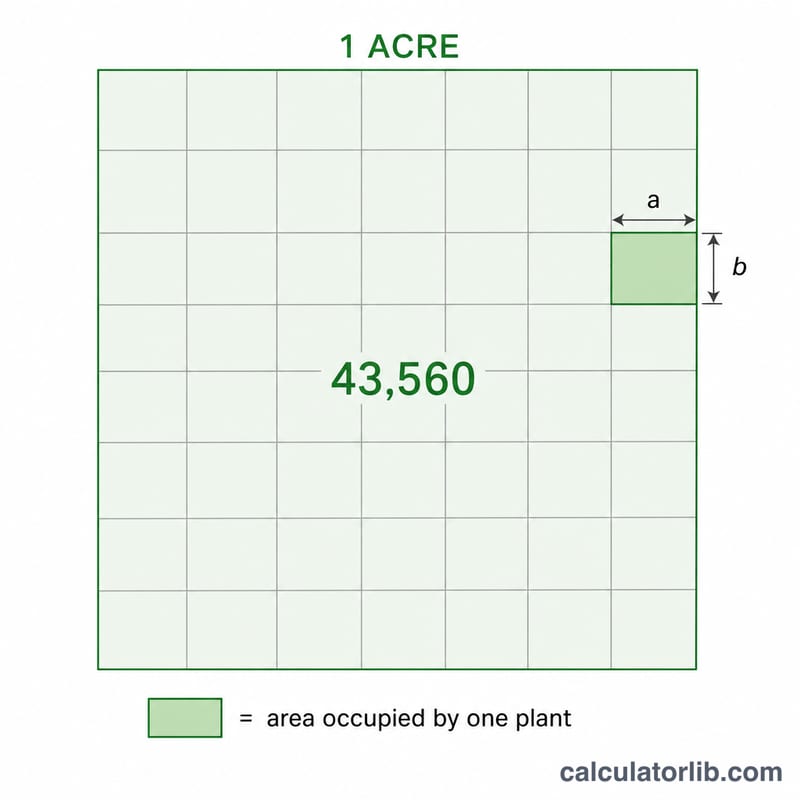
Enter the distance between your rows in feet, the distance between plants within a row in feet, and the total area you intend to plant in acres. The calculator divides one acre (43,560 square feet) by the area each plant occupies, then multiplies by your acreage for the total population.
The Formula Explained
One acre equals 43,560 square feet. Each plant occupies a rectangle equal to Row Spacing × Plant Spacing square feet. Dividing 43,560 by that area gives the number of plants per acre:
$$\text{Plants per Acre} = \dfrac{43{,}560}{\text{Row Spacing} \times \text{Plant Spacing}}$$
Multiplying by total acres gives the full plant population.
Worked Example
Suppose rows are spaced 2.5 ft apart, plants are spaced 0.5 ft apart within the row, and you have 1 acre. The area per plant is \(2.5 \times 0.5 = 1.25\) sq ft. Plants per acre = \(43{,}560 \div 1.25 = 34{,}848\). For 1 acre, the total population is also 34,848 plants.
Spacing Conversion and Plants-per-Acre Quick Table
The calculator expects spacing in feet, so convert inches first by dividing by 12. One acre is 43,560 square feet.
| Inches | Feet |
|---|---|
| 6 in | 0.5 ft |
| 8 in | 0.667 ft |
| 12 in | 1 ft |
| 15 in | 1.25 ft |
| 20 in | 1.667 ft |
| 30 in | 2.5 ft |
| 36 in | 3 ft |
Plants per acre equal \(\frac{43{,}560}{\text{row ft} \times \text{plant ft}}\). Example: 30 in rows (2.5 ft) with plants 6 in (0.5 ft) apart give \(\frac{43{,}560}{2.5 \times 0.5} = \frac{43{,}560}{1.25} = \)34,848 plants per acre.
| In-row spacing | 15 in rows (1.25 ft) | 30 in rows (2.5 ft) | 36 in rows (3 ft) |
|---|---|---|---|
| 2 in | 209,088 | 104,544 | 87,120 |
| 4 in | 104,544 | 52,272 | 43,560 |
| 6 in | 69,696 | 34,848 | 29,040 |
| 8 in | 52,272 | 26,136 | 21,780 |
| 12 in | 34,848 | 17,424 | 14,520 |
To get the total for a field, multiply the plants-per-acre value by the number of acres.
Practical Tips for Planning Seed Orders
- Order extra seed for germination and emergence losses. Not every seed becomes an established plant. Divide your target plant population by the expected germination or emergence rate (as a decimal): \(\text{Seeds per acre} = \frac{\text{Target plants per acre}}{\text{Expected emergence rate}}\). For example, a target of 32,000 plants per acre with 90% expected emergence needs \(\frac{32{,}000}{0.90} \approx 35{,}556\) seeds per acre. Use the germination rate on the seed tag as a starting point, then lower the emergence estimate for cold, wet, crusted or poorly prepared seedbeds.
- Reduce the planted acreage. Headlands, turn rows, paths, waterways, wet spots and buffers are not planted. Subtract them from the gross field area before you enter acres. If 5% of a 40-acre field is unplanted, use 38 acres.
- Round up to whole bags or units. Seed is sold in fixed units, such as bags of 80,000 seeds. Continuing the example, 35,556 seeds per acre × 38 acres ≈ 1,351,111 seeds, and 1,351,111 ÷ 80,000 ≈ 16.9, so order 17 bags. A small surplus also covers planter calibration, skips and replanting of small areas.
- Check the planter against the plan. Make sure the planter's seed spacing or seeding rate matches the in-row spacing you calculated. Measure actual spacing in the field after planting and adjust if it differs.
- Confirm the target with local sources. Use extension or seed-company guidance for your area, variety and irrigation level.
This is general planning information. Actual recommendations vary with crop, region and field conditions.
FAQ
What units should I use? Enter spacing values in feet. If your spacing is in inches, divide by 12 first (e.g. 6 inches = 0.5 ft).
Does this account for headlands or gaps? No — it assumes the full area is planted at uniform spacing. Reduce your acreage to allow for paths, turning rows, or unplanted edges.
Why 43,560? That is the exact number of square feet in one acre (\(43{,}560 = 66 \text{ ft} \times 660 \text{ ft}\)).