
What Is Population Variance?
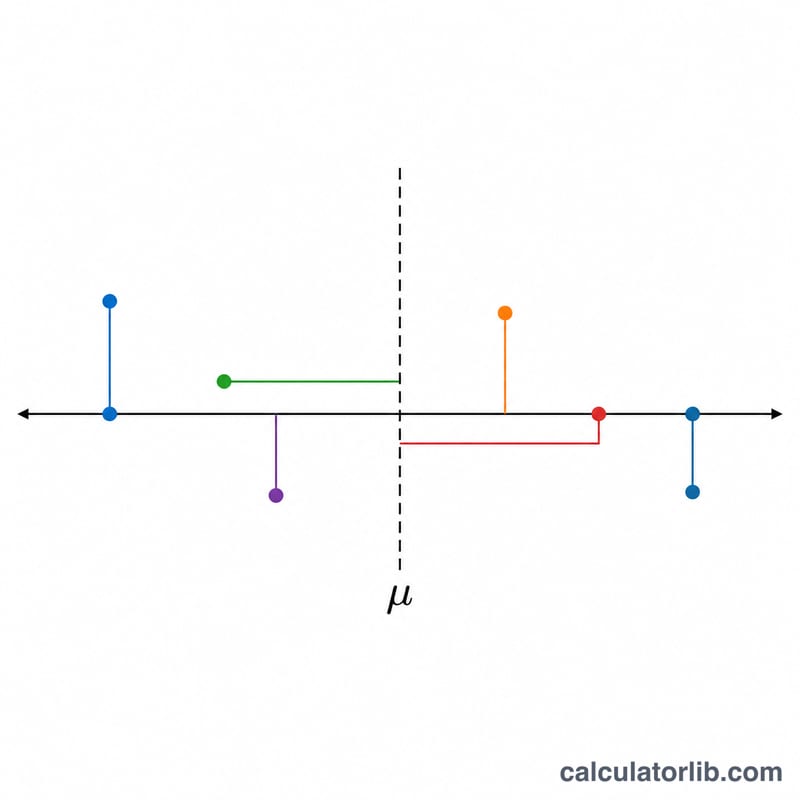
Population variance (\(\sigma^2\)) measures how spread out a complete set of data values is around its mean. Unlike sample variance, it divides the sum of squared deviations by N — the total number of values — rather than N−1. Use population variance when your data represents the entire population, not just a sample drawn from it.
How to Use This Calculator
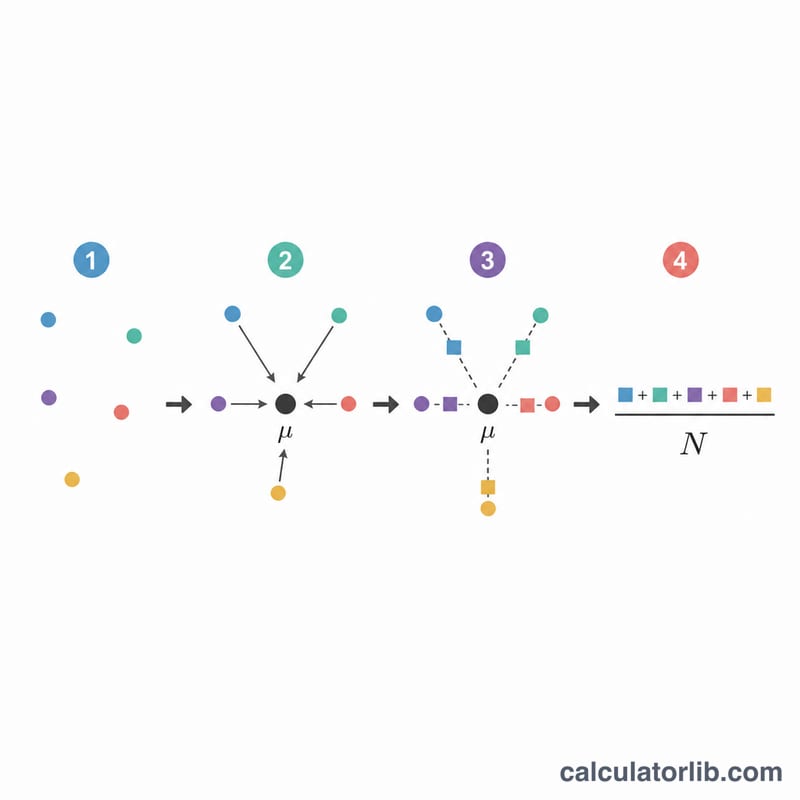
Type your data values into the box, separated by commas or spaces (for example: 4, 8, 6, 5, 3, 8). The calculator finds the mean, subtracts it from each value, squares those deviations, adds them up, and divides by the number of values. You instantly get the variance, mean, sum of squared deviations, and the population standard deviation.
The Formula Explained
The population variance formula is $$\sigma^2 = \frac{1}{n}\sum_{i=1}^{n}\left(x_i - \mu\right)^2$$ Here \(\mu\) is the population mean, \(x_i\) is each individual value, N is the count of values, and \(\Sigma\) means "sum of." Each value's distance from the mean is squared so that negative and positive deviations don't cancel out. The population standard deviation \(\sigma\) is simply the square root of the variance.
Worked Example
Consider the data set 4, 8, 6, 5, 3, 8. The mean is $$\frac{4+8+6+5+3+8}{6} = \frac{34}{6} \approx 5.6667$$ Squared deviations: \((4-5.6667)^2 = 2.7778\), \((8-5.6667)^2 = 5.4444\), \((6-5.6667)^2 = 0.1111\), \((5-5.6667)^2 = 0.4444\), \((3-5.6667)^2 = 7.1111\), \((8-5.6667)^2 = 5.4444\). Their sum is \(21.3333\). Divide by \(N=6\) to get \(\sigma^2 \approx 3.5556\), and \(\sigma \approx 1.8856\).
FAQ
Population vs. sample variance — which do I need? Use population variance (\(\div N\)) when your numbers are the whole population. Use sample variance (\(\div N-1\)) when they're a sample used to estimate a larger population.
Can variance be negative? No. Because deviations are squared, variance is always zero or positive. It equals zero only when every value is identical.
What units does variance have? Variance is in squared units of the data. To return to the original units, take the square root to get the standard deviation.