
What Is the Standard Deviation Index (SDI)?
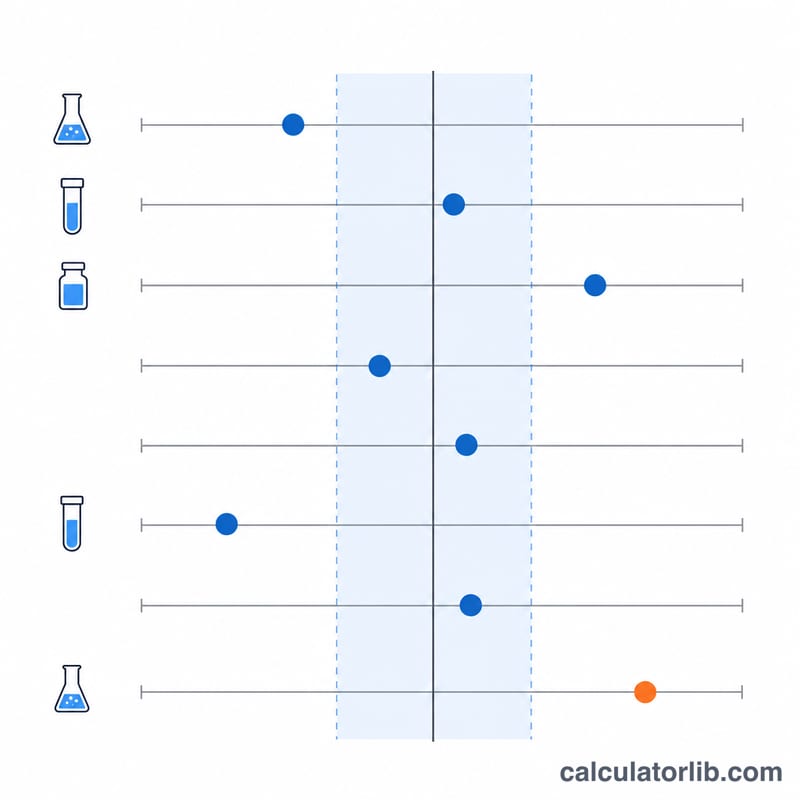
The Standard Deviation Index (SDI) is a quality-control statistic used in laboratory medicine, especially within external quality assessment (EQA) and peer-comparison programs. It expresses how far a laboratory's mean result for an analyte sits from the consensus (peer-group) mean, measured in units of the group's standard deviation. An SDI near zero means the lab agrees closely with its peers, while a large positive or negative SDI signals a systematic bias.
How to Use This Calculator
Enter three values from your QC or EQA report: your laboratory's mean for the analyte, the peer (group) mean, and the group standard deviation. The calculator returns the SDI, its absolute value, and a quick interpretation based on common acceptance thresholds.
The Formula Explained
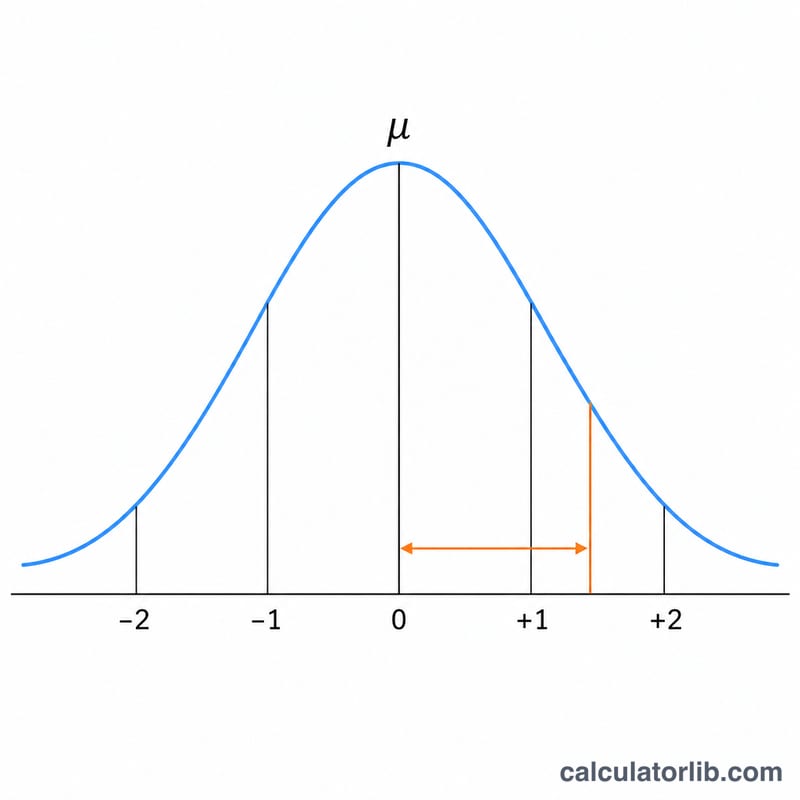
$$\text{SDI} = \frac{\text{lab mean} - \text{group mean}}{\text{group SD}}$$ The numerator is the bias of your lab versus the group; dividing by the group SD scales that bias so labs measuring different analytes can be compared on the same dimensionless scale. A common interpretation guide: \(|\text{SDI}| \le 1.0\) is acceptable, 1.0–2.0 is marginal and worth monitoring or investigating, and \(|\text{SDI}| > 2.0\) is generally unacceptable and warrants corrective action.
Worked Example
Suppose your lab's mean glucose value is 102 mg/dL, the peer-group mean is 100 mg/dL, and the group SD is 4 mg/dL. Then $$\text{SDI} = \frac{102 - 100}{4} = \frac{2}{4} = 0.5.$$ An SDI of 0.5 is well within the acceptable range, so your lab agrees with its peers.
FAQ
What is a good SDI value? Values between −1.0 and +1.0 are typically considered acceptable; the closer to 0, the better the agreement.
What does a negative SDI mean? A negative SDI means your lab's mean is below the peer-group mean (a low bias); positive means above it.
How is SDI different from a Z-score? They are computed the same way mathematically; SDI is simply the term used in laboratory peer-comparison QC, using the group mean and group SD as the reference.