
What Is Relative Standard Deviation?
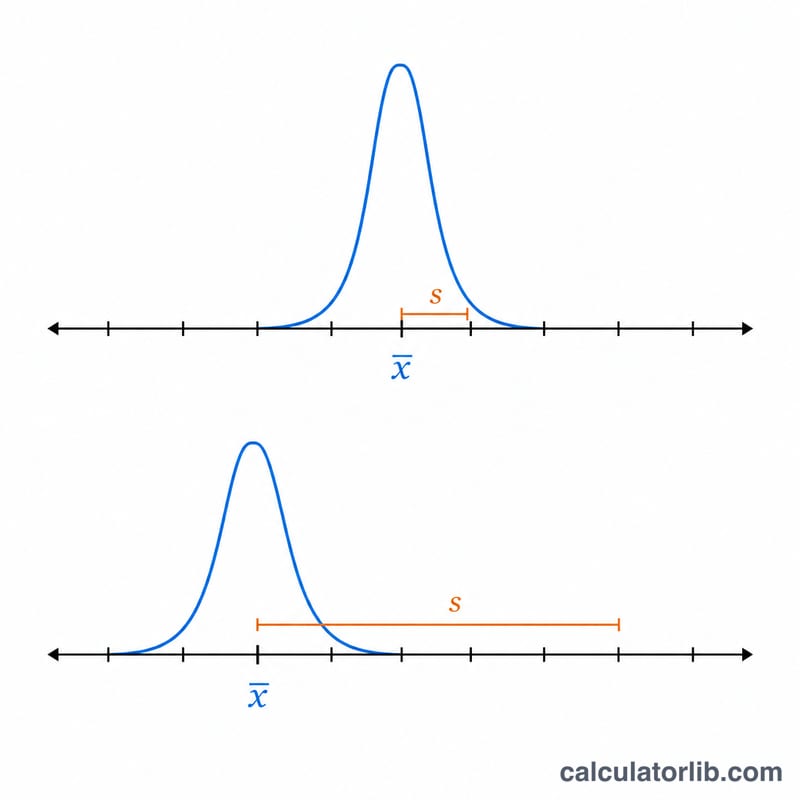
The relative standard deviation (RSD), also known as the coefficient of variation (%CV), measures how spread out a set of values is relative to its average. Because it divides the standard deviation by the mean and multiplies by 100, the result is a dimensionless percentage. This makes RSD ideal for comparing the precision of measurements that have different units or very different magnitudes — something a raw standard deviation cannot do.
How to Use This Calculator
Enter your data values separated by commas or spaces. Choose whether you want a sample standard deviation (uses n−1, the usual choice when your data is a subset of a larger group) or a population standard deviation (uses n, when your data represents the entire group). The calculator returns the RSD as a percentage along with the mean, standard deviation, and the number of data points.
The Formula Explained
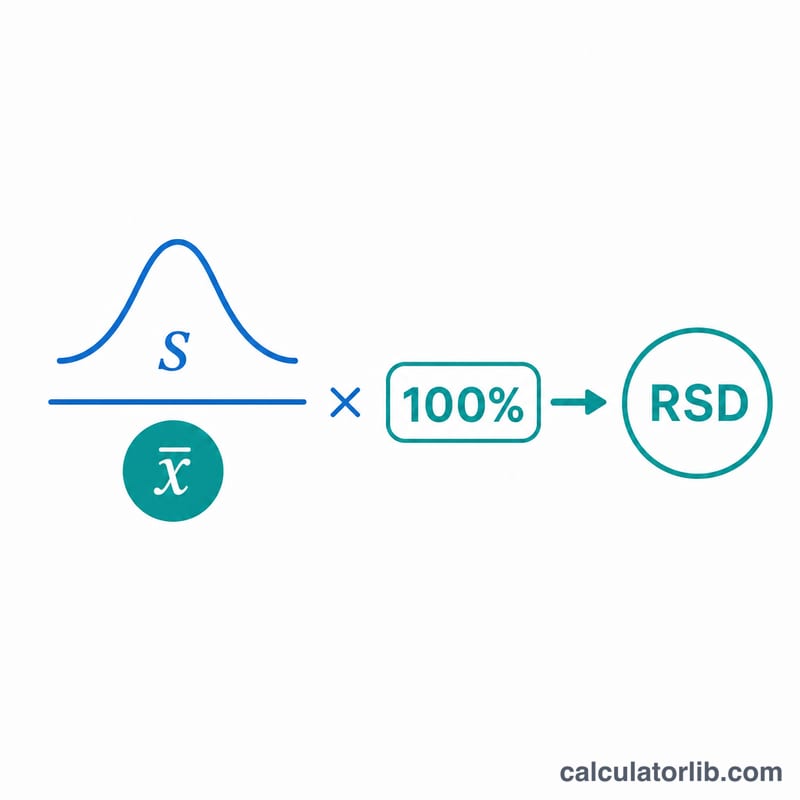
First the mean (\(\bar{x}\)) is calculated. Then the standard deviation (\(s\)) is found from the squared deviations about the mean. Finally $$\text{RSD} = \frac{s}{\bar{x}} \times 100\%$$ A small RSD (under ~10%) indicates tightly clustered, precise data; a large RSD signals high variability.
Worked Example
For the data set 10, 12, 14, 16, 18: the mean is 14. The sample variance is $$\frac{(-4)^2+(-2)^2+0^2+2^2+4^2}{4} = \frac{40}{4} = 10,$$ so \(s = \sqrt{10} \approx 3.1623\). $$\text{RSD} = \frac{3.1623}{14} \times 100 \approx 22.59\%.$$
FAQ
Is RSD the same as %CV? Yes — relative standard deviation and the percent coefficient of variation refer to the same calculation.
Should I use sample or population? Use sample (n−1) when your values are a sample drawn from a bigger population, which covers most lab and survey scenarios. Use population (n) only when you have measured every member of the group.
What is a good RSD? It depends on the field. In analytical chemistry an RSD below 2% is often considered excellent precision, while in other contexts up to 15–20% may be acceptable.