
What Is Pooled Standard Deviation?
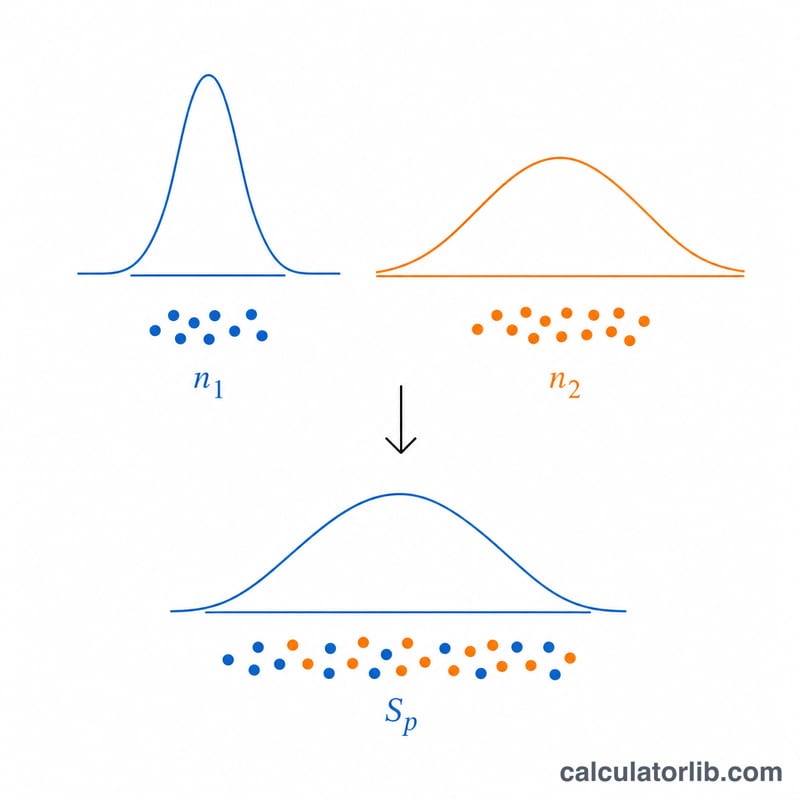
The pooled standard deviation (Sp) is a weighted average of two sample standard deviations, combined into a single estimate of the common population standard deviation. It is used when you assume two independent samples come from populations that share the same variance. The pooled estimate is central to the two-sample t-test, Cohen's d effect size, and confidence intervals for the difference between two means.
How to Use This Calculator
Enter the size of each sample (\(n_1\) and \(n_2\)) and each sample's standard deviation (\(s_1\) and \(s_2\)). The calculator returns the pooled standard deviation, the pooled variance (\(S_p^2\)), and the degrees of freedom (\(n_1 + n_2 - 2\)). Each sample must contain at least two observations so the degrees of freedom stay positive.
The Formula Explained
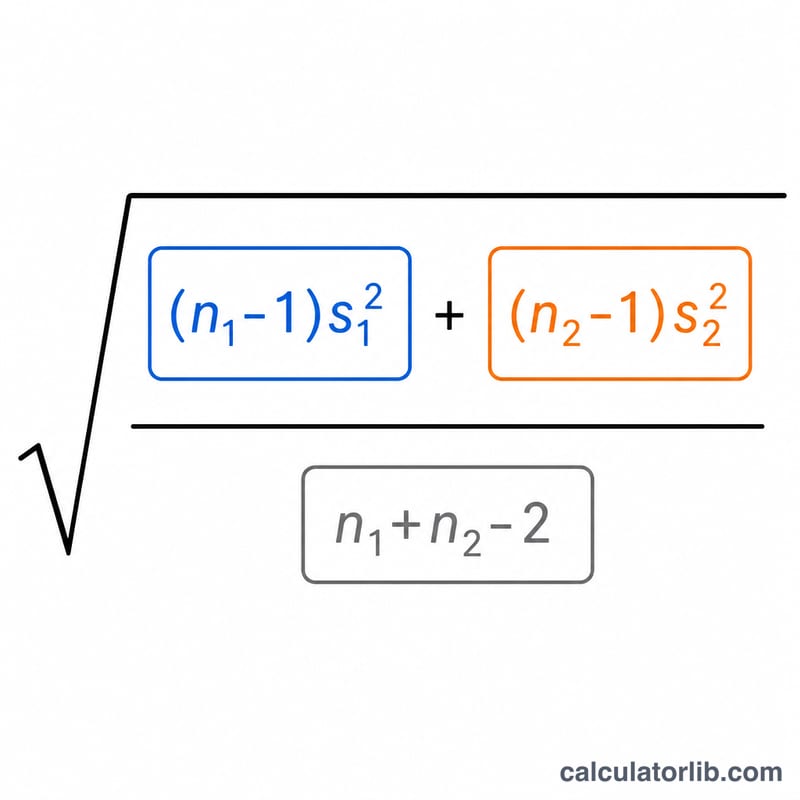
The pooled variance weights each sample's variance by its degrees of freedom (\(n - 1\)):
$$S_p^{2} = \dfrac{(n_1 - 1)\,s_1^{2} + (n_2 - 1)\,s_2^{2}}{n_1 + n_2 - 2}$$
Taking the square root gives the pooled standard deviation, \(S_p\). Larger samples contribute more heavily to the pooled estimate, which is why the variances are weighted rather than simply averaged.
Worked Example
Suppose sample 1 has \(n_1 = 10\) and \(s_1 = 5\), and sample 2 has \(n_2 = 12\) and \(s_2 = 6\). Then \((10-1)\cdot 25 = 225\) and \((12-1)\cdot 36 = 396\), summing to 621. The degrees of freedom are \(10 + 12 - 2 = 20\), so $$S_p^{2} = \frac{621}{20} = 31.05 \quad\text{and}\quad S_p = \sqrt{31.05} \approx 5.5722.$$
FAQ
When should I pool standard deviations? Pool when the two groups are assumed to have equal population variances. If variances differ greatly, use Welch's t-test instead.
Why use n - 1 instead of n? Using \(n - 1\) (Bessel's correction) gives an unbiased estimate of variance from a sample.
Does sample order matter? No. Swapping the two samples produces the same pooled standard deviation.