
What is the Sample Standard Deviation?
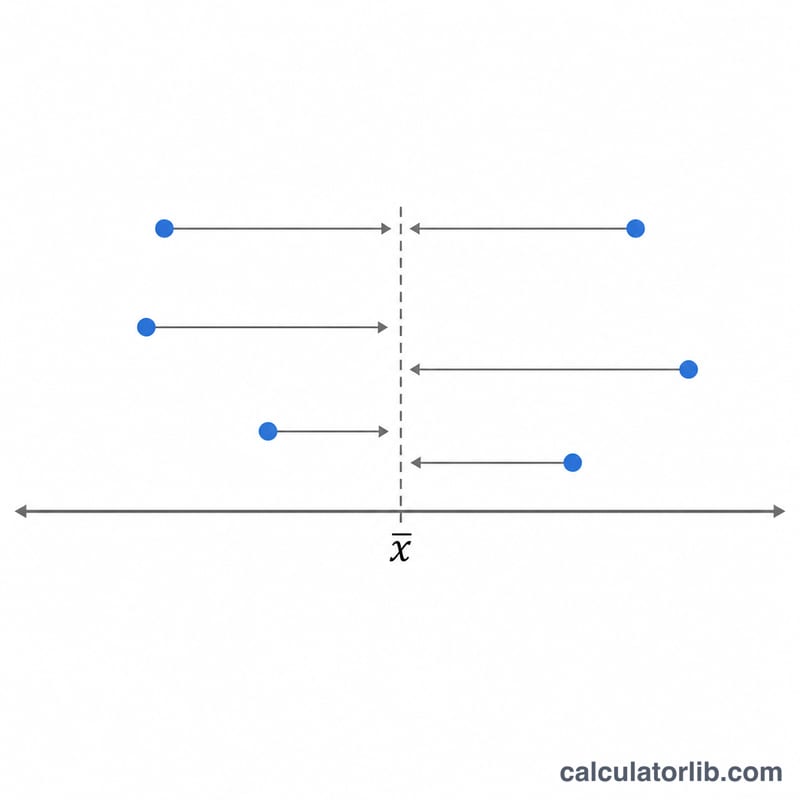
The sample standard deviation measures how spread out a set of data values is around their mean, using the Bessel-corrected denominator \(n-1\). It is the most common dispersion statistic when your data is a sample drawn from a larger population rather than the entire population.
Formula
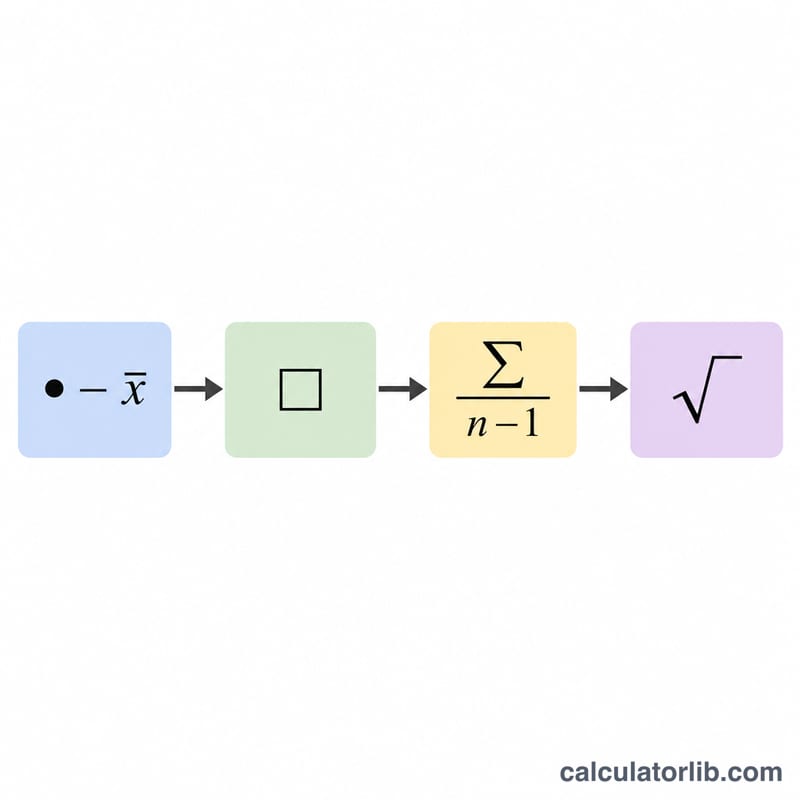
Given \(n\) values \(x_1, x_2, \dots, x_n\) with mean \(\bar{x}\), the sample standard deviation \(s\) is:
$$s = \sqrt{\frac{1}{n-1}\sum_{i=1}^{n}(x_i-\bar{x})^2}$$Here \(\bar{x}=\frac{1}{n}\sum x_i\) is the mean and the inner sum is the total sum of squared deviations.
How to use it
Enter your numbers separated by commas or spaces, then read off the standard deviation, mean, variance, and sum of squared deviations. Use this version (n-1) for samples; use the population version (n) only when you have every member of the population.
Worked example
Take the data set \(2, 4, 12, 18, 24, 30\). The mean is:
$$\bar{x}=\frac{2+4+12+18+24+30}{6}=\frac{90}{6}=15$$The squared deviations are \(169, 121, 9, 9, 81, 225\), summing to:
$$\sum(x_i-\bar{x})^2 = 169+121+9+9+81+225 = 614$$Then the variance and standard deviation are:
$$s^2=\frac{614}{6-1}=122.8,\qquad s=\sqrt{122.8}\approx 11.08$$FAQ
When do I divide by n instead of n-1? Divide by \(n\) only for a population standard deviation. For a sample, \(n-1\) corrects the bias in estimating the population variance.
What if I enter one value? The standard deviation is undefined (division by zero), so the result is reported as 0.
Can I mix commas and spaces? Yes — values may be separated by either, e.g. 4, 8 15 16.