
What is the Bitcoin Mining Profit Calculator?
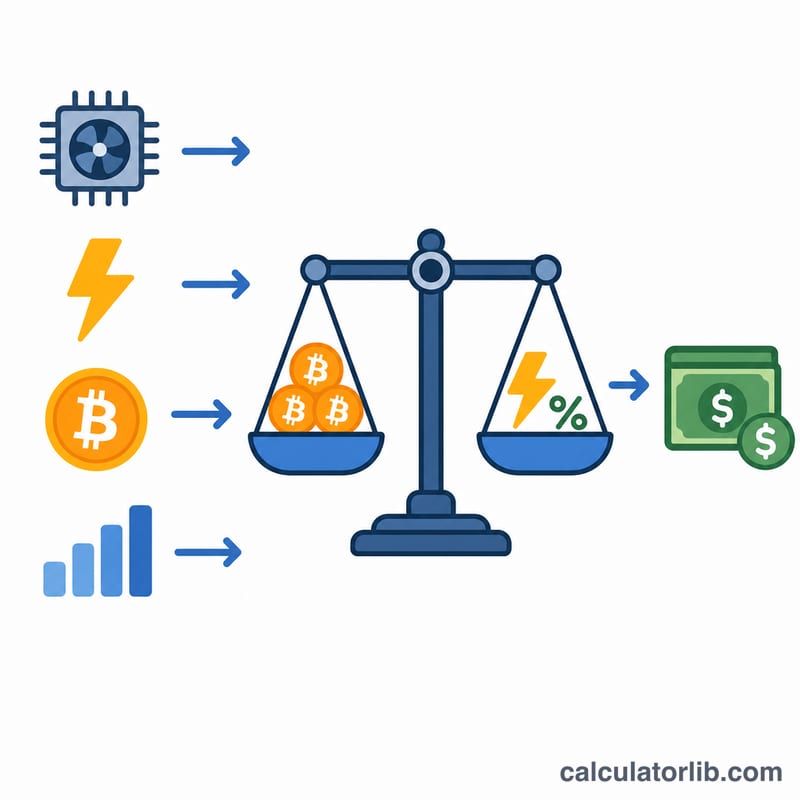
This tool estimates how much profit a Bitcoin mining rig can earn based on its hash rate, power draw, your electricity cost, the current BTC price, the network difficulty, the block reward and your pool fee. It returns the expected BTC mined per day along with daily, monthly and yearly profit after electricity and fees.
How to use it
Enter your rig hash rate in TH/s and its power consumption in watts. Add your electricity price in dollars per kWh, the live Bitcoin price, the current network difficulty and block reward (3.125 BTC after the 2024 halving), and your mining pool fee percentage. The calculator instantly shows your estimated returns.
The formula explained
The expected coins mined follow from your share of total network work:
$$\text{BTC/day} = \frac{H \times 86400 \times R}{D \times 2^{32}}$$where \(H\) = hash rate in H/s, \(R\) = block reward, \(D\) = difficulty. Profit subtracts power cost:
$$\text{Profit} = (\text{BTC/day} \times (1-f) \times P) - \frac{W}{1000}\times 24 \times C$$with \(f\) = pool fee fraction, \(P\) = BTC price, \(W\) = watts, \(C\) = $/kWh.
Worked example
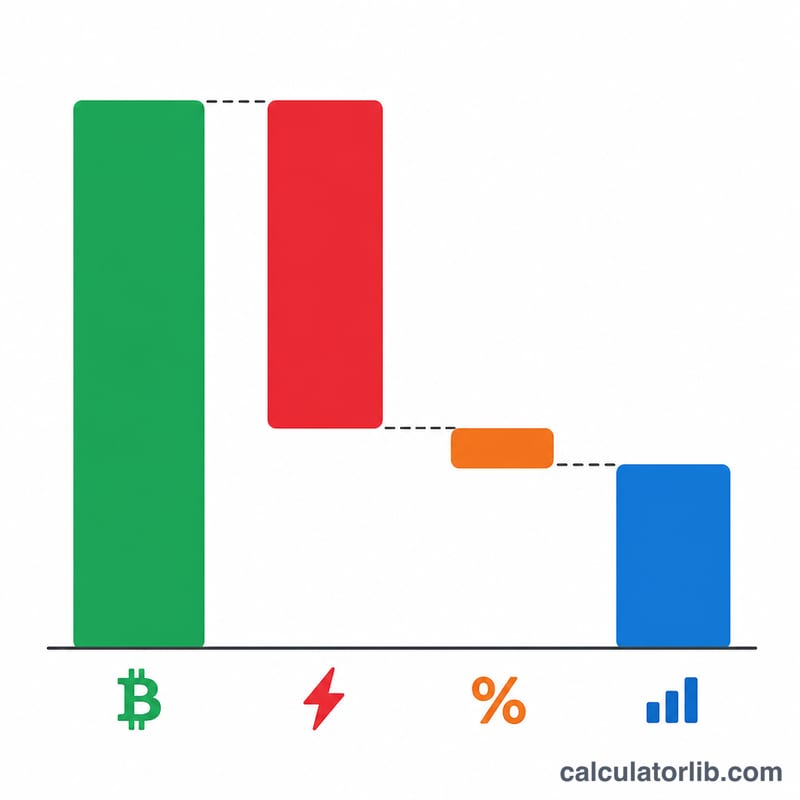
A 100 TH/s rig (\(H = 10^{14}\) H/s) at difficulty \(D = 9\times10^{13}\), reward 3.125 BTC:
$$\text{BTC/day} = \frac{10^{14}\times 86400 \times 3.125}{9\times10^{13}\times 2^{32}} \approx 0.0000699\,\text{BTC}$$After a 1% fee at $60,000 that is about $4.15 revenue; a 3250 W rig at $0.10/kWh costs $7.80/day, giving a loss near \(-\$3.65\) per day.
Bitcoin Block Reward Halving History
Roughly every 210,000 blocks (about every four years), the Bitcoin protocol halves the reward paid to miners for adding a new block. This event, called the halving, steadily reduces the rate at which new BTC is created until the supply approaches its 21 million cap. Because the block reward (the reward field in the calculator) is a direct multiplier in the daily revenue formula, each halving cuts the BTC earned per unit of hash rate roughly in half, all else being equal.
| Halving Event | Approx. Year | Block Height | Block Reward (BTC) |
|---|---|---|---|
| Genesis era (launch) | 2009 | 0 | 50 |
| 1st halving | 2012 | 210,000 | 25 |
| 2nd halving | 2016 | 420,000 | 12.5 |
| 3rd halving | 2020 | 630,000 | 6.25 |
| 4th halving | 2024 | 840,000 | 3.125 |
| 5th halving (expected) | ~2028 | 1,050,000 | 1.5625 |
Halving dates after the next event are estimates because the exact timing depends on the network's average block interval, which targets about 10 minutes but varies with total hash rate and difficulty adjustments. When estimating future profitability, set the reward field to the value matching the period you are modeling.
Key Terms & Variables
- Hash Rate (TH/s)
-
The number of hash computations a miner performs per second, entered in the
hashratefield in terahashes per second (TH/s). One TH/s equals \(10^{12}\) hashes per second (H/s). Other common units are GH/s (\(10^{9}\)), PH/s (\(10^{15}\)) and EH/s (\(10^{18}\)). The calculator multiplies your TH/s value by \(10^{12}\) to convert it to raw H/s before computing your share of the network. - Network Difficulty
-
A unitless number (the
difficultyfield) that scales how hard it is to find a valid block. The network adjusts difficulty every 2,016 blocks (about two weeks) so that blocks are found roughly every 10 minutes regardless of total network hash rate. Higher difficulty means a smaller share of rewards for the same hash rate. - Block Reward
-
The amount of newly minted BTC paid to the miner of each block (the
rewardfield). It is set by the halving schedule and currently 3.125 BTC since the 2024 halving. Transaction fees are paid on top of this but are not included in the base reward figure. - Pool Fee
-
The percentage (the
poolfeefield) a mining pool deducts from your earnings in exchange for combining many miners' hash rate to smooth out payouts. Typical pool fees range from 0% to about 3%. A 2% fee means you keep 98% of your gross BTC reward. - kWh (Kilowatt-hour)
-
A unit of energy equal to one kilowatt of power used for one hour. Electricity is billed per kWh (the
costfield, in your local currency per kWh). The calculator converts the miner'spowerdraw (in watts) to kilowatts by dividing by 1,000, multiplies by 24 hours, and multiplies by your cost per kWh to get daily electricity expense. - The \(2^{32}\) Constant
- Equal to 4,294,967,296, this constant appears in the expected-reward formula because Bitcoin difficulty is defined relative to the maximum target. The expected number of hashes needed to find a block is \(\text{difficulty} \times 2^{32}\). Dividing your hash output over a day (hashes per second \(\times\) 86,400) by this value gives your expected fraction of blocks—and therefore BTC—earned per day.
FAQ
Why is my profit negative? At high difficulty or high electricity cost, power costs can exceed mining revenue. Lower-cost power improves profitability.
Does this include hardware cost? No, it shows operating profit only. Subtract your rig purchase to estimate ROI time.
What block reward should I use? Since the April 2024 halving the reward is 3.125 BTC per block.