What Is the Crypto Mining Profitability Calculator?
This calculator estimates how much money a cryptocurrency mining rig can earn after electricity costs. It works for any proof-of-work coin (Bitcoin, Litecoin, Monero and others) as long as you enter the network's parameters using consistent units. Mining profitability shifts constantly with coin price, network difficulty and your power bill, so the result is a snapshot, not a guarantee.
How to Use It
Enter your rig's hashrate and the total network hashrate in the same unit (for example both in H/s, or both in TH/s). Add the current block reward, the average number of blocks per day (Bitcoin \(\approx 144\)), the live coin price in USD, your rig's power draw in kilowatts, and your electricity rate per kWh. The calculator returns daily profit plus monthly and yearly projections.
The Formula Explained
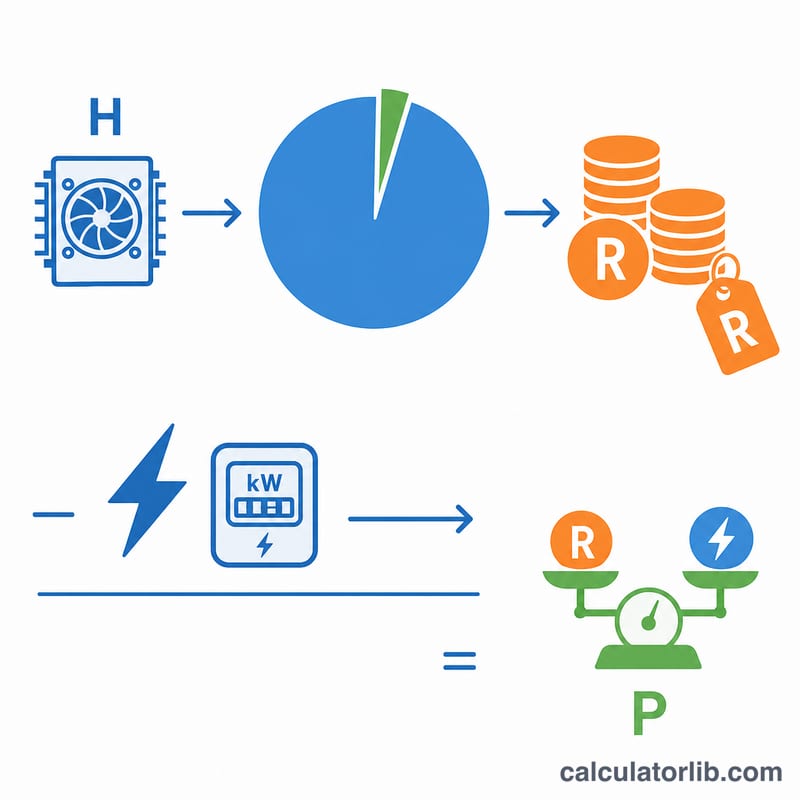
Your share of the network equals your hashrate divided by total network hashrate. Multiply that share by the daily coin issuance (block reward × blocks per day) to get coins mined per day, then by coin price for daily revenue. Electricity cost is power (kW) × 24 hours × rate. Profit is revenue minus electricity cost:
$$\text{Daily Profit} = \left( \frac{H}{N} \cdot R \cdot B \cdot P \right) - \left( K \cdot 24 \cdot E \right)$$
Worked Example
Suppose your rig does 100 TH/s on a 500 EH/s Bitcoin network (so share = \(100\mathrm{e}12 \div 500\mathrm{e}18 = 2\mathrm{e}{-7}\)). With a 3.125 BTC block reward, 144 blocks/day, and a $65,000 price, daily revenue $$\approx 2\mathrm{e}{-7} \times 3.125 \times 144 \times 65{,}000 \approx \$5.85.$$ If your rig draws 3.5 kW at $0.12/kWh, electricity costs $$3.5 \times 24 \times 0.12 = \$10.08/\text{day}.$$ Net daily profit \(\approx -\$4.23\) — a loss under these conditions.
Hashrate Unit Conversion Table
Hashrate is measured in hashes per second (H/s) using standard SI prefixes. The formula divides your hashrate \(H\) by the network hashrate \(N\), so both must use the same unit. Convert both to H/s, or to the same prefix, before entering them.
| Unit | Symbol | Equivalent in H/s | Relation to the next smaller unit |
|---|---|---|---|
| Kilohash per second | kH/s | 1 × 103 = 1,000 H/s | 1 kH/s = 1,000 H/s |
| Megahash per second | MH/s | 1 × 106 = 1,000,000 H/s | 1 MH/s = 1,000 kH/s |
| Gigahash per second | GH/s | 1 × 10⁹ H/s | 1 GH/s = 1,000 MH/s |
| Terahash per second | TH/s | 1 × 10¹² H/s | 1 TH/s = 1,000 GH/s |
| Petahash per second | PH/s | 1 × 10¹⁵ H/s | 1 PH/s = 1,000 TH/s |
| Exahash per second | EH/s | 1 × 10¹⁸ H/s | 1 EH/s = 1,000 PH/s = 1,000,000 TH/s |
| Zettahash per second | ZH/s | 1 × 10²¹ H/s | 1 ZH/s = 1,000 EH/s |
Example: 100 TH/s = \(100 \times 10^{12} = 10^{14}\) H/s, and 500 EH/s = \(500 \times 10^{18} = 5 \times 10^{20}\) H/s.
Power units: 1 kW = 1,000 W. The calculator expects power draw in kilowatts, so divide the watts on a miner's spec sheet by 1,000. For example, 3,500 W = 3.5 kW.
Mining Terms and Variables Glossary
- Hashrate
- The number of hash calculations your hardware performs per second, in H/s or a prefixed unit such as TH/s.
- Network hashrate
- The combined hashrate of all miners on the network. A higher network hashrate means a smaller share of rewards for the same hardware.
- Block reward
- The number of new coins awarded for each block found. Transaction fees are usually extra and are not included in this formula unless you add them to the reward.
- Blocks per day
- The average number of blocks the network produces daily. Bitcoin targets one block about every 10 minutes, which is about 144 blocks per day.
- Difficulty
- A protocol setting that controls how hard it is to find a valid block. Bitcoin adjusts it every 2,016 blocks to keep block times near the target. Difficulty rises with network hashrate.
- Halving
- A scheduled cut of the block reward. Bitcoin's reward halves every 210,000 blocks (about four years); since April 2024 it has been 3.125 BTC.
- Pool fee
- A percentage that a mining pool keeps from your payouts. This calculator does not subtract it. To approximate it, multiply revenue by \(1 - \text{fee}\).
- Power draw (kW)
- The electrical power your mining equipment uses, in kilowatts (watts ÷ 1,000).
- Electricity rate ($/kWh)
- The price you pay per kilowatt-hour. Rates vary widely by location and contract.
- Break-even electricity price
- The rate at which daily revenue equals daily electricity cost, so net profit is zero: \(E_{\text{be}} = \dfrac{H}{N} \cdot R \cdot B \cdot P \div (24K)\).
Formula variables
- \(H\) – your hashrate (H/s).
- \(N\) – network hashrate (H/s), in the same unit as \(H\).
- \(R\) – block reward in coins per block.
- \(B\) – blocks per day.
- \(P\) – coin price in USD.
- \(K\) – power draw in kilowatts.
- \(E\) – electricity rate in USD per kWh. The \(24\) in \(K \cdot 24 \cdot E\) is hours per day.
Results are estimates. Real profit depends on difficulty changes, pool fees, fees, hardware costs, cooling and price movements. This is general information, not financial advice.
FAQ
Does this include pool fees or hardware cost? No. It models revenue minus electricity only. Subtract pool fees (typically 1–2%) and amortized hardware cost separately for a full picture.
Why is my profit negative? High electricity rates or low coin prices push mining into a loss. Lower your power cost or wait for more favorable market conditions.
What units should I use for hashrate? Any unit works as long as your hashrate and network hashrate use the same one, because the calculation only uses their ratio.