
What this calculator does
The VinFast Charging Time Calculator estimates how long it takes to charge a VinFast electric vehicle from a starting battery percentage to a target percentage. It works for any EV charging scenario — Level 2 home wall boxes, public AC chargers, or as a rough guide for DC fast charging — by combining your battery's usable capacity, the charger's power output, and a real-world efficiency factor.
How to use it
Enter your VinFast model's battery capacity in kWh (for example, the VF 8 Eco is around 82 kWh and the Plus around 87.7 kWh). Enter the charger power in kW, then set your current charge level and your desired target level. Finally, set a charging efficiency — 85–92% is typical for AC charging to account for energy lost as heat. The result shows total time in hours and minutes plus the energy you'll actually add.
The formula explained
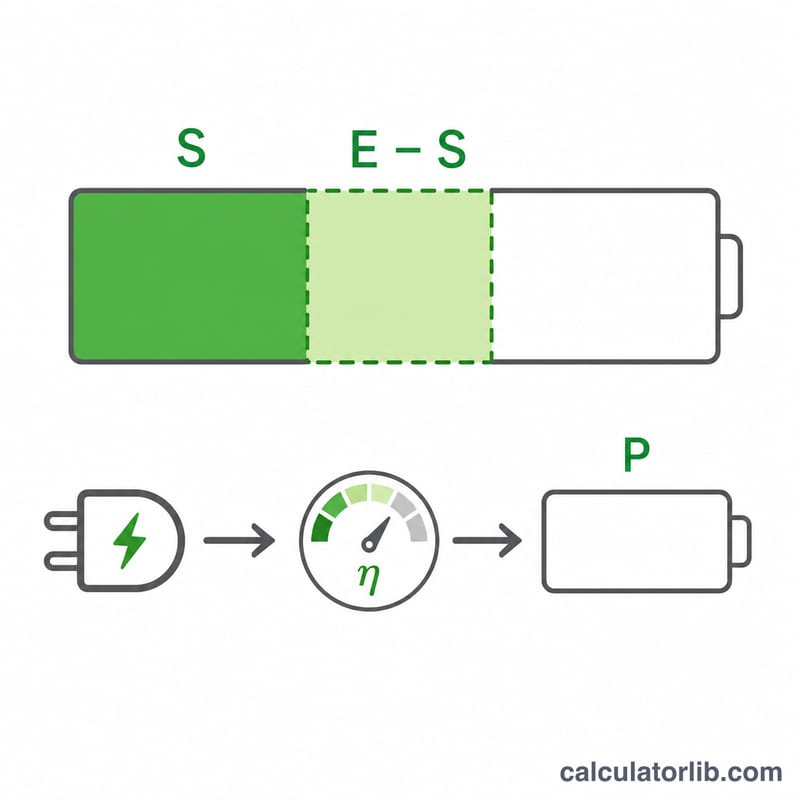
The core equation is $$t = \frac{\text{Battery (kWh)} \times \dfrac{\text{Target \%} - \text{Start \%}}{100}}{\text{Charger (kW)} \times \dfrac{\text{Efficiency \%}}{100}}$$. First we find the energy that must be added: battery capacity times the percentage gap. Dividing that energy by the effective delivered power (charger power × efficiency) gives the time in hours. Efficiency matters because not all electricity drawn from the charger ends up stored in the battery.
Worked example
Suppose a VinFast with an 87.7 kWh battery charging on an 11 kW wall box from 20% to 80% at 90% efficiency. Energy needed = \(87.7 \times (80 - 20) / 100 = 52.62\) kWh. Effective power = \(11 \times 0.90 = 9.9\) kW. Time = $$52.62 \div 9.9 \approx 5.32 \text{ hours}$$ or about 5 hours 19 minutes.
FAQ
Why is the real charging time longer than expected? Charging speed tapers off above ~80%, and efficiency losses, cold batteries, and shared power circuits all add time.
What efficiency should I use? Around 90% for AC home charging and 92–95% for DC fast charging are reasonable starting points.
Does this apply only to VinFast cars? The math is universal for any EV — just plug in that vehicle's battery capacity instead.