What is the VinFast Charging Time Calculator?
This tool estimates how long it takes to charge a VinFast electric vehicle — such as the VF 8, VF 9, VF 6, or VF 7 — from its current state of charge (SOC) to a target level. It works for any EV model because you enter the actual battery capacity and charger power yourself. The result is shown in hours and minutes, along with the energy added in kWh.
How to use it
Enter your battery's usable capacity in kWh (for example, ~82 kWh for a VF 8 Eco). Enter the charger power in kW — a typical home AC charger is 7–11 kW, while public DC fast chargers range from 50 to 150+ kW. Set your current charge percentage and the target you want to reach. Finally, set a charging efficiency: AC charging is usually around 85–92%, and DC fast charging often 90–95%. Click calculate to see the estimated time.
The formula explained
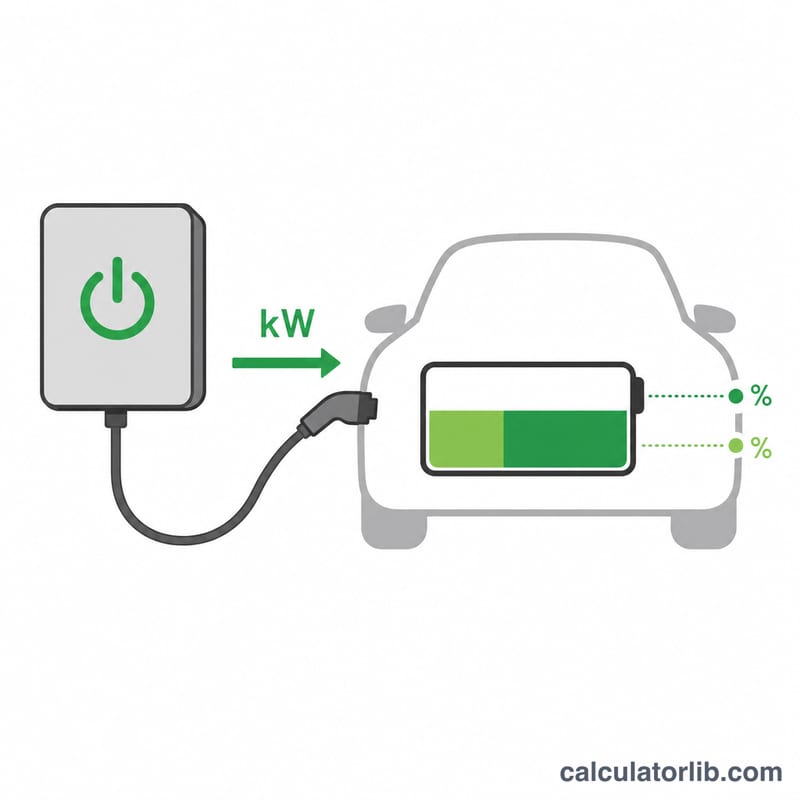
Charging time equals the energy you need to add divided by the effective power. The energy needed is the battery capacity multiplied by the percentage gap between target and start SOC. The effective power is the charger's rated power multiplied by the efficiency factor, which accounts for losses as heat in the cables, charger and battery.
$$\text{Time (h)} = \frac{\text{Capacity} \times \dfrac{\text{Target \%} - \text{Start \%}}{100}}{\text{Power} \times \dfrac{\text{Efficiency \%}}{100}}$$
Worked example
Suppose you charge an 82 kWh VinFast battery from 20% to 80% on an 11 kW home charger at 90% efficiency. Energy needed = \(82 \times (80 - 20) / 100 = 49.2\) kWh. Effective power = \(11 \times 0.90 = 9.9\) kW. Time:
$$\text{Time} = \frac{49.2}{9.9} \approx 4.97 \text{ hours}$$
or about 4 hours 58 minutes.
VinFast Models: Battery Capacity and Charging Reference
The table lists approximate figures for current and recent VinFast models. Capacity, onboard charger and DC rate differ by variant (for example Eco vs Plus), production year and market. Treat every number as a rounded guide and confirm it against the official VinFast specification for your exact vehicle before entering it in the calculator.
| Model | Approx. battery capacity (kWh) | Max AC onboard charging (kW) | Max DC fast charging (kW) |
|---|---|---|---|
| VF 3 | ~18.6 | ~2–3 (low-power AC) | ~32 |
| VF 5 | ~37 | ~7.4 | ~70 |
| VF 6 | ~59.6 | ~11 | ~150 |
| VF 7 | ~59.6 (Eco) to ~75 (Plus) | ~11 | ~150 |
| VF 8 | ~82 usable (~88 gross) | ~11 | ~150 |
| VF 9 | ~92 to ~123 depending on variant | ~11 | ~150 to ~250 depending on variant |
| VF e34 | ~42 | ~7.4 | ~110 |
Usable and gross capacity are not the same. Gross capacity is the total pack size, while usable capacity is what the car can actually draw on. Use the figure that matches how your start and target state-of-charge (SOC) values are displayed. In the calculator, enter the charger power as the lower of the charger's rating and the car's maximum for that charging type (AC or DC).
Interpreting Your Result
The calculator uses a simple, idealised model: energy added to the battery divided by the effective charging power.
$$\text{Time (h)} = \frac{ \text{Capacity} \times (\text{Target \%} - \text{Start \%}) / 100}{\text{Power} \times \text{Efficiency \%} / 100}$$
This assumes the power stays constant for the whole session. Real sessions do not behave this way, so the figure should be read as a best-case estimate.
- DC charge-curve tapering: Lithium-ion batteries accept the highest power at low to mid SOC. Above roughly 80% the car reduces power sharply to protect the cells, so the last 10–20% can take as long as a much larger portion lower down. A constant-power estimate therefore understates real DC time, especially for targets above 80%.
- Onboard charger limit on AC: On AC, the car's onboard charger converts the power, so it caps the rate no matter how powerful the wall box or public post is. A 22 kW station will still deliver only what the car accepts, such as about 7.4 kW or 11 kW depending on model. Enter the lower of the two values as the power.
- Temperature: Cold batteries accept less power until they warm up, and very hot conditions can also trigger limits. Preconditioning and ambient temperature can noticeably change DC session times.
- Battery condition: Age, degradation, and pack balancing can reduce both usable capacity and peak charging power. A charger that is shared between vehicles, or a station that is power-limited, can also deliver less than its rated output.
- Efficiency: The efficiency input accounts for conversion and thermal losses between the charger and the cells. These are typically larger on AC than on DC, and they vary with conditions.
In practice, treat the result as a lower bound for a real DC session and as a reasonable approximation for AC charging, provided the power entered reflects the onboard charger limit.
FAQ
Why is real charging slower near 100%? EVs slow charging above ~80% to protect the battery, especially on DC fast chargers, so real times for the last 20% are longer than this linear estimate.
What efficiency should I use? Use ~90% for AC home charging and ~92–95% for DC fast charging as a reasonable default.
Does this work for any EV? Yes — although tuned for VinFast models, you can enter any battery size and charger power for any electric car.