
What Is This Calculator?
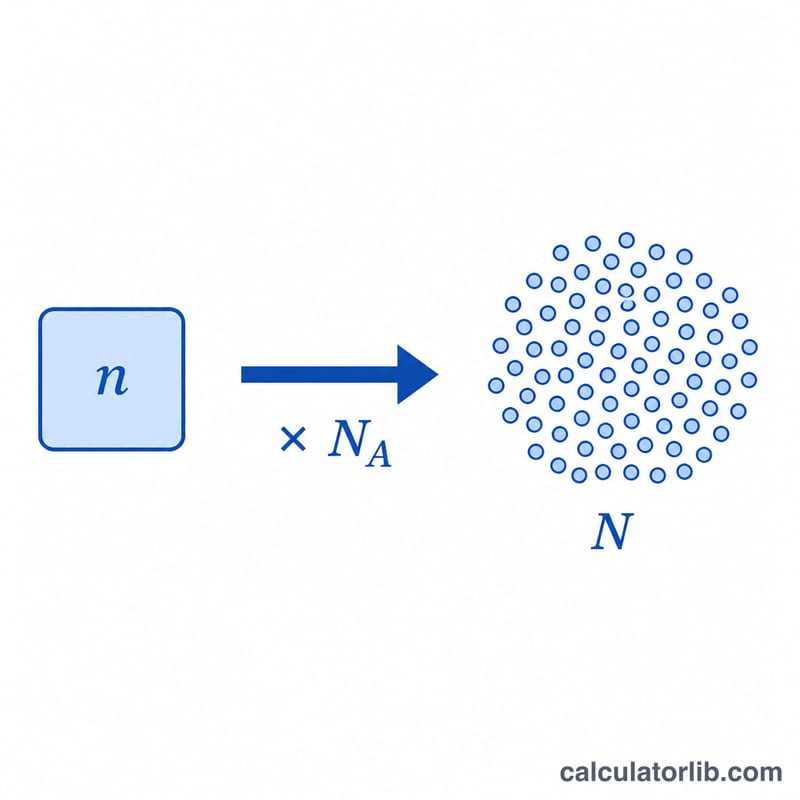
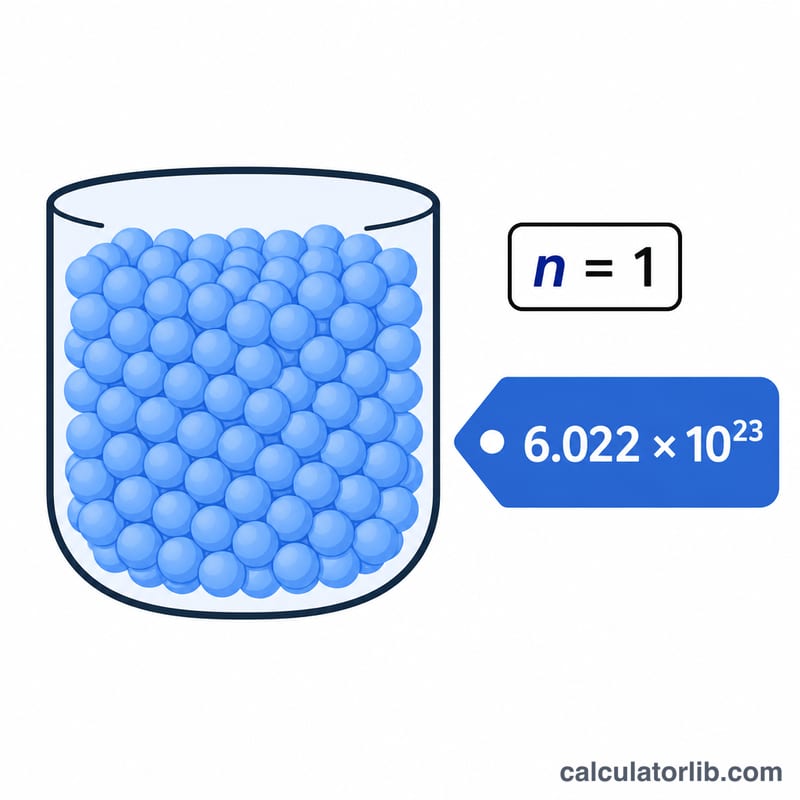
The Moles to Number of Particles Calculator converts an amount of substance, measured in moles, into the actual count of individual particles — atoms, molecules, ions, or formula units. It relies on Avogadro's number, one of the cornerstone constants of chemistry, which defines exactly how many particles make up one mole.
The Formula
The relationship is simple and linear:
$$N = n \times N_A$$
where \(N\) is the number of particles, \(n\) is the amount of substance in moles, and \(N_A\) is Avogadro's number, approximately \(6.022 \times 10^{23}\) particles per mole. Because the equation is directly proportional, doubling the moles doubles the particle count.
How to Use It
Enter the number of moles you have. The calculator multiplies it by \(6.022 \times 10^{23}\) and returns the total particle count. If you only know the mass of your sample, first divide the mass by the molar mass to find the moles, then use this tool.
Worked Example
Suppose you have 2 moles of water (H₂O). The number of water molecules is:
$$N = 2 \times 6.022 \times 10^{23} = 1.2044 \times 10^{24} \text{ molecules.}$$
Note that each water molecule contains 3 atoms, so the total atom count would be three times this value.
FAQ
What is Avogadro's number? It is the number of constituent particles in one mole of a substance, defined as exactly \(6.02214076 \times 10^{23}\) (rounded here to \(6.022 \times 10^{23}\)).
Does this work for atoms and molecules? Yes. "Particles" can be atoms, molecules, ions, or formula units — whatever the mole refers to.
Can I use a fractional number of moles? Absolutely. Enter values like 0.5 or 0.025; the proportional relationship still holds.