
What This Calculator Does
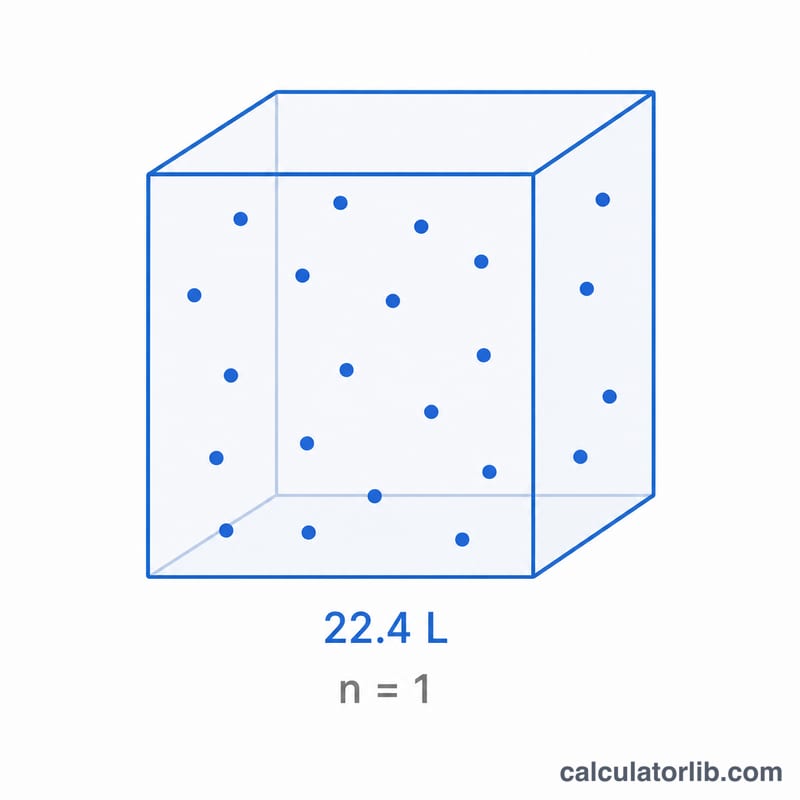
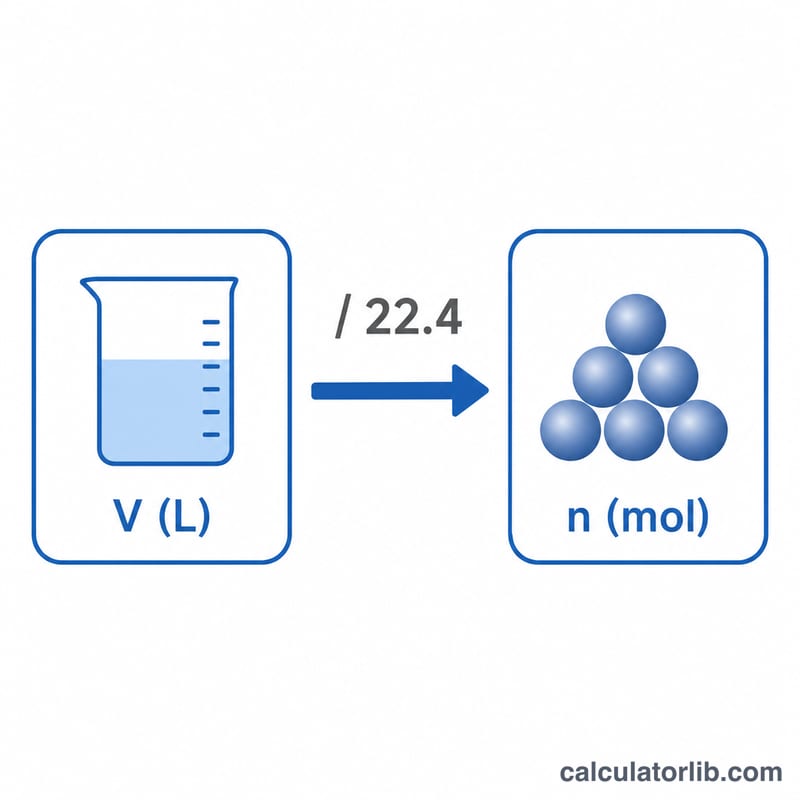
This tool converts the volume of a gas, measured in liters, into the amount of substance in moles. It relies on the fact that one mole of any ideal gas occupies the same volume under the same conditions. At Standard Temperature and Pressure (STP: 0°C and 1 atm) that volume — the molar volume — is 22.4 liters per mole. So a simple division turns liters into moles.
The Formula
The relationship is $$n = \frac{V}{V_m}$$ where \(n\) is the number of moles, \(V\) is the gas volume in liters, and \(V_m\) is the molar volume. At STP this becomes $$n = \frac{V}{22.4}$$ If you are working at room temperature (25°C, sometimes called RTP), the molar volume is closer to 24.0 L/mol, so change the second input accordingly.
How To Use It
Enter the gas volume in liters. Leave the molar volume at 22.4 for STP, or switch it to 24.0 for room-temperature conditions or to any value your problem specifies. The calculator divides the volume by the molar volume and reports the moles instantly.
Worked Example
Suppose you have 44.8 L of oxygen gas at STP. Using $$n = \frac{V}{22.4} = \frac{44.8}{22.4} = 2 \text{ moles}$$ To find the mass, multiply by the molar mass of O2 (32 g/mol): \(2 \times 32 = 64\) g.
FAQ
Why 22.4 liters? The ideal gas law (\(PV = nRT\)) shows that at 273.15 K and 1 atm, one mole occupies about 22.414 L, commonly rounded to 22.4.
Does this work for any gas? Yes, for ideal gases. Real gases deviate slightly, but the approximation is excellent for typical chemistry problems.
What if my conditions are not STP? Change the molar volume input. For precise non-standard conditions, use the full ideal gas law instead, \(n = \frac{PV}{RT}\).