
What this calculator does
This tool reverses a percent change to find the starting (original) value. If you only know the final amount after a known percentage increase or decrease, this calculator works backward to tell you what the value was before the change. It is handy for backing out a pre-tax price, finding an original salary before a raise, or recovering a list price after a markdown.
How to use it
Choose whether the change was an increase or a decrease, enter the final value (the amount you currently have), and type the percent change as a number. The calculator returns the original value plus the actual amount that was added or subtracted.
The formula explained
A percent increase multiplies the original by \((1 + r)\), where \(r\) is the rate as a decimal. To undo it, divide the final value by \((1 + r)\). A percent decrease multiplies by \((1 - r)\), so dividing the final value by \((1 - r)\) recovers the original. Here \(r = \text{percent} / 100\). The amount of change is simply the difference between the final and original values.
$$\text{Original} = \frac{\text{Final Value}}{1 + \dfrac{\text{Percent}}{100}}$$$$\text{Original} = \frac{\text{Final Value}}{1 - \dfrac{\text{Percent}}{100}}$$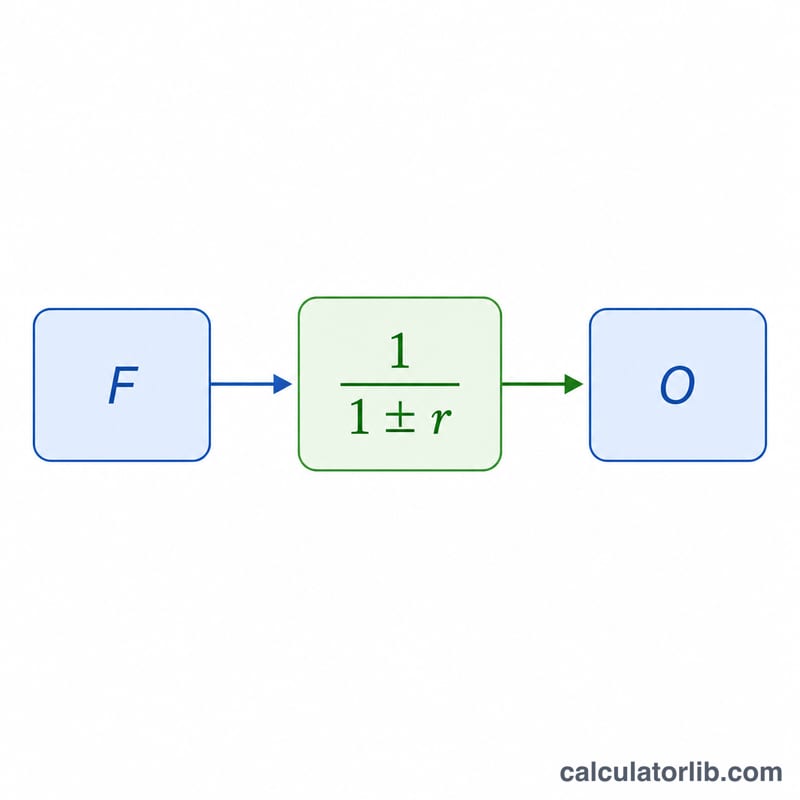
Worked example
Suppose a product now costs 120 after a 20% increase. With \(r = 0.20\), the original price is
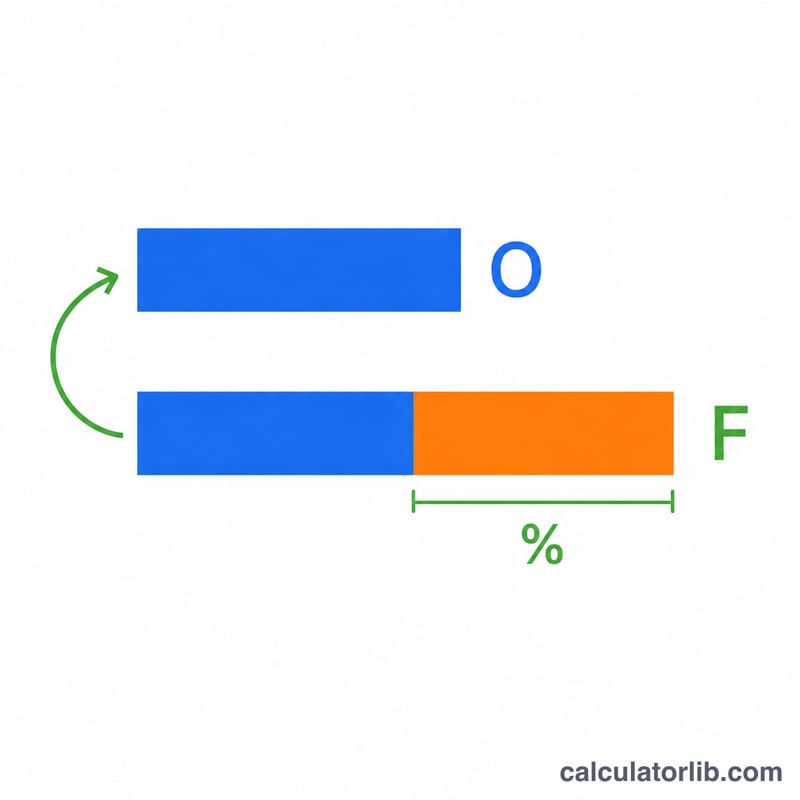
$$120 / (1 + 0.20) = 120 / 1.20 = 100$$The amount of increase was \(120 - 100 = 20\). Notice that taking 20% of the final 120 (which is 24) would be wrong, because the percentage was applied to the smaller original value.
FAQ
Why not just subtract the percent from the final value? Because the percentage was applied to the original, not the final, value. Subtracting it from the final value overstates the change.
Can the percent be 100% or more for a decrease? A decrease of 100% would divide by zero (the value vanished), so it is not solvable; keep decrease percentages below 100%.
Does it work with money and any units? Yes. The math is unit-agnostic, so it works for prices, salaries, populations, weights, or any quantity.