
What Is Percent Daily Value (%DV)?
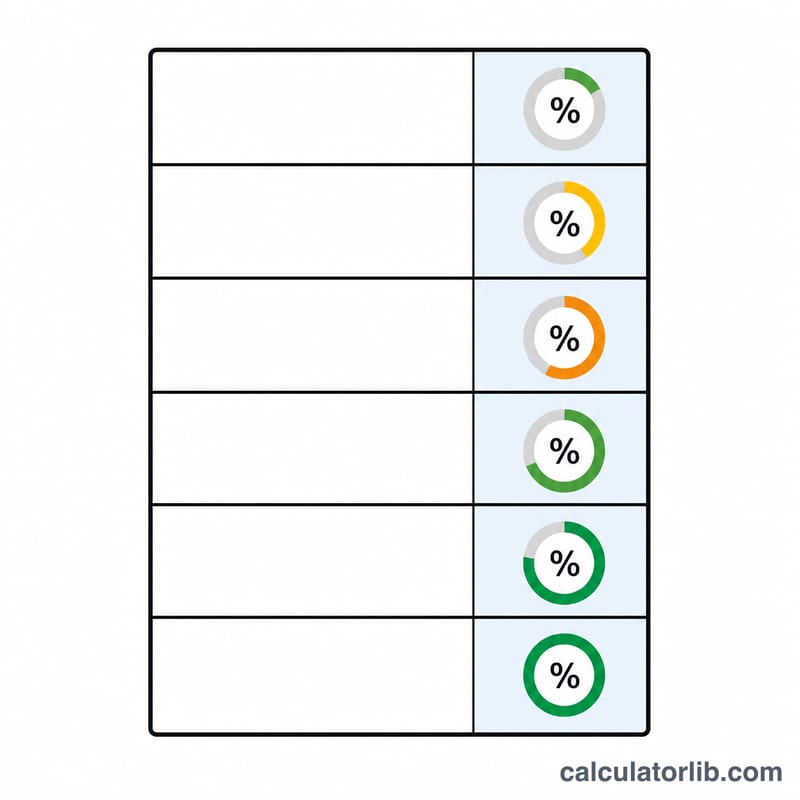
The Percent Daily Value (%DV) tells you how much a single serving of food contributes to your total recommended intake of a nutrient for the day. It appears on nutrition labels next to nutrients such as sodium, fiber, calcium, vitamin C, and added sugars. A %DV of 5% or less is generally considered low for a nutrient, while 20% or more is considered high. This calculator works with any reference value, so it is useful regardless of which country labeling standard you follow.
How to Use the Calculator
Enter the amount of the nutrient contained in one serving (for example, 300 mg of sodium) and the recommended daily value for that nutrient (for example, 2,300 mg). The calculator divides the two and multiplies by 100 to give you the %DV. Use the same unit for both fields (mg with mg, g with g) so the ratio is meaningful.
The Formula Explained
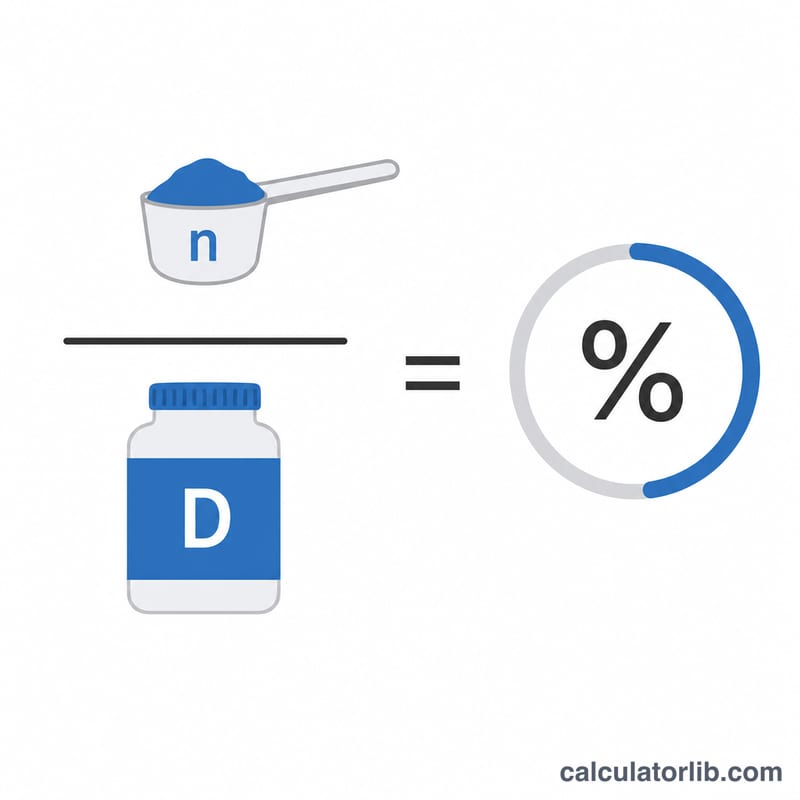
The math is a simple proportion: $$\%\text{DV} = \frac{\text{Nutrient Amount}}{\text{Daily Value}} \times 100\%$$ The numerator is what the serving provides, the denominator is the full-day target, and multiplying by 100 converts the fraction into a percentage.
Worked Example
Suppose a snack contains 300 mg of potassium and the recommended daily value is 1,000 mg. Then $$\%\text{DV} = \left(\frac{300}{1000}\right) \times 100 = 30\%$$ That single serving supplies 30% of your daily potassium target, which counts as a high amount.
FAQ
Are daily values the same everywhere? No. Reference daily intakes differ by country and by age or pregnancy status, so always use the value that applies to you.
What does a %DV above 100% mean? It means one serving provides more than a full day worth of that nutrient — fine for some vitamins, but worth watching for sodium, saturated fat, or added sugars.
Can I add up %DV across several foods? Yes. Adding the %DV of each food you eat estimates your total daily intake percentage for that nutrient.