
What this calculator does
This tool computes the exact probability of rolling a specific total when you throw several dice at once. It works for any number of fair dice (\(n\)) and any number of sides per die (\(s\)), not just the standard six-sided cube. Instead of estimating with simulations, it counts every possible ordered outcome exactly, so the answer is mathematically precise.
How to use it
Enter the number of dice, the number of sides on each die, and the target sum you want the dice to add up to. Press calculate to see the probability as a percentage and a decimal, the number of favorable outcomes, the total number of outcomes, and the odds expressed as "1 in N". The possible-sum range tells you the smallest and largest totals achievable.
The formula explained
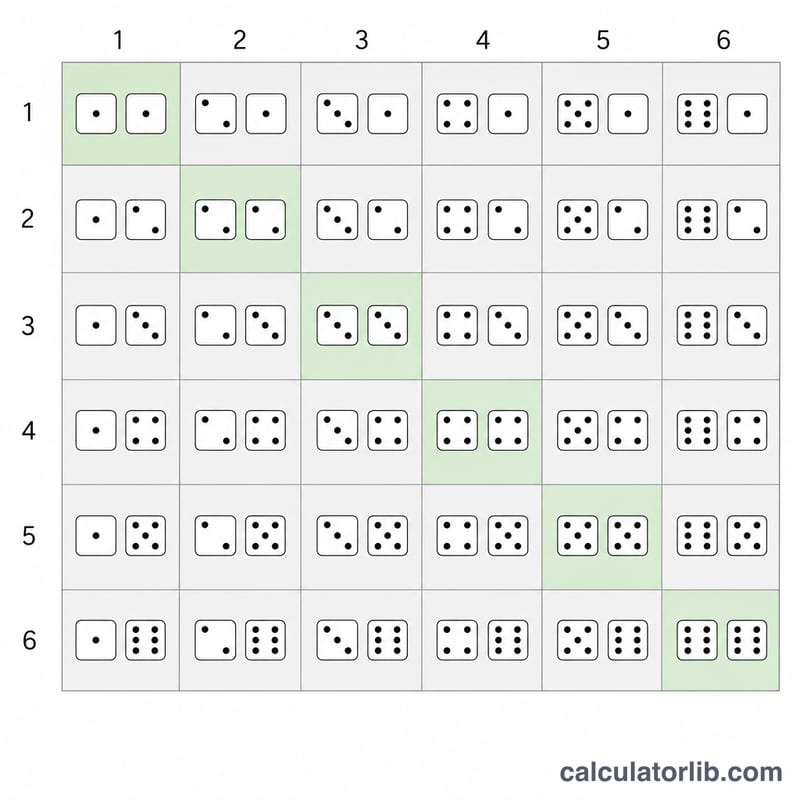
The probability is $$P = \frac{N(\text{sum})}{s^{n}}.$$ The denominator \(s^{n}\) is the total number of equally likely ordered outcomes (for two six-sided dice that is \(6^{2} = 36\)). The numerator \(N(\text{sum})\) is the number of those outcomes that add up to your target. We compute \(N(\text{sum})\) by convolution: the distribution of one die is repeatedly combined with itself once per extra die. This is the coefficient of \(x^{\text{sum}}\) in \(\left(x + x^{2} + \cdots + x^{s}\right)^{n}\).
Worked example
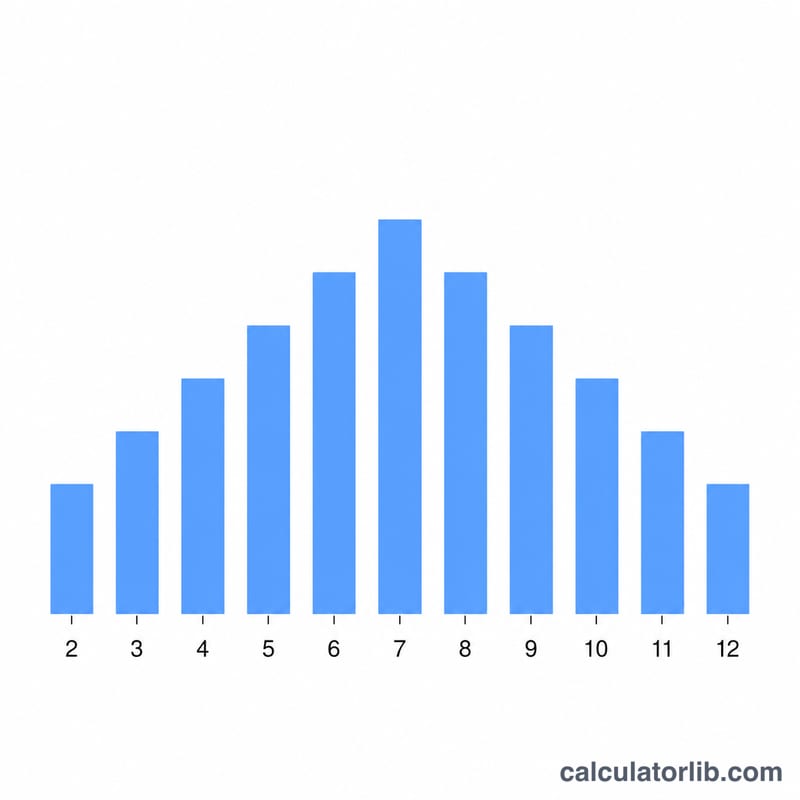
Roll two standard six-sided dice and ask for a sum of 7. The combinations are (1,6), (2,5), (3,4), (4,3), (5,2), (6,1) — that is 6 ways. Total outcomes are \(6^{2} = 36\). So $$P = \frac{6}{36} = 0.16667,$$ or about 16.67%, which is the most likely single total on two dice.
FAQ
Why count ordered outcomes? Each die is distinct, so (2,5) and (5,2) are separate equally likely outcomes. Counting them separately keeps every outcome equally probable, which is required for the formula.
Can I use non-standard dice? Yes. Set sides to 4, 8, 10, 20 or any value from 2 to 100 to model d4, d8, d10, d20 and more.
What if the target is impossible? If your target is below \(n\) (all ones) or above \(n\) times the sides (all max faces), the probability is simply 0.