
What Is Watt's Law?
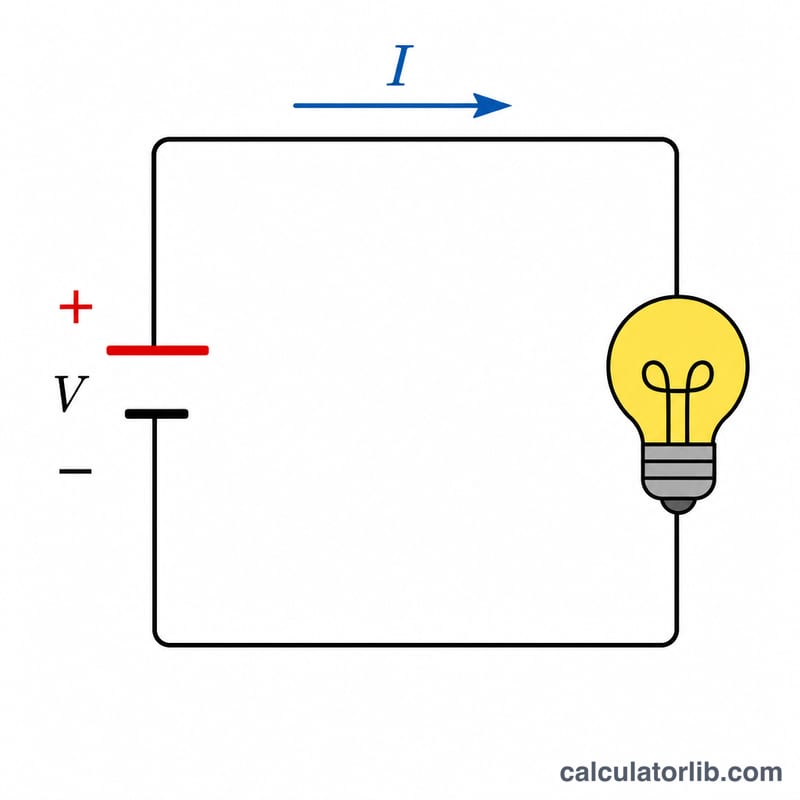
Watt's Law describes the relationship between power (P), voltage (V), and current (I) in an electrical circuit. The core equation is \(P = V \times I\), meaning power in watts equals voltage in volts multiplied by current in amperes. This Watt's Law calculator lets you enter any two of the three quantities and instantly solves for the missing one, making it a handy tool for electronics hobbyists, electricians, and students.
How to Use the Calculator
First choose what you want to solve for: Power, Voltage, or Current. Then enter the two known values. For example, to find power, enter the voltage and current and the calculator returns the wattage. The relevant fields are read automatically based on your selection, so you only need to supply the two values that apply to your problem.
The Formula Explained
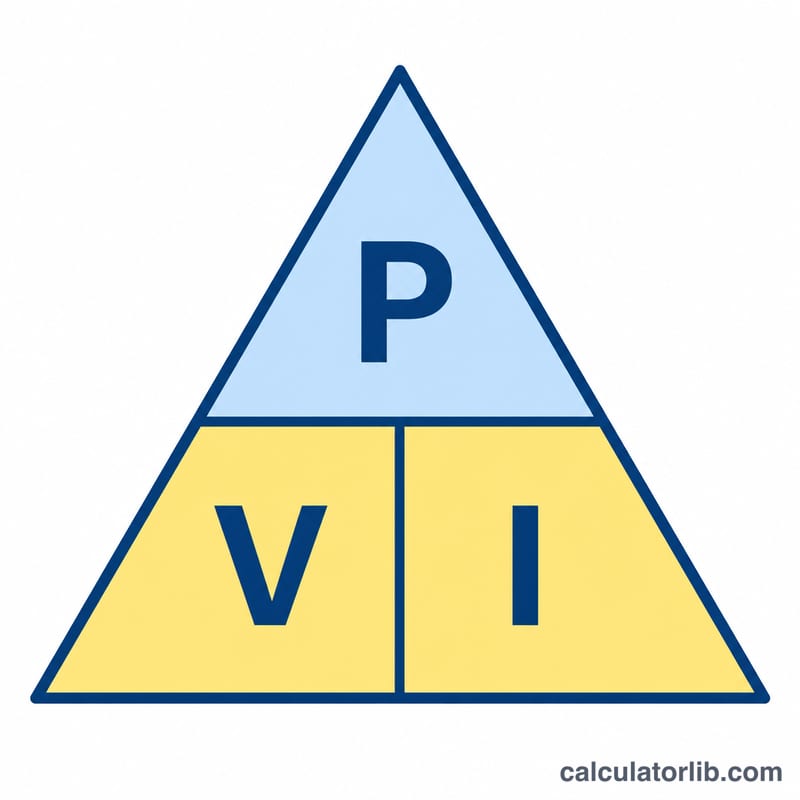
The three rearrangements of Watt's Law are:
$$P = V \times I$$(power from voltage and current)
$$V = \frac{P}{I}$$(voltage from power and current)
$$I = \frac{P}{V}$$(current from power and voltage)
These follow directly from the base relationship by simple algebra. Note that dividing requires a non-zero divisor — the calculator guards against division by zero.
Worked Example
Suppose a device runs on 12 volts and draws 2 amps. To find its power consumption, select "Power," enter 12 V and 2 A, and the calculator computes $$P = 12 \times 2 = 24 \text{ watts}.$$ If instead you knew the device used 24 watts at 12 volts, selecting "Current" gives $$I = \frac{24}{12} = 2 \text{ amps}.$$
FAQ
Is Watt's Law the same as Ohm's Law? No. Ohm's Law relates voltage, current, and resistance (\(V = I \times R\)), while Watt's Law relates power, voltage, and current. They are often used together.
What units does this use? Power in watts (W), voltage in volts (V), and current in amperes (A).
Can I find resistance with this? Not directly — this tool focuses on power. Use an Ohm's Law calculator for resistance.