
What This Calculator Does
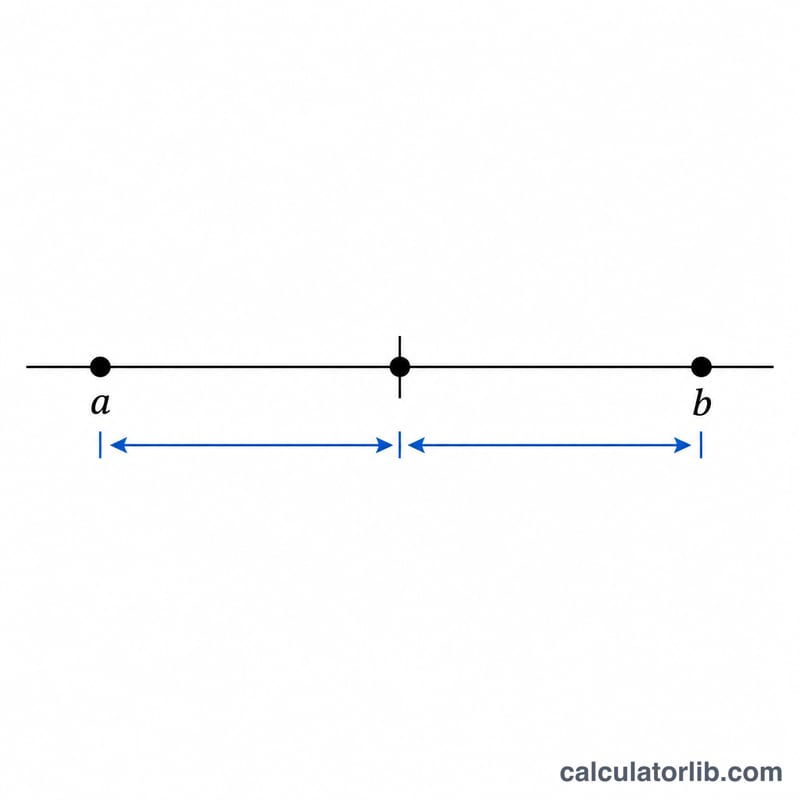
This tool finds the average of two numbers, which is the same as the midpoint of the range they span. Whether you are splitting the difference between two prices, finding the center of a data interval, or simply taking the mean of two test scores, the average gives you the single value that sits exactly halfway between your two inputs.
How to Use It
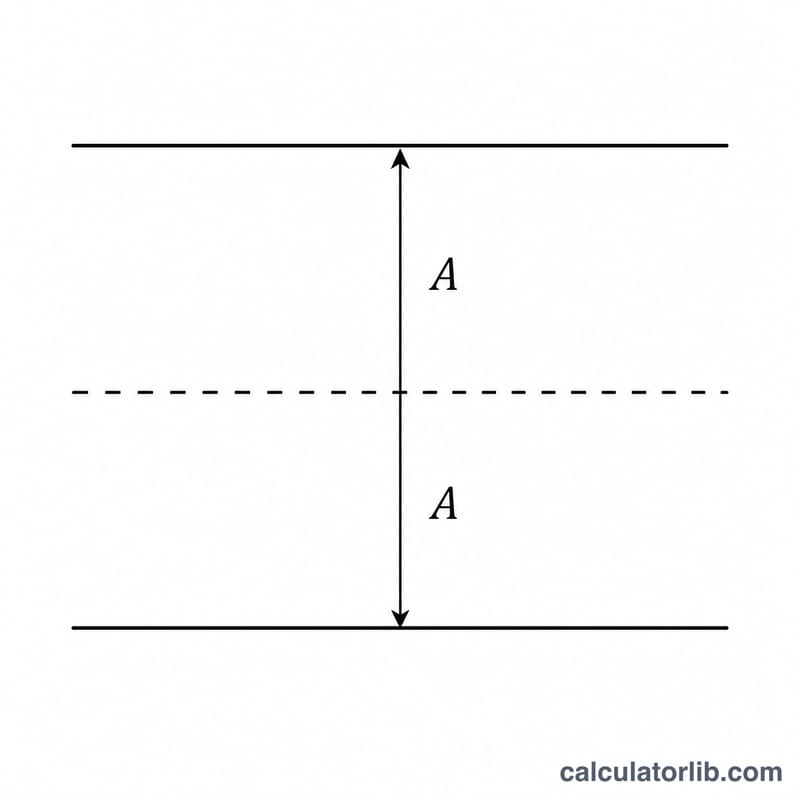
Enter your first number (a) and your second number (b), then read off the result. The calculator returns the average alongside the amplitude — half the distance between the two numbers — which tells you how far each value lies from the midpoint.
The Formula Explained
The average of two numbers is computed by adding them together and dividing by two:
$$\text{average} = \frac{a + b}{2}$$
The amplitude, or half-range, measures the spread:
$$\text{amplitude} = \frac{\left|\,a - b\,\right|}{2}$$
Together these describe a range as a center point plus a deviation: any value between a and b can be written as average ± amplitude.
Worked Example
Suppose a = 10 and b = 20. The average is $$\frac{10 + 20}{2} = \frac{30}{2} = \mathbf{15}.$$ The amplitude is $$\frac{\left|\,10 - 20\,\right|}{2} = \frac{10}{2} = \mathbf{5}.$$ So the range 10 to 20 is centered at 15 with a half-range of 5, meaning every point lies within \(15 \pm 5\).
FAQ
Is the average the same as the midpoint? For exactly two numbers, yes — the arithmetic mean and the geometric midpoint of the interval coincide.
Can I use negative numbers? Absolutely. For example, the average of -4 and 10 is 3, and the amplitude is 7.
What is amplitude used for? It expresses uncertainty or tolerance, such as \(15 \pm 5\), common in measurements, signal ranges, and statistics.