What Is the Percent of Goal Achieved?
The percent of goal achieved — also called quota attainment or goal completion rate — tells you how far along you are toward a target. It is one of the most common metrics in sales, fundraising, project tracking, and personal goal setting. A value of 100% means you hit your goal exactly; above 100% means you exceeded it, and below 100% means you still have work to do.
How to Use This Calculator
Enter two numbers: the Actual Achieved (what you have done so far, such as revenue booked or units sold) and the Target / Goal (the number you are aiming for). The calculator instantly shows your attainment percentage, the amount still remaining, and the percentage left to reach 100%.
The Formula Explained
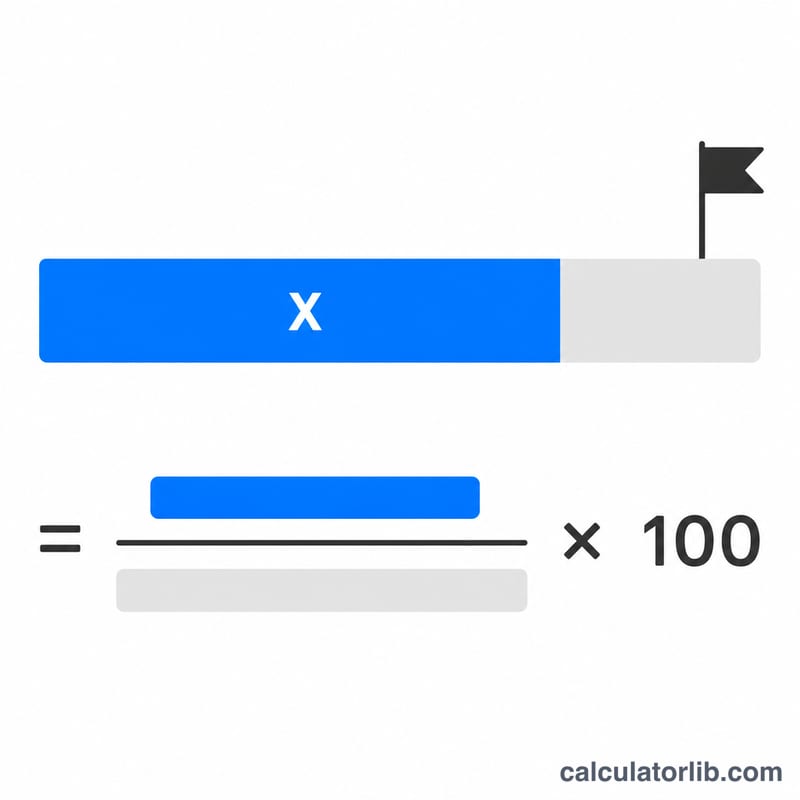
The math is a simple ratio scaled to a percentage:
$$\text{Attainment \%} = \frac{\text{Actual}}{\text{Target}} \times 100$$
If the target is zero the percentage is undefined, so the calculator returns 0 to avoid dividing by zero. The remaining amount is simply Target − Actual.
Worked Example
Suppose a sales rep has a quarterly quota of $100,000 and has closed $85,000 so far. $$\text{Attainment} = \frac{85{,}000}{100{,}000} \times 100 = \mathbf{85\%}$$ The remaining amount is \(100{,}000 - 85{,}000 = \$15{,}000\), which is 15% left to goal.
Interpreting Your Attainment Percentage
Percent of goal achieved (quota attainment) is the ratio of what you actually achieved to the target you were given, expressed as a percentage: \(\frac{\text{actual}}{\text{target}} \times 100\%\). The "% left to goal" is simply 100% minus attainment, and the amount remaining is target minus actual.
- Below 100%: the goal has not been reached yet. The remaining amount shows how much more is needed, and the % left shows the gap as a share of the target.
- Exactly 100%: the goal has been met precisely. The remaining amount is zero.
- Above 100%: the goal has been exceeded. The remaining amount becomes negative, which means a surplus over target (for example, 120% attainment means 20% above goal).
Keep in mind that attainment is only a ratio of actual to target. It says nothing about how difficult or realistic the target was, nor about when in the period the results came in. 90% of an ambitious target can be a stronger result than 110% of an easy one.
Many sales teams group results into bands, for example under 50%, 50-90%, 90-100%, and 100%+. These bands are internal conventions that vary from company to company, and they often tie into commission or accelerator rules, so check your own plan for the actual thresholds.
Finally, compare attainment with the time elapsed in the period. Being at 50% attainment is on pace halfway through the period, but behind pace at 75% of the way through. A simple pacing check is attainment % versus the % of the period that has passed.
Attainment Across Different Scenarios
The table below uses a target of $100,000 with different actual results. A negative remaining amount means a surplus over target.
| Target | Actual | Attainment % | Amount Remaining | % Left to Goal |
|---|---|---|---|---|
| $100,000 | $25,000 | 25% | $75,000 | 75% |
| $100,000 | $50,000 | 50% | $50,000 | 50% |
| $100,000 | $85,000 | 85% | $15,000 | 15% |
| $100,000 | $100,000 | 100% | $0 | 0% |
| $100,000 | $120,000 | 120% | -$20,000 (surplus) | -20% |
| $40,000 | $30,000 | 75% | $10,000 | 25% |
The last row uses a different target to show that the ratio scales: \(\frac{30000}{40000} \times 100\% = 75\%\). Attainment depends only on the proportion of actual to target, not on the size of the numbers.
FAQ
Can the result be over 100%? Yes. If you beat your goal, attainment exceeds 100% — for example, $120,000 against a $100,000 target is 120%.
What if my target is 0? Division by zero is undefined, so the calculator shows 0%. Set a positive target for a meaningful result.
Does this work for non-sales goals? Absolutely. It applies to any goal with a measurable target: steps walked, donations raised, tasks completed, or savings accumulated.