
What This Calculator Does
This calculator tells you how many people you need to survey to estimate a population proportion within a chosen margin of error at a given confidence level. It is widely used in market research, political polling, quality control, and academic surveys. The tool is jurisdiction-independent — it is pure statistics and applies anywhere.
How to Use It
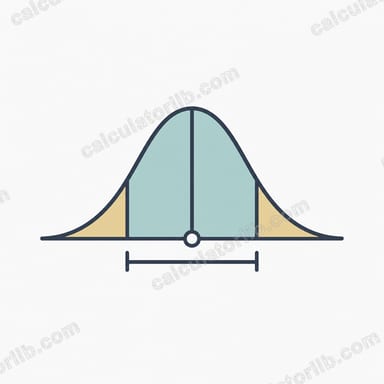
Pick your confidence level (90%, 95%, or 99%), enter the margin of error you can tolerate (for example 5%), and provide an estimated proportion. If you have no prior estimate, use 50% — this is the most conservative value and yields the largest, safest sample. Optionally enter your total population size to apply the finite population correction, which reduces the required sample when the population is small.
The Formula Explained
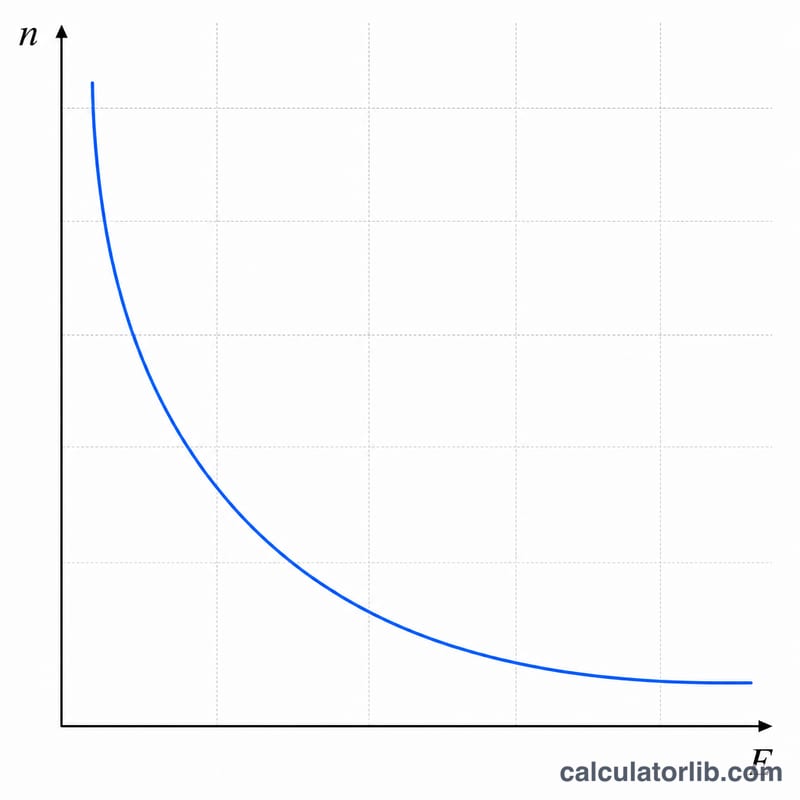
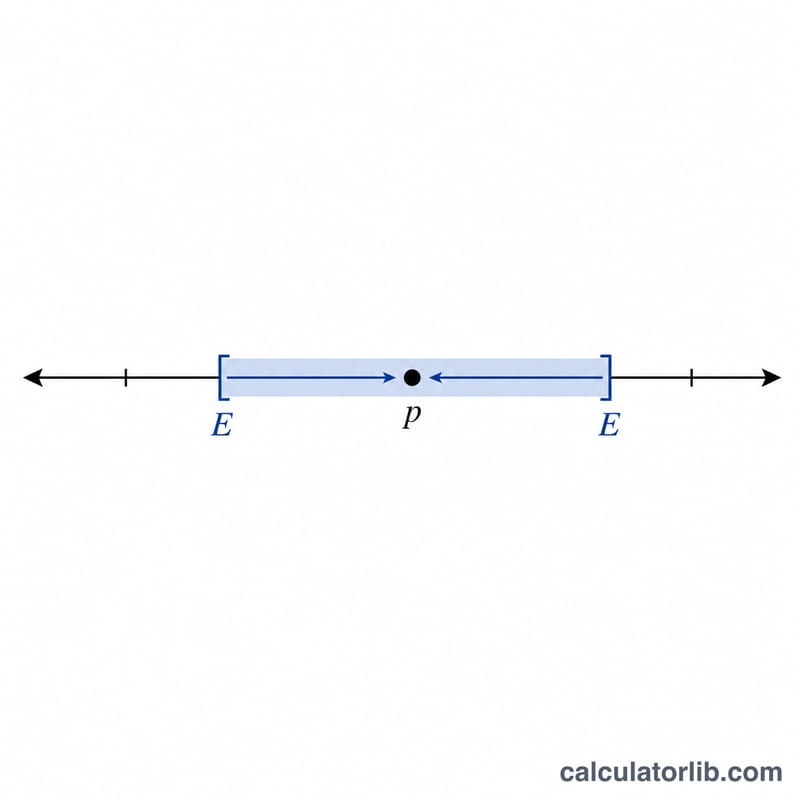
The core equation is $$n = \dfrac{z^2 \cdot p(1 - p)}{E^2}.$$ Here \(z\) is the standard normal critical value for your confidence level (1.645 for 90%, 1.96 for 95%, 2.576 for 99%), \(p\) is the expected proportion expressed as a decimal, and \(E\) is the margin of error as a decimal. The term \(p(1 - p)\) is largest at \(p = 0.5\), which is why 50% gives the maximum sample size. When a finite population \(N\) is supplied, the result is scaled down by the correction factor $$n = \dfrac{n_0}{1 + \dfrac{n_0 - 1}{N}}.$$
Worked Example
Suppose you want 95% confidence (\(z = 1.96\)), a 5% margin of error (\(E = 0.05\)), and you assume \(p = 0.5\). Then $$n = \dfrac{1.96^2 \times 0.5 \times 0.5}{0.05^2} = \dfrac{3.8416 \times 0.25}{0.0025} = \dfrac{0.9604}{0.0025} = 384.16,$$ which rounds up to 385 respondents.
FAQ
What proportion should I use if I have no estimate? Use 50% — it maximizes the required sample and guarantees your margin of error will be met.
Why round up? Sample size must be a whole number, and rounding up ensures the margin of error is not exceeded.
When does population size matter? The finite population correction only meaningfully reduces the sample when your population is small relative to \(n_0\) (e.g. a few thousand or fewer).