
What is the Head Loss per 100 ft Calculator?
This tool estimates friction head loss in a pipe using the Hazen-Williams equation, expressed in feet of water per 100 feet of pipe. It is widely used in fire-protection (NFPA 13), plumbing, and water-distribution design where water flows in full pressurized pipes at ordinary temperatures.
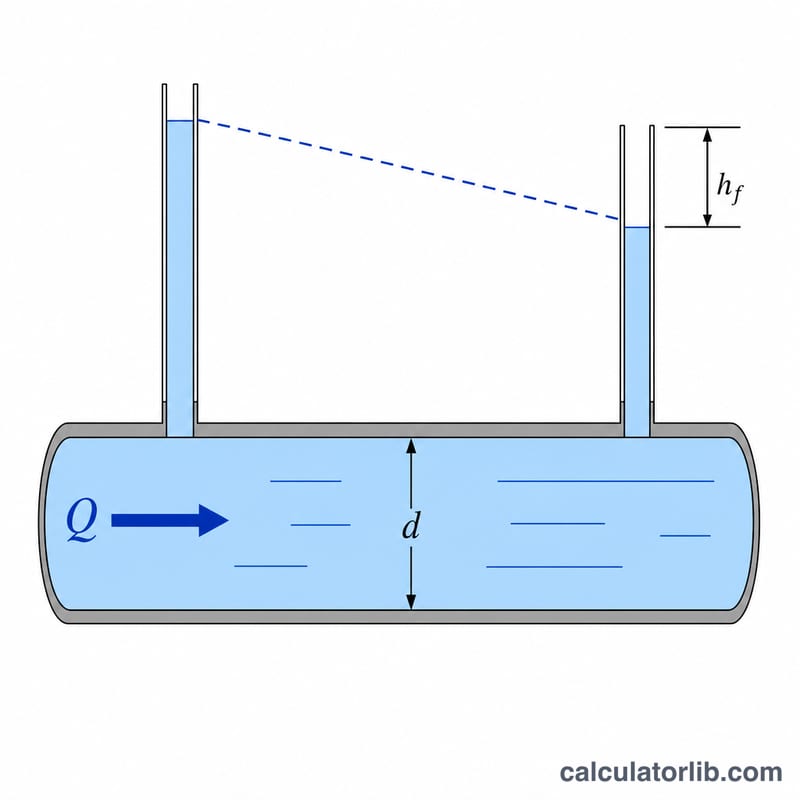
How to use it
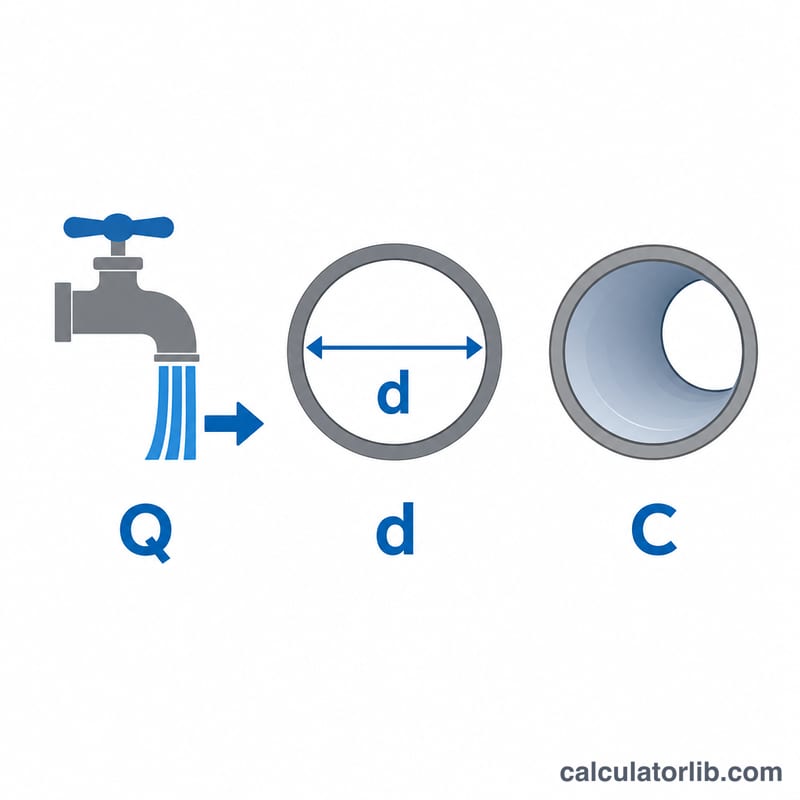
Enter the flow rate in US gallons per minute (gpm), the pipe inside diameter in inches, and the Hazen-Williams roughness coefficient C (about 150 for new plastic/PVC, 130 for cement-lined or new steel, 100 for older steel/iron). The result is the friction loss for every 100 feet of straight pipe. Multiply by the actual length divided by 100 to get total loss.
The formula explained
The US-unit Hazen-Williams form used here is $$h_f = 0.2083 \left(\frac{100}{\text{C}}\right)^{1.852} \frac{\text{Flow (gpm)}^{1.852}}{\text{Diameter (in)}^{4.8655}}$$ giving head loss in feet per 100 ft. Higher C (smoother pipe) lowers loss; loss rises sharply as diameter shrinks because of the \(d^{4.8655}\) term.
Worked example
For 50 gpm through a 2-inch pipe with C = 130: \((100/130)^{1.852} = 0.6149\), \(50^{1.852} = 1387.0\), \(2^{4.8655} = 29.16\). Then $$h_f = 0.2083 \times 0.6149 \times \frac{1387.0}{29.16} \approx 6.09 \text{ ft per 100 ft}$$ (values vary slightly with rounding).
FAQ
What C value should I use? Use the design value for your pipe material and age; conservative fire-protection work often uses C = 120 for steel.
Does temperature matter? Hazen-Williams assumes ordinary water near 60°F; it is not valid for hot fluids or non-water liquids.
Is this for full pipes only? Yes — the equation applies to pressurized, fully flowing pipe, not partially full gravity flow.