
What is the OD600 to Cell Density Calculator?
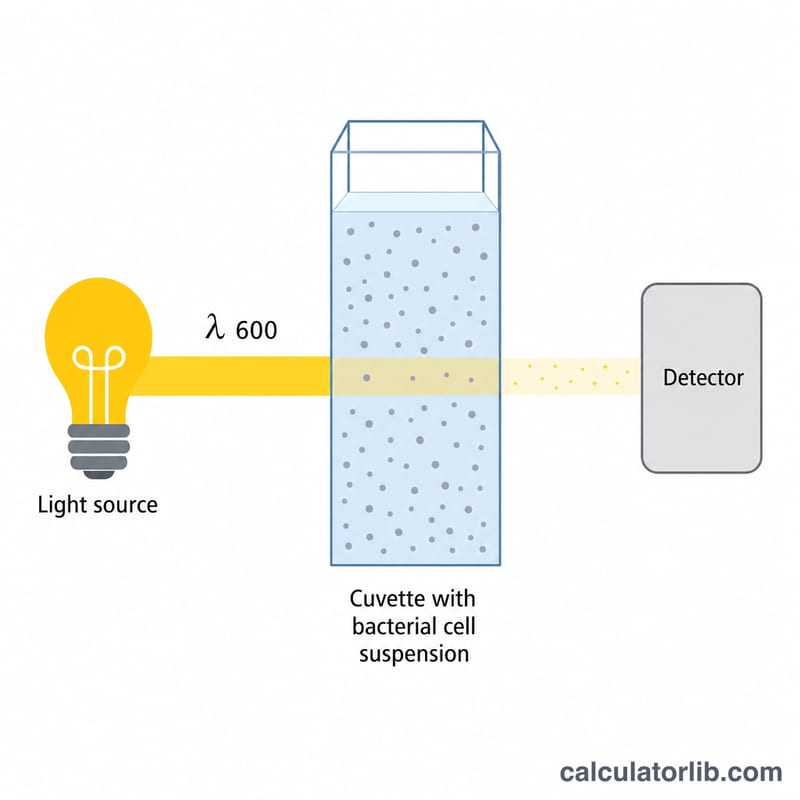
Optical density at 600 nm (OD600) is a fast, non-destructive way to estimate how many cells are in a liquid culture. Because a spectrophotometer measures light scattering rather than counting cells directly, you convert the OD600 reading to a cell density (cells per mL) using an empirically determined conversion factor. This calculator multiplies your OD600 by that factor and, optionally, by the culture volume to give the total cell count.
How to use it
Enter your OD600 reading, the conversion factor appropriate for your organism and instrument, and (optionally) the culture volume in mL. A widely cited rule of thumb for E. coli is that OD600 = 1.0 corresponds to roughly 8×10⁸ cells/mL, so the default factor is 800,000,000. Different species, strains, growth phases and spectrophotometers give different factors, so calibrate with a plate count or cell counter for accurate work.
The formula explained
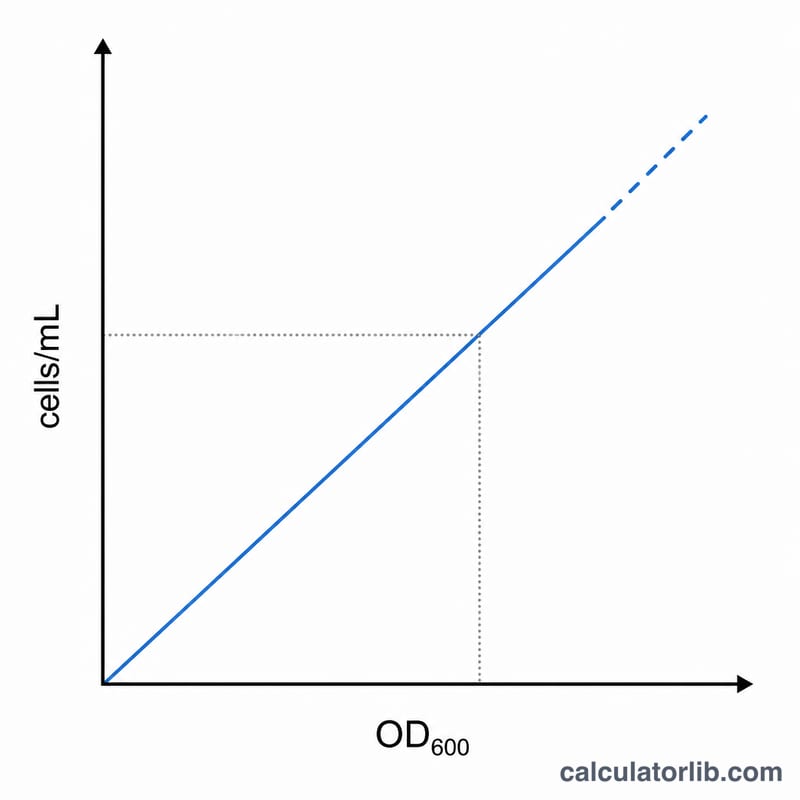
The core relationship is \(\text{Cells/mL} = \text{OD600} \times f\), where f is the conversion factor (cells per mL per unit of OD).
$$\text{Total Cells} = \text{Cells/mL} \times \text{Volume (mL)}$$The relationship is approximately linear only at low OD (typically below ~0.8); at higher densities, dilute the sample and multiply back to stay in the linear range.
Worked example
Suppose you read OD600 = 0.5 for an E. coli culture using f = 8×10⁸ cells/mL. Then cell density:
$$\text{Cells/mL} = 0.5 \times 800{,}000{,}000 = 400{,}000{,}000 \text{ cells/mL} \; (4\times10^8)$$For a 10 mL culture, total cells:
$$\text{Total Cells} = 400{,}000{,}000 \times 10 = 4{,}000{,}000{,}000 \text{ cells} \; (4\times10^9)$$FAQ
Why is the conversion factor different for my strain? Cell size, shape, clumping and instrument optics all affect scattering, so each lab should calibrate its own factor.
Can I use this for yeast or mammalian cells? Yes, but use a factor calibrated for those cells — yeast factors are much higher per OD unit than bacteria.
My OD600 is above 1 — is the result accurate? Probably not. Dilute the sample into the linear range (often OD < 0.8) and multiply the result by the dilution factor.