
What Is Percent Composition?
Percent composition (or mass percent) tells you what fraction of a compound mass comes from a particular element. It is a core concept in chemistry used to identify compounds, determine empirical formulas, and check the purity of substances. This calculator works for any element in any compound — it is universal and not specific to any country or standard.
How to Use This Calculator
Enter three values: the number of atoms of your chosen element in one formula unit (n), the atomic mass of that element in g/mol (from the periodic table), and the molar mass of the whole compound in g/mol. The calculator returns the percentage of the compound mass attributable to that element, along with the total mass that element contributes.
The Formula Explained
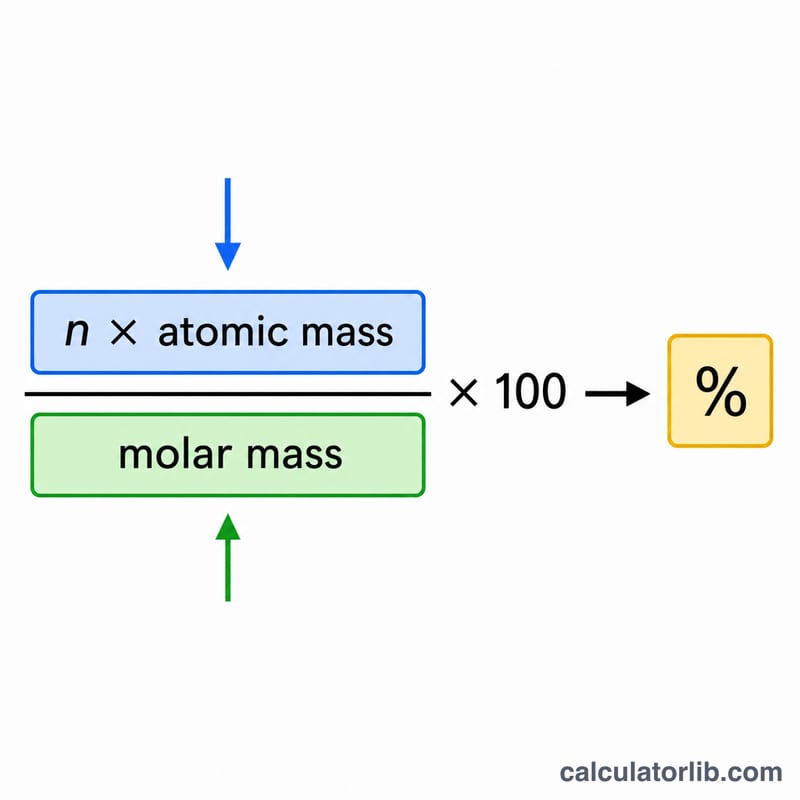
The equation is $$\text{\% element} = \frac{\text{n} \times \text{atomic mass}}{\text{molar mass}} \times 100$$ The numerator (\(\text{n} \times \text{atomic mass}\)) is the total mass that the element contributes per mole of compound. Dividing by the compound molar mass gives the mass fraction, and multiplying by 100 converts it to a percentage.
Worked Example
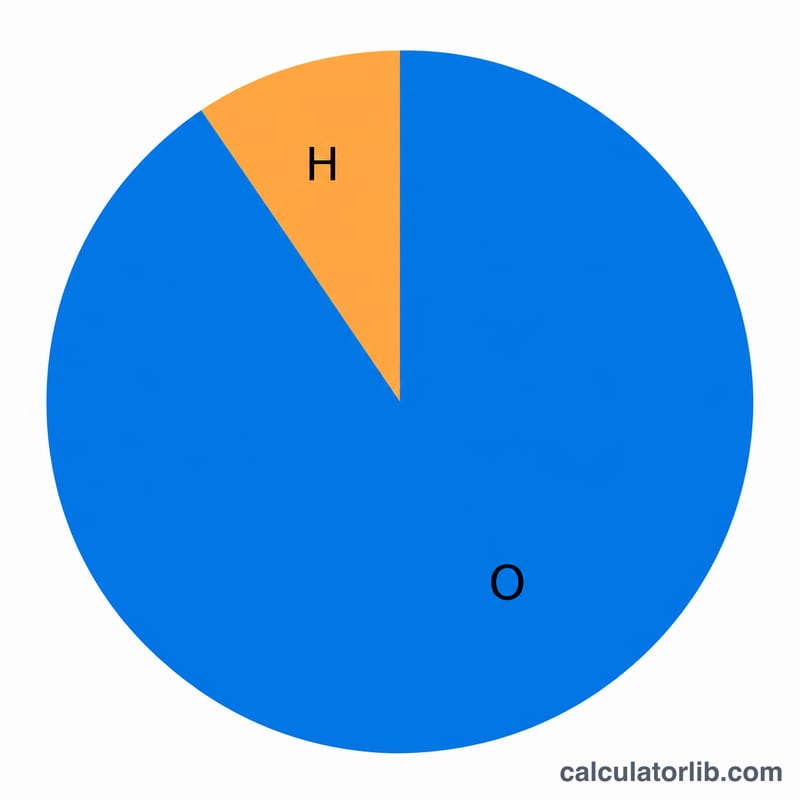
Find the percent of oxygen in water, H2O. Water has one oxygen atom (\(\text{n} = 1\)) with atomic mass 16.00 g/mol, and a molar mass of 18.015 g/mol. So $$\text{\% O} = \left(\frac{1 \times 16.00}{18.015}\right) \times 100 \approx 88.82\%$$ The remaining ~11.18% is hydrogen.
FAQ
Where do I get the molar mass? Add up the atomic masses of every atom in the formula. For H2O that is \(2(1.008) + 16.00 = 18.016\) g/mol.
Should all element percentages add to 100? Yes — if you compute the percent for every element in a compound, the values should sum to roughly 100% (small rounding differences are normal).
Can n be more than 1? Absolutely. For carbon in CO2, \(\text{n} = 1\); for oxygen in CO2, \(\text{n} = 2\).