What is the Solve for y Calculator?
This calculator rearranges a linear equation written in standard form, \(Ax + By = C\), so that y is by itself on one side. Given the coefficients A, B and C plus a chosen x value, it instantly returns the matching value of y. It also reports the slope and y-intercept so you can see the equation in slope-intercept form, \(y = mx + b\).
How to use it
Enter the coefficient of x (A), the coefficient of y (B), the constant (C), and the x value you want to evaluate. Press calculate and the tool isolates y using $$y = \frac{C - Ax}{B}$$ If B is zero the equation has no unique y and the result is left at zero, since you cannot divide by zero.
The formula explained
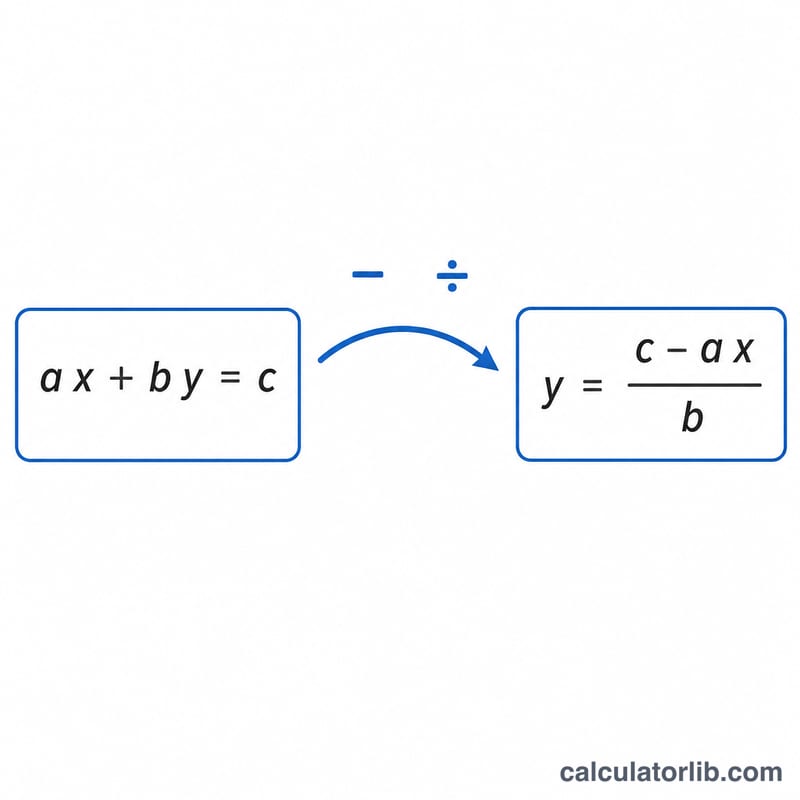
Starting from \(Ax + By = C\), subtract Ax from both sides to get \(By = C - Ax\). Then divide both sides by B to isolate y: $$y = \frac{C - Ax}{B}$$ Writing this as \(y = \left(-\frac{A}{B}\right)x + \frac{C}{B}\) reveals the slope \(m = -\frac{A}{B}\) and the y-intercept \(b = \frac{C}{B}\), which are useful for graphing the line.
Worked example
Suppose \(2x + 3y = 12\) and you want y when \(x = 3\). Substitute: $$y = \frac{12 - 2\cdot 3}{3} = \frac{12 - 6}{3} = \frac{6}{3} = 2$$ So \(y = 2\). The slope is \(-\frac{A}{B} = -\frac{2}{3} \approx -0.6667\) and the y-intercept is \(\frac{C}{B} = \frac{12}{3} = 4\).
Key Terms: Standard Form, Slope and Intercept
- Standard form: a linear equation written as \(Ax + By = C\), where A, B and C are constants and A and B are not both zero.
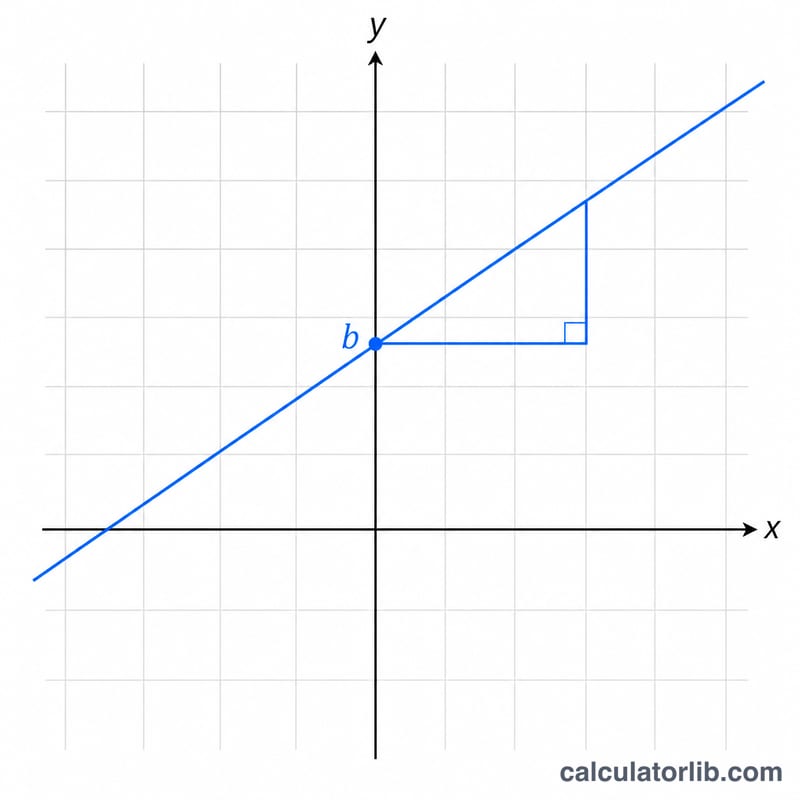
- Slope-intercept form: the same line written as \(y = mx + b\), where m is the slope and b is the y-intercept. Solving standard form for y gives \(m = -\frac{A}{B}\) and \(b = \frac{C}{B}\).
- Coefficient: a constant multiplying a variable. In \(Ax + By = C\), A is the coefficient of x and B is the coefficient of y.
- Slope: the change in y per one-unit increase in x (rise over run). Positive slopes rise to the right and negative slopes fall.
- Y-intercept: the point where the line crosses the y-axis, at x = 0. Its y-value is \(\frac{C}{B}\).
- Isolating a variable: using inverse operations on both sides of an equation, such as subtracting \(Ax\) and then dividing by B, until the variable stands alone on one side.
- Horizontal line: a line with \(A = 0\) and \(B \neq 0\). It has the form \(y = \frac{C}{B}\) and a slope of 0.
- Vertical line: a line with \(B = 0\) and \(A \neq 0\). It has the form \(x = \frac{C}{A}\) and an undefined slope. It is not a function of x, so y cannot be solved for uniquely.
FAQ
What if B is 0? Then the term By disappears and y cannot be solved uniquely — the equation only constrains x. The calculator returns 0 in that case.
Can A or C be negative? Yes. Enter negative values normally; the algebra works for any real coefficients.
Does this only work for one x? The y value is specific to the x you enter, but the reported slope and intercept describe the whole line.