
What this calculator does
This tool solves a one-variable linear inequality of the form \(a\cdot x + b \gtreqless c\), where \(\gtreqless\) is one of \(\le\), \(<\), \(\ge\), or \(>\). It returns the boundary value, the solved direction (for example \(x \le 4\)), and the answer written in interval notation so you can graph it on a number line.
How to use it
Enter the coefficient a, the constant b, choose the relation, and enter the right-hand value c. Press calculate. The result tells you whether the solution is a left ray, a right ray, all real numbers, or empty.
The formula explained
Start with \(a\cdot x + b \gtreqless c\). Subtract b from both sides to get \(a\cdot x \gtreqless c - b\). Then divide both sides by a. The single most important rule: if a is negative, you must reverse the inequality sign. So $$\text{a}\,x + \text{b} \;\le\; \text{c} \;\Longrightarrow\; x \le \dfrac{\text{c} - \text{b}}{\text{a}}$$ \(2x + 3 \le 11\) gives \(x \le 4\), while \(-2x \le 6\) gives \(x \ge -3\).
Worked example
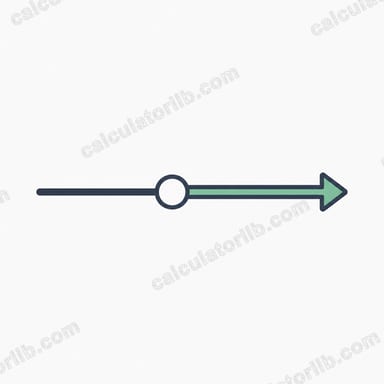
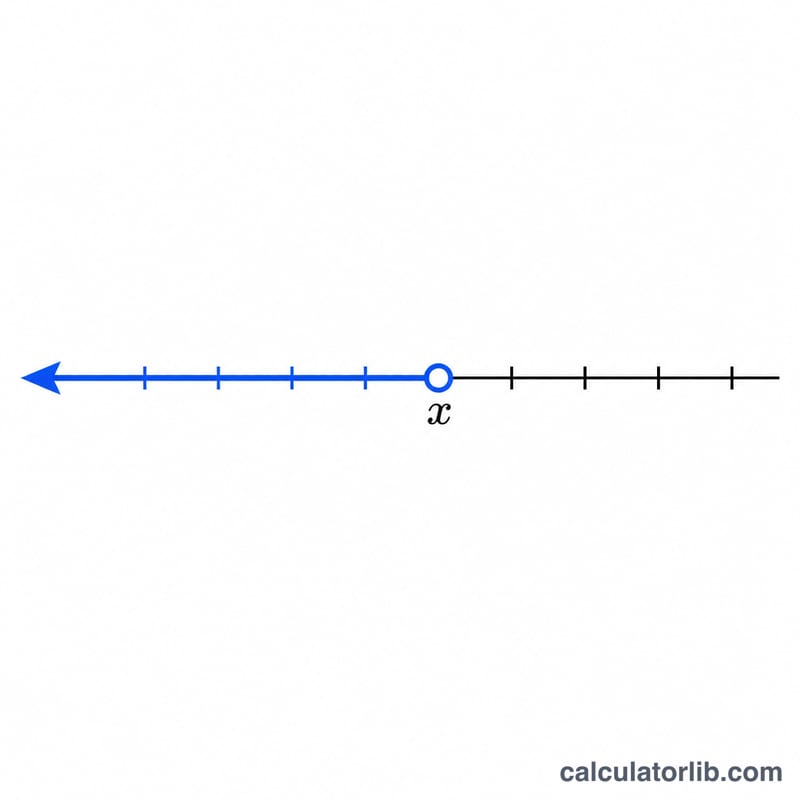
Solve \(2x + 3 \le 11\). Subtract 3: \(2x \le 8\). Divide by 2: \(x \le 4\). Because the relation is "less than or equal," the boundary 4 is included, so the interval is \((-\infty, 4]\). On a number line, draw a filled dot at 4 and shade to the left.
FAQ
When do I flip the sign? Only when you multiply or divide both sides by a negative number — here, whenever \(a < 0\).
What if a = 0? Then x disappears and the statement is either always true (all real numbers) or always false (no solution), depending on b and c.
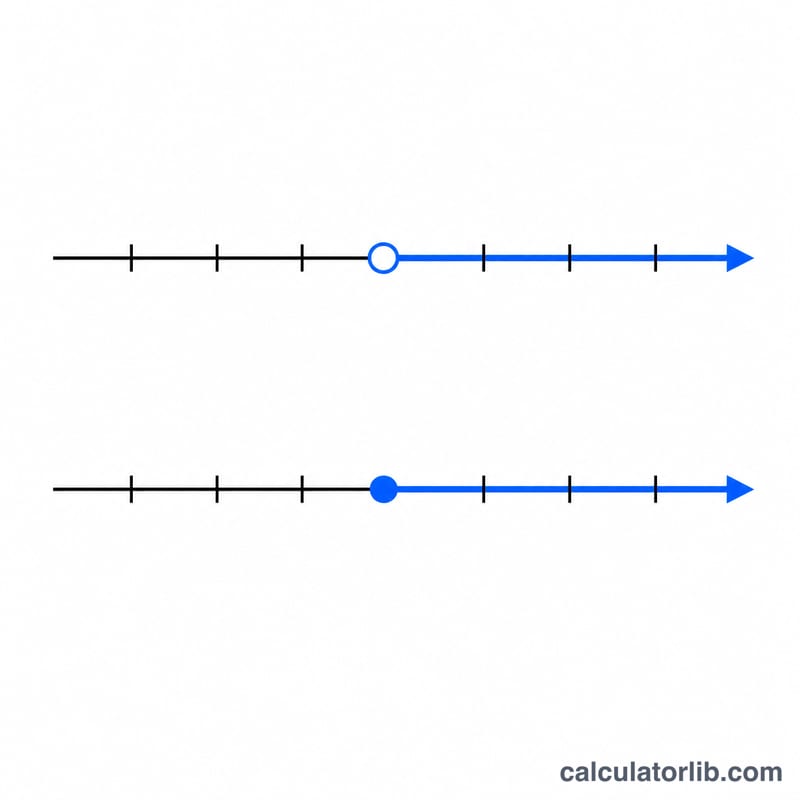
Open or closed bracket? Use a closed bracket [ ] for \(\le\) and \(\ge\), and an open bracket ( ) for \(<\) and \(>\). Infinity always gets an open parenthesis.