
What this calculator does
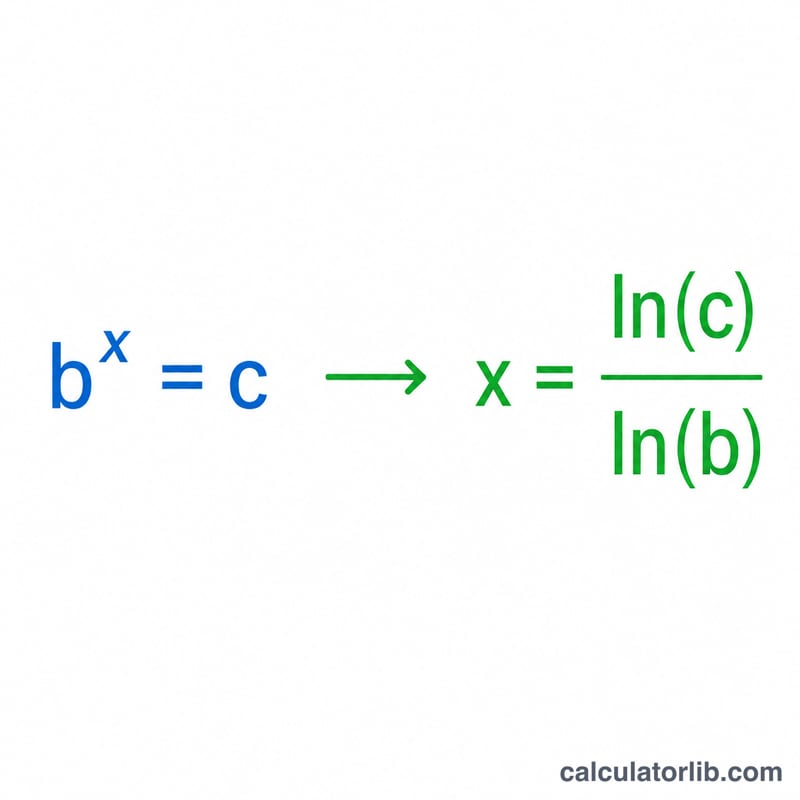
This tool solves the exponential equation \(b^x = c\) for the unknown exponent x. When the variable you are looking for sits in the exponent, you cannot isolate it with ordinary algebra — you take a logarithm of both sides. The result is the closed-form answer \(x = \ln(c) / \ln(b)\), valid for any positive base b (not equal to 1) and any positive c.
How to use it
Enter the base b (for example 2, 10, or e ≈ 2.71828) and the target value c. The calculator returns the exponent x and a verification row showing \(b^x\), which should reproduce your value of c. Both b and c must be positive because an exponential of a positive base is always positive, and b cannot equal 1 (the equation \(1^x = c\) has no single solution).
The formula explained
Start with \(b^x = c\). Apply the natural logarithm to both sides: \(\ln(b^x) = \ln(c)\). The power rule of logarithms pulls the exponent in front: \(x \cdot \ln(b) = \ln(c)\). Dividing both sides by \(\ln(b)\) gives $$x = \frac{\ln(c)}{\ln(b)}$$ You could use log base 10 or any other base and get the same number — the base cancels in the ratio (the change-of-base identity).
Worked example
Solve \(2^x = 8\). Then $$x = \frac{\ln(8)}{\ln(2)} = \frac{2.0794}{0.6931} = 3$$ Indeed \(2^3 = 8\). ✓ Another: \(10^x = 1000\) gives \(x = \ln(1000)/\ln(10) = 3\), since \(10^3 = 1000\).
FAQ
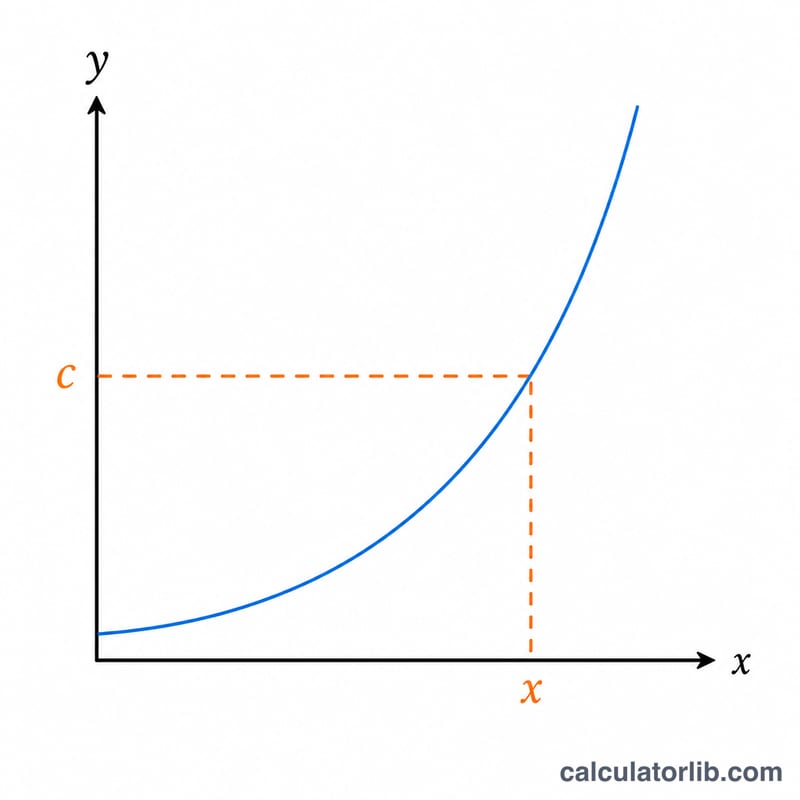
Can x be negative or a fraction? Yes. If c is between 0 and 1 (with b > 1), x is negative; non-integer answers are perfectly valid, e.g. \(2^x = 5\) gives \(x \approx 2.3219\).
Why must c be positive? \(b^x\) is always positive for a positive base, so there is no real x that makes it zero or negative.
What if the base is e? Then \(x = \ln(c)\) directly, since \(\ln(b) = \ln(e) = 1\).