

What This Calculator Does
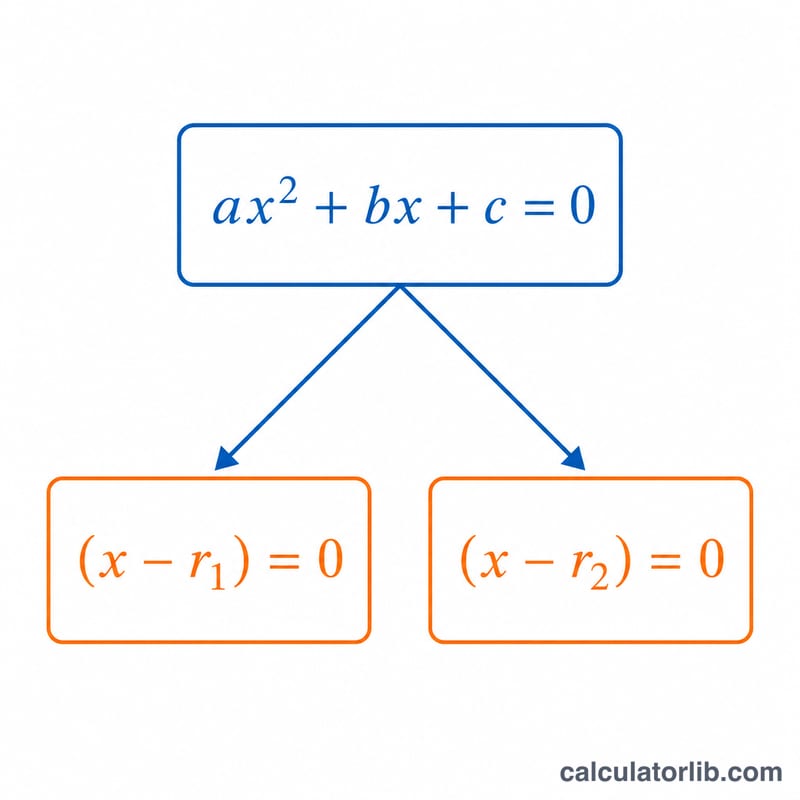
This tool solves any quadratic equation written in standard form, \(ax^{2} + bx + c = 0\), by finding the two values of x that make it true. When a quadratic factors over the integers, it can be written as \(a(x - r_{1})(x - r_{2}) = 0\), and each factor set to zero gives a root. The calculator finds those roots even when clean integer factors do not exist, using the equivalent quadratic formula.
How to Use It
Enter the three coefficients a, b, and c from your equation. For example, \(x^{2} - 5x + 6 = 0\) has a = 1, b = −5, c = 6. Press calculate to see both roots, the discriminant, and the nature of the solution. If a = 0 the equation is linear, not quadratic, and a single root is returned.
The Formula Explained
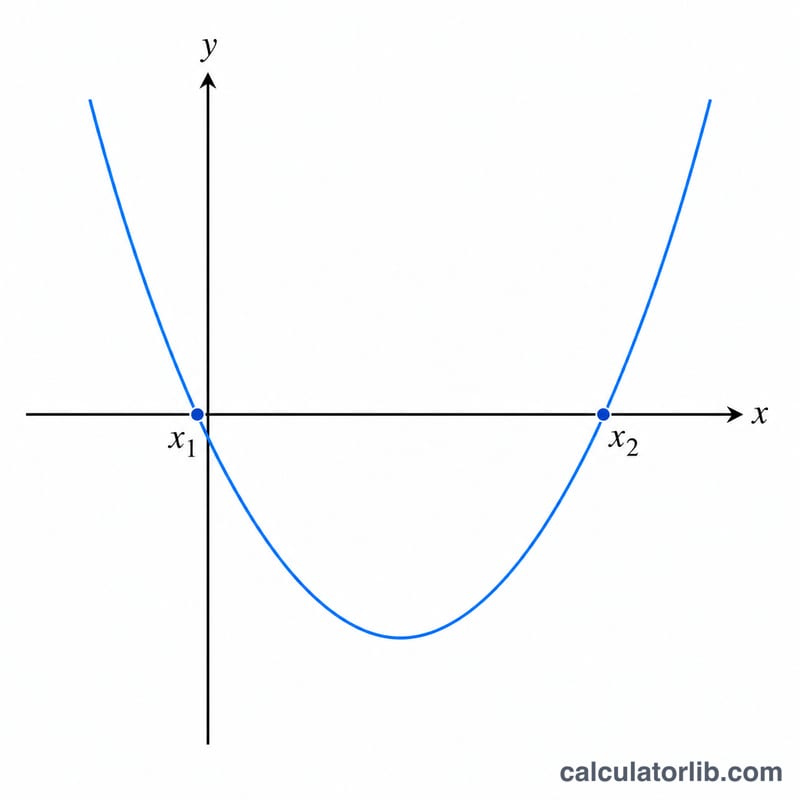
The roots come from $$x = \frac{-b \pm \sqrt{b^{2} - 4ac}}{2a}.$$ The expression under the square root, \(\Delta = b^{2} - 4ac\), is the discriminant. If \(\Delta > 0\) there are two distinct real roots; if \(\Delta = 0\) there is one repeated root; if \(\Delta < 0\) the roots are a complex conjugate pair.
Worked Example
For \(x^{2} - 5x + 6 = 0\): $$\Delta = (-5)^{2} - 4(1)(6) = 25 - 24 = 1.$$ Roots \(= \frac{5 \pm 1}{2} = 3\) and \(2\). This factors neatly as \((x - 3)(x - 2) = 0\), confirming the roots 3 and 2.
FAQ
What if my equation does not factor nicely? The calculator still returns exact decimal roots using the quadratic formula, which works even when integer factors do not exist.
What happens with a negative discriminant? The roots are complex; the tool reports them as a real part ± an imaginary part times i.
Can a be zero? If a = 0 the equation is linear (\(bx + c = 0\)), and the tool returns the single root \(-c/b\).