
What is the Solve for X Calculator?
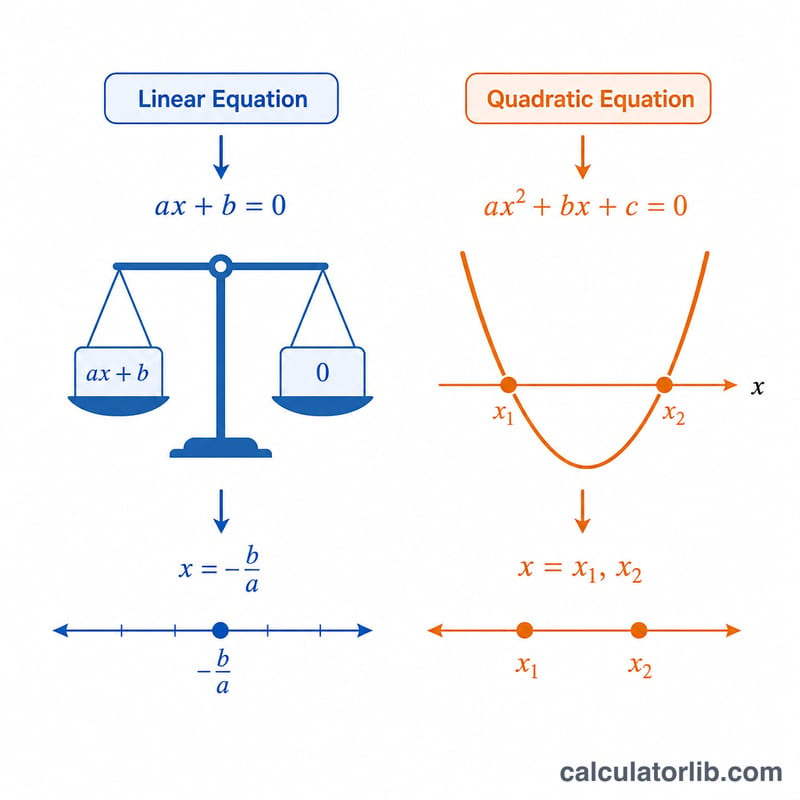
This tool finds the value (or values) of x in two of the most common algebra problems: a linear equation of the form \(ax + b = c\) and a quadratic equation of the form \(ax^{2} + bx + c = 0\). Choose the equation type, enter the coefficients a, b, and c, and the calculator returns the exact solution along with the discriminant and the number of real roots.
How to use it
Select Linear if your equation looks like \(ax + b = c\) (the unknown appears only to the first power). Select Quadratic if it contains an \(x^{2}\) term and is written so the right side equals zero. Then type the three coefficients. Decimals and negatives are allowed. Press calculate to see x.
The formulas explained
For a linear equation, subtract b from both sides and divide by a:
$$x = \frac{c - b}{a}$$This requires \(a \neq 0\), otherwise there is no single solution.
For a quadratic, the quadratic formula gives
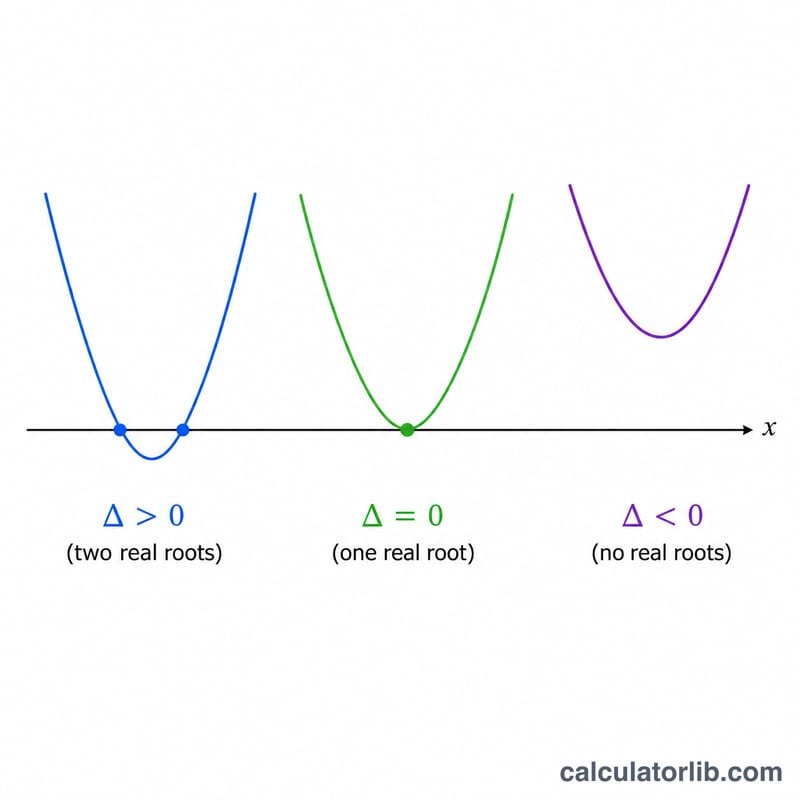
$$x = \frac{-b \pm \sqrt{b^{2} - 4ac}}{2a}$$The expression under the root, \(b^{2} - 4ac\), is the discriminant. When it is positive there are two real roots, when it equals zero there is one repeated root, and when it is negative there are no real roots.
Worked example
Solve \(2x^{2} + 3x - 5 = 0\). Here \(a = 2\), \(b = 3\), \(c = -5\). The discriminant is
$$3^{2} - 4\cdot 2\cdot(-5) = 9 + 40 = 49, \quad \sqrt{49} = 7.$$So
$$x = \frac{-3 + 7}{4} = 1 \quad\text{and}\quad x = \frac{-3 - 7}{4} = -2.5.$$The two solutions are \(x = 1\) and \(x = -2.5\).
FAQ
What if I enter a = 0 for a quadratic? The equation is no longer quadratic; the calculator falls back to solving the resulting linear equation \(bx + c = 0\) when possible.
Why does it say no real solution? For a quadratic, that means the discriminant is negative, so the roots are complex. For a linear equation it means \(a = 0\), which has no unique solution.
Does it handle decimals and negatives? Yes — enter any real numbers for a, b, and c.