
What Is the Transmittance to Absorbance Calculator?
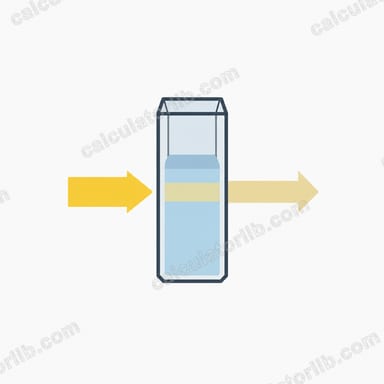
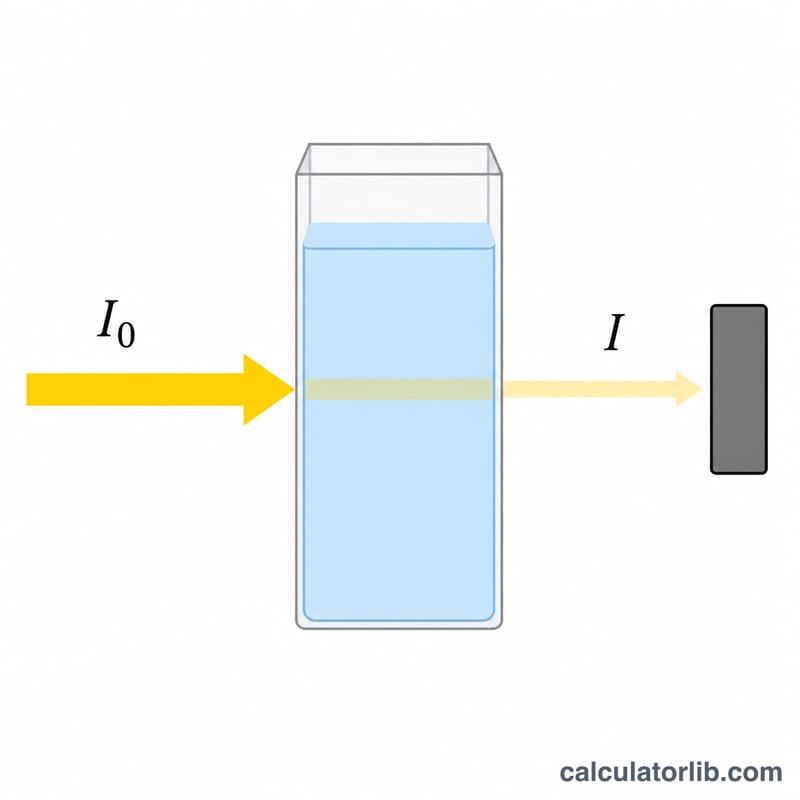
This calculator converts percent transmittance (%T) — the fraction of light that passes through a sample — into absorbance (A), a logarithmic measure of how much light a sample absorbs. Both quantities come from spectrophotometry and are central to UV-Vis analysis, the Beer-Lambert law, and many quantitative chemistry and biology assays. While transmittance is what a detector physically measures, absorbance is usually preferred for calculations because it is linearly proportional to concentration.
How to Use It
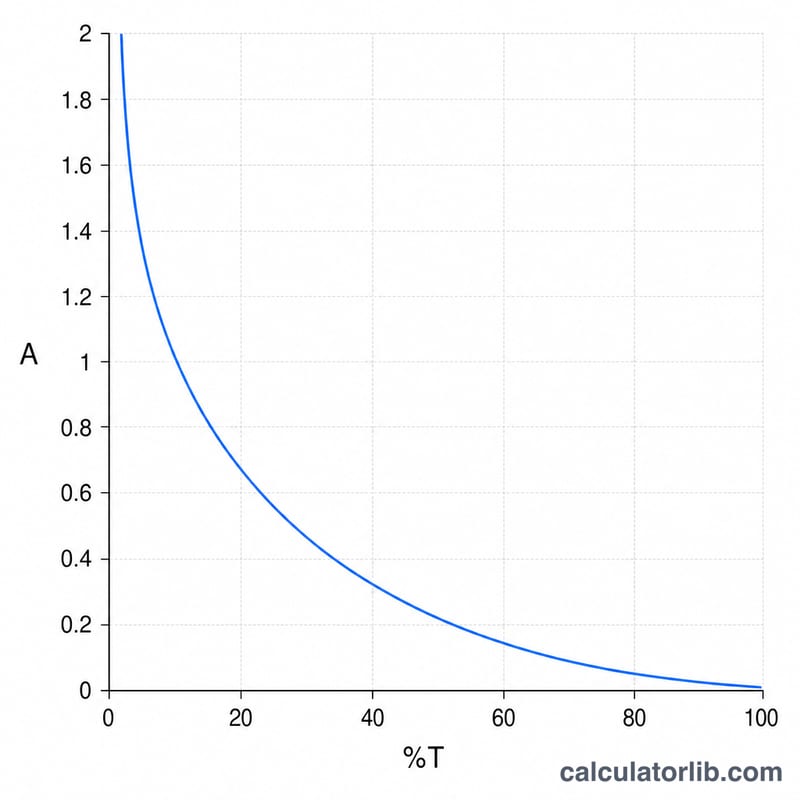
Enter the percent transmittance reading from your spectrophotometer (a value between 0 and 100). The calculator divides it by 100 to get the transmittance fraction and then applies the negative base-10 logarithm to return absorbance in absorbance units (AU). A value of 100%T gives an absorbance of 0, while smaller transmittance values yield higher absorbance.
The Formula Explained
The conversion uses $$A = -\log_{10}\left(\frac{\text{Transmittance (\%T)}}{100}\right)$$ The term \(\%T/100\) converts the percentage to a fraction between 0 and 1. Taking the base-10 logarithm of a fraction yields a negative number, so the leading minus sign makes absorbance positive. Because the relationship is logarithmic, each tenfold drop in transmittance adds 1 to the absorbance: \(10\%T = 1.0\ A\), \(1\%T = 2.0\ A\), and \(0.1\%T = 3.0\ A\).
Worked Example
Suppose a sample transmits 25% of the incident light. First convert to a fraction: \(25 / 100 = 0.25\). Then take the negative logarithm: $$A = -\log_{10}(0.25) = -(-0.60206) = 0.60206$$ So 25%T corresponds to an absorbance of about 0.602 AU.
FAQ
What does 100%T mean? It means all light passes through with no absorption, giving an absorbance of exactly 0.
Why use absorbance instead of transmittance? Absorbance is directly proportional to concentration through the Beer-Lambert law, making linear calibration curves possible.
Can transmittance be 0%? A true 0%T would give infinite absorbance, which is not physically meaningful. Use a small positive value instead.