
What is the mg to mmol Calculator?
This calculator converts a mass given in milligrams (mg) into an amount of substance in millimoles (mmol). It is widely used in chemistry, pharmacology, and clinical laboratory work where concentrations and doses are often reported in both mass and molar units.
How to use it
Enter the mass of your substance in milligrams and its molar mass in grams per mole (g/mol). The molar mass is the sum of the atomic masses of all atoms in the molecule — for example, glucose (C6H12O6) has a molar mass of about 180.16 g/mol. Click calculate to get the result in millimoles.
The formula explained
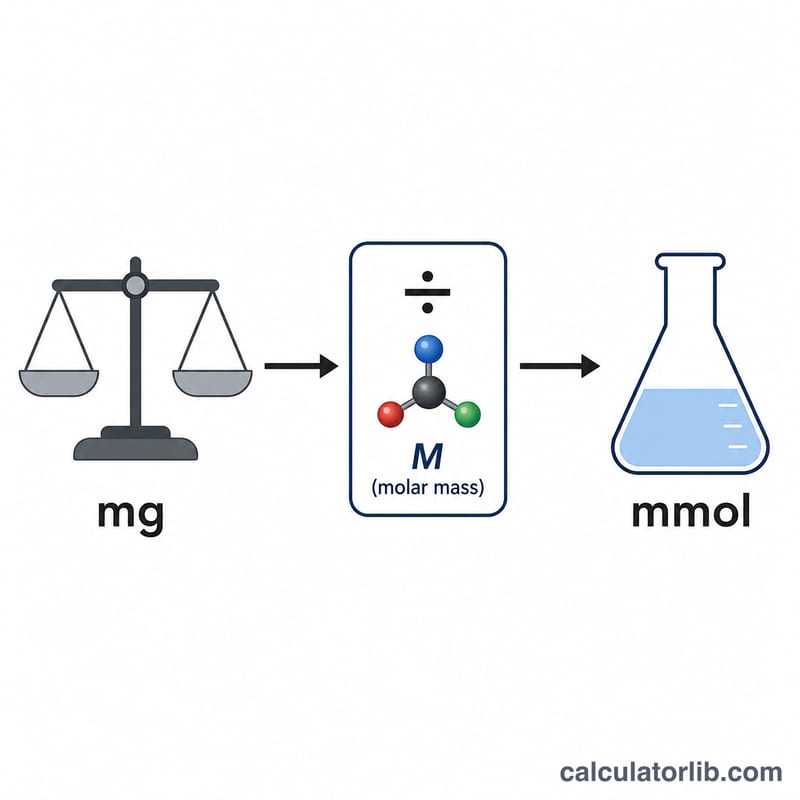
The conversion uses the relationship $$\text{mmol} = \frac{\text{Mass (mg)}}{\text{Molar mass (g/mol)}}$$ Because milligrams are one-thousandth of a gram and millimoles are one-thousandth of a mole, the factors of 1000 cancel out. This means you can divide milligrams directly by the molar mass expressed in g/mol to get millimoles, with no extra unit scaling required.
Worked example
Suppose you have 180 mg of glucose, which has a molar mass of 180.16 g/mol. Dividing: $$180 / 180.16 = 0.99911 \text{ mmol}.$$ So 180 mg of glucose is approximately 0.999 mmol.
FAQ
Why does mg/(g/mol) give mmol? Dividing grams by g/mol gives moles. Since \(1 \text{ mg} = 0.001 \text{ g}\) and \(1 \text{ mmol} = 0.001 \text{ mol}\), the thousandths cancel, so mg divided by g/mol gives mmol directly.
Where do I find the molar mass? It is printed on chemical reference sheets, datasheets, or can be calculated from the molecular formula using atomic weights from the periodic table.
Can I convert back from mmol to mg? Yes — multiply the millimoles by the molar mass: \(\text{mg} = \text{mmol} \times \text{molar mass}\).