

What Is the Binomial Expansion Term Calculator?
This calculator finds a single specific term in the binomial expansion of \((a + b)^n\) without expanding the whole expression. Whether you need the 5th term, the constant term, or the coefficient of a particular power, the general-term formula gives it directly. This is a universal mathematics tool — it applies anywhere, with no country-specific rules.
How to Use It
Enter the first base value a, the second base value b, the exponent n, and the term position k (1 for the first term, 2 for the second, and so on). The calculator returns the binomial coefficient \(C(n, r)\), the value of the term, and the underlying exponents. Note that the kth term uses \(r = k - 1\).
The Formula Explained
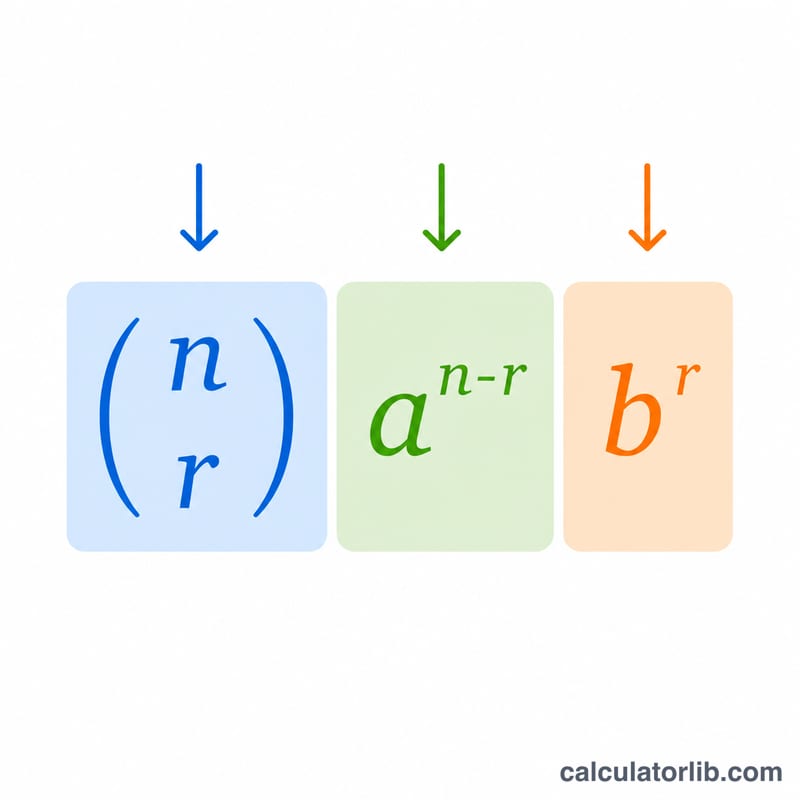
The general term in the expansion of \((a + b)^n\) is:
$$T_{r+1} = \binom{n}{r} \cdot a^{\,n-r} \cdot b^{\,r}$$
Here \(C(n, r) = \dfrac{n!}{r!\,(n-r)!}\) is the binomial coefficient. The kth term corresponds to \(r = k - 1\), so the first term has \(r = 0\) and the last term has \(r = n\). The exponents always sum to \(n\): \((n - r) + r = n\).
Worked Example
Find the 3rd term of \((2 + 3)^4\). Here \(a = 2\), \(b = 3\), \(n = 4\), \(k = 3\), so \(r = 2\). The coefficient is \(C(4, 2) = 6\). The term is $$6 \cdot 2^{\,4-2} \cdot 3^2 = 6 \cdot 4 \cdot 9 = 216.$$
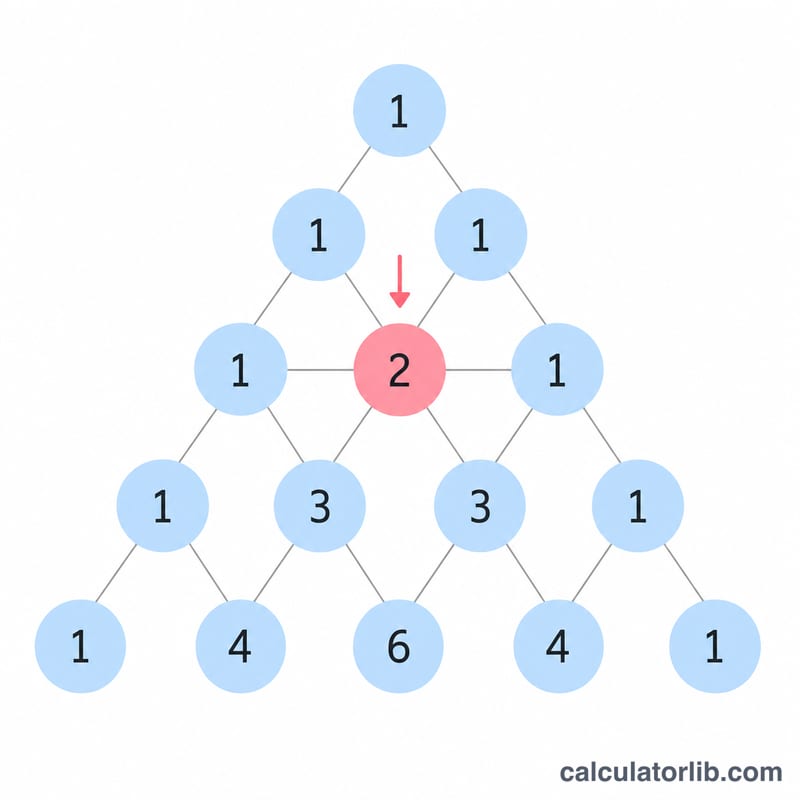
Pascal's Triangle / Binomial Coefficient Table
The entries below are the binomial coefficients \(\binom{n}{r}\). To find the \(k\)th term of an expansion, read along row \(n\) and take the value in column \(r=k-1\) (columns are numbered starting at 0). For example, the 4th term of \((a+b)^6\) uses \(r=3\), giving \(\binom{6}{3}=20\).
| n | r=0 | r=1 | r=2 | r=3 | r=4 | r=5 | r=6 | r=7 | r=8 | r=9 | r=10 |
|---|---|---|---|---|---|---|---|---|---|---|---|
| 0 | 1 | ||||||||||
| 1 | 1 | 1 | |||||||||
| 2 | 1 | 2 | 1 | ||||||||
| 3 | 1 | 3 | 3 | 1 | |||||||
| 4 | 1 | 4 | 6 | 4 | 1 | ||||||
| 5 | 1 | 5 | 10 | 10 | 5 | 1 | |||||
| 6 | 1 | 6 | 15 | 20 | 15 | 6 | 1 | ||||
| 7 | 1 | 7 | 21 | 35 | 35 | 21 | 7 | 1 | |||
| 8 | 1 | 8 | 28 | 56 | 70 | 56 | 28 | 8 | 1 | ||
| 9 | 1 | 9 | 36 | 84 | 126 | 126 | 84 | 36 | 9 | 1 | |
| 10 | 1 | 10 | 45 | 120 | 210 | 252 | 210 | 120 | 45 | 10 | 1 |
Each entry equals the sum of the two entries above it, and each row is symmetric: \(\binom{n}{r}=\binom{n}{n-r}\).
Definitions & Glossary
- \(a\) — first term (base)
- The leading expression inside the binomial \((a+b)^n\). In each term it is raised to the power \(n-r\).
- \(b\) — second term (base)
- The trailing expression inside the binomial. In each term it is raised to the power \(r\). It may be negative or a reciprocal (e.g. \(1/x\)); its sign and form carry through to the term value.
- \(n\) — exponent (degree)
- The power to which the binomial is raised. The full expansion has \(n+1\) terms, and the exponents on \(a\) and \(b\) in each term always sum to \(n\).
- \(k\) — term number
- The position of the term you want, counted from 1 (the first term, \(a^n\), is \(k=1\)). Valid values run from \(1\) to \(n+1\).
- \(r\) — coefficient index
- The zero-based index used in the binomial coefficient and powers, defined by \(r=k-1\). It is also the power on \(b\).
- \(T_{r+1}\) — general term
- The formula for the \((r+1)\)th term of the expansion: \(T_{r+1}=\binom{n}{r}\,a^{\,n-r}\,b^{\,r}\). Setting \(r=k-1\) gives the \(k\)th term.
- \(\binom{n}{r}\) — binomial coefficient
- Read "\(n\) choose \(r\)", it counts the ways to choose \(r\) items from \(n\) and is computed as \(\binom{n}{r}=\dfrac{n!}{r!\,(n-r)!}\). It is the numerical coefficient (before any sign from \(a\) or \(b\)) of the term.
FAQ
What does k mean? \(k\) is the term number counting from 1. The kth term uses \(r = k - 1\) in the formula.
How do I find the constant term? For expressions like \((x + 1/x)^n\), set the net power of \(x\) to zero and solve for \(r\), then use that \(r\) (\(k = r + 1\)) here.
Can a and b be negative or fractional? Yes — the calculator evaluates \(a^{\,n-r} \cdot b^{\,r}\) numerically, so negatives and decimals work.