
What Is the Common Difference?
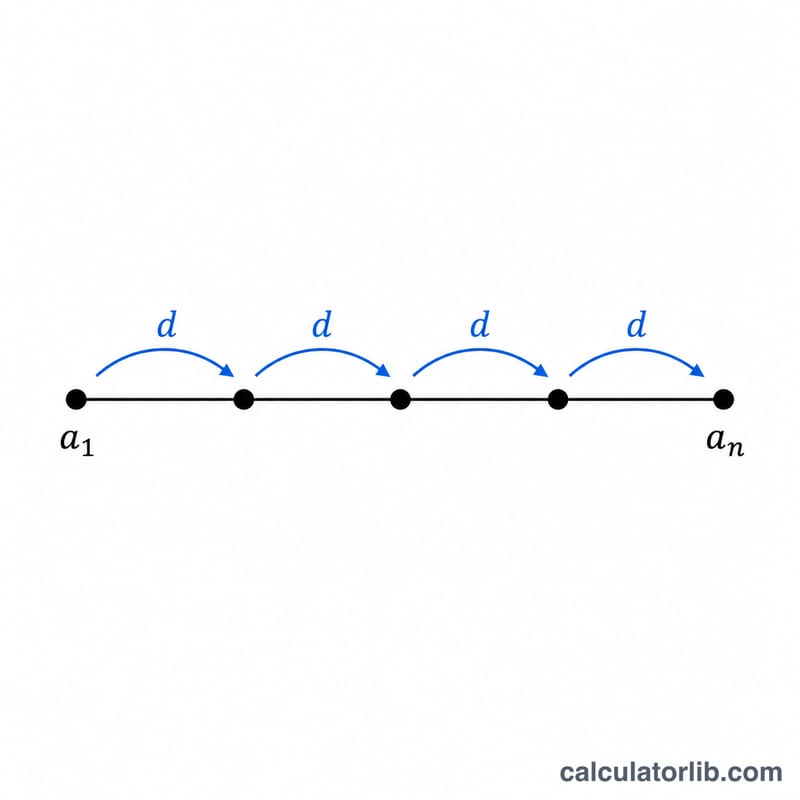
In an arithmetic sequence, each term is obtained by adding a fixed number to the previous one. That fixed number is called the common difference, written as d. For example, in the sequence 3, 7, 11, 15, … the common difference is 4 because every term is 4 more than the one before it. This calculator finds d from any two known terms of the sequence.
How to Use This Calculator
Enter the first term a₁, the value of a later term aₙ, and the position n of that later term (so n = 2 for the second term, n = 3 for the third, and so on). The calculator divides the gap between the two terms by the number of steps between them to return the common difference, plus the next term in the sequence.
The Formula Explained
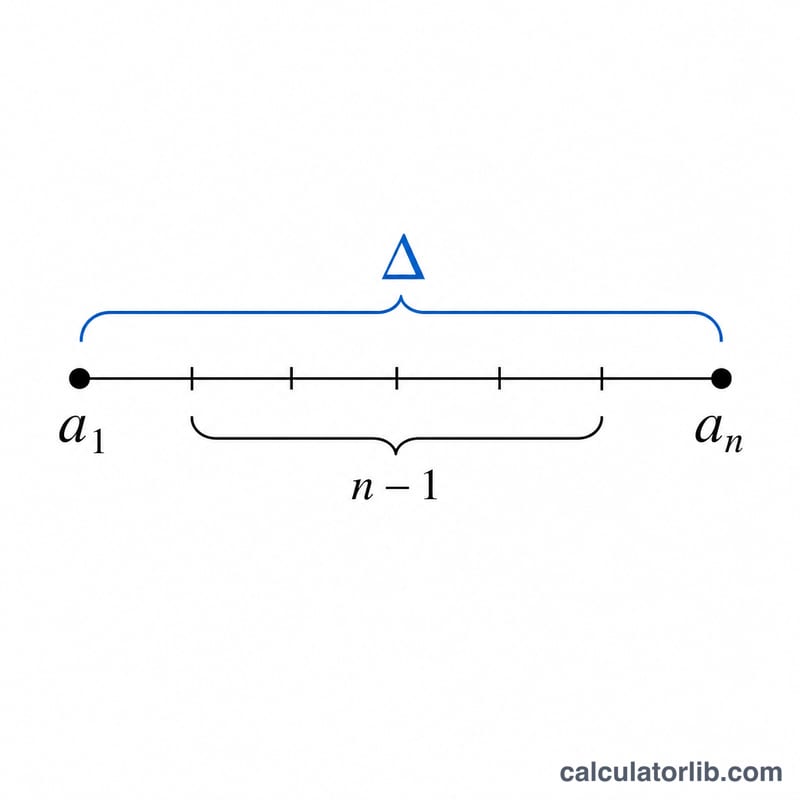
Between the first term and the term at position n there are exactly n − 1 equal steps. So the total change aₙ − a₁ spread evenly across those steps gives:
$$d = \frac{a_n - a_1}{n - 1}$$
When you already know two consecutive terms, the formula simplifies to \(d = a_{n+1} - a_n\).
Worked Example
Suppose a₁ = 3 and the 6th term is 23, so aₙ = 23 and n = 6. There are n − 1 = 5 steps between them. Then $$d = \frac{23 - 3}{5} = \frac{20}{5} = 4.$$ The next term after 23 is \(23 + 4 = 27\), confirming the sequence 3, 7, 11, 15, 19, 23, 27.
FAQ
Can the common difference be negative? Yes. A negative d means the sequence decreases, such as 20, 17, 14, … where d = −3.
What if d turns out to be a fraction? That is fine — arithmetic sequences can step by any real number, including fractions or decimals.
How do I know if a sequence is arithmetic? Check that the difference between every pair of consecutive terms is the same. If it is constant, the sequence is arithmetic and that constant is the common difference.