
What Is a Common Denominator?
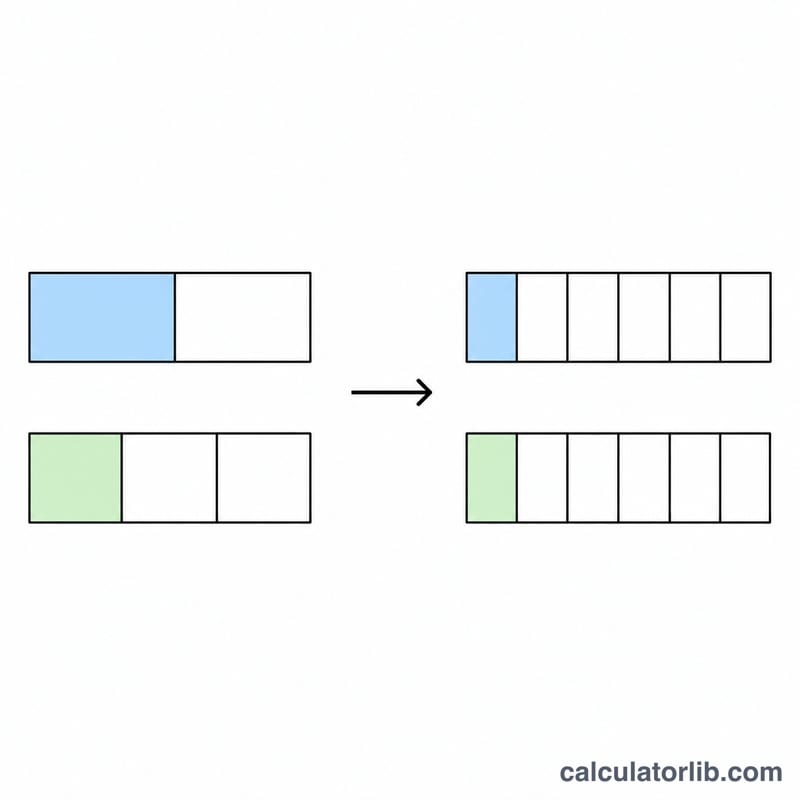
A common denominator is a shared bottom number for two or more fractions. To add, subtract, or compare fractions, they must have the same denominator. The least common denominator (LCD) is the smallest such number — it equals the least common multiple (LCM) of the original denominators. Using the LCD keeps your fractions as simple as possible.
How to Use This Calculator
Enter the two denominators you want to combine (for example, the 4 in 1/4 and the 6 in 5/6). The calculator returns the least common denominator along with the greatest common divisor used in the computation. Both inputs should be positive whole numbers.
The Formula Explained
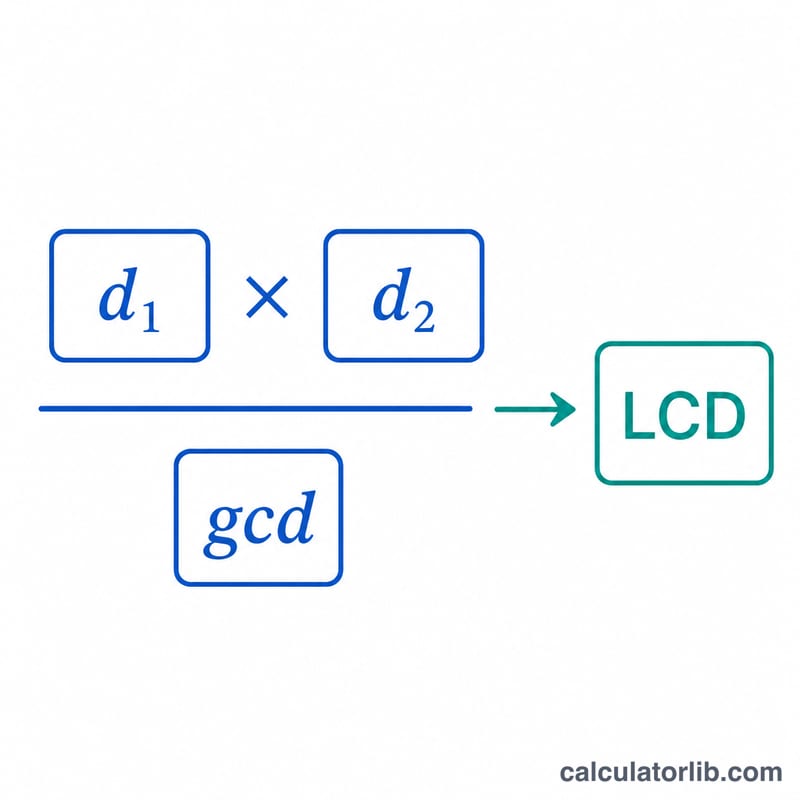
The tool uses the relationship between the LCM and the GCD: $$\text{LCD} = \frac{d_1 \times d_2}{\gcd(d_1,\ d_2)}$$. The greatest common divisor is computed with the Euclidean algorithm, which repeatedly replaces the pair \((a,\ b)\) with \((b,\ a \bmod b)\) until one value is zero. Dividing the product of the denominators by their GCD removes the duplicated factors, leaving the smallest common multiple.
Worked Example
Suppose you want to add 1/4 and 5/6. The denominators are 4 and 6. Their GCD is 2, so the LCD is $$4 \times 6 \div 2 = 24 \div 2 = \mathbf{12}.$$ Rewriting: \(1/4 = 3/12\) and \(5/6 = 10/12\), which can now be added directly to get \(13/12\).
FAQ
Is the LCD always the product of the denominators? No — only when the denominators share no common factor (their GCD is 1). For 3 and 5 the LCD is 15, but for 4 and 6 it is 12, not 24.
What if both denominators are the same? Then the LCD equals that number, since it already divides itself evenly.
Can I use it for improper fractions? Yes. Only the denominator matters when finding a common denominator, so the numerator can be anything.