

What Is Rationalizing the Denominator?
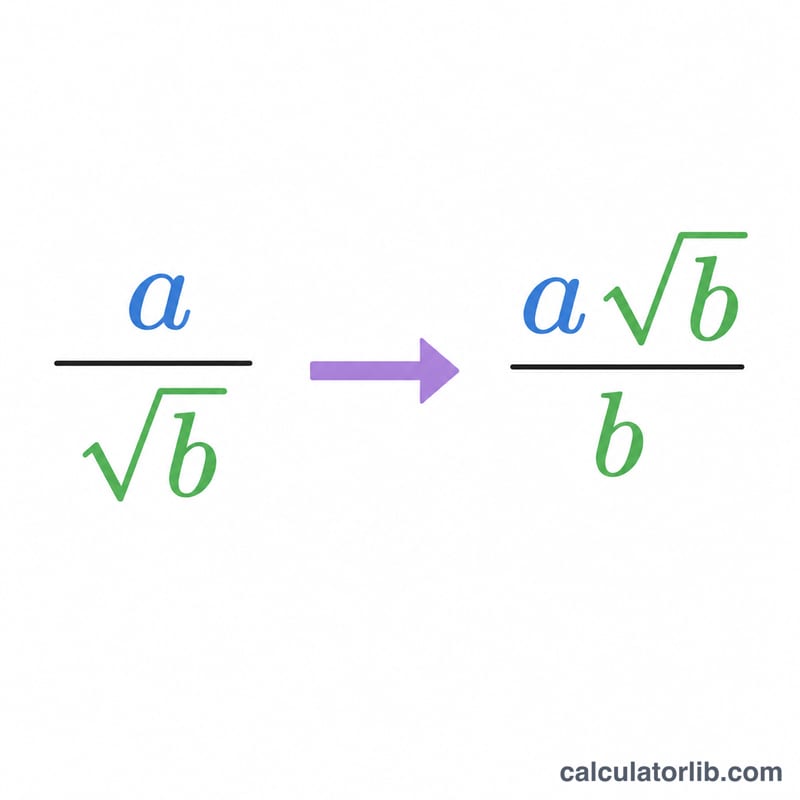
Rationalizing the denominator is the algebra technique of rewriting a fraction so that no radical (square root) remains in the denominator. Although a value like \(1/\sqrt{2}\) is perfectly valid, the standard simplified form is \(\sqrt{2}/2\). This calculator handles two common cases: a single radical denominator \(a/\sqrt{b}\) and a binomial (conjugate) denominator \(a/(c+\sqrt{d})\).
How to Use This Calculator
Choose the denominator type. For the simple case enter the numerator a and the value b under the square root. For the conjugate case enter a, the rational part c, and the value d under the root. The tool reports the rationalized denominator and the exact decimal value of the whole expression so you can check your hand work.
The Formula Explained
For a single radical, multiply the top and bottom by \(\sqrt{b}\): since \(\sqrt{b}\cdot\sqrt{b} = b\), the denominator becomes the whole number b, giving
$$\frac{\text{a}}{\sqrt{\text{b}}} = \frac{\text{a}\,\sqrt{\text{b}}}{\text{b}}$$For a binomial denominator, multiply by the conjugate \(c-\sqrt{d}\). Using the difference-of-squares pattern \((c+\sqrt{d})(c-\sqrt{d}) = c^{2} - d\), the radical cancels and the denominator becomes the rational number \(c^{2} - d\).
$$\frac{\text{a}}{\text{c} + \sqrt{\text{d}}} = \frac{\text{a}\left(\text{c} - \sqrt{\text{d}}\right)}{\text{c}^{2} - \text{d}}$$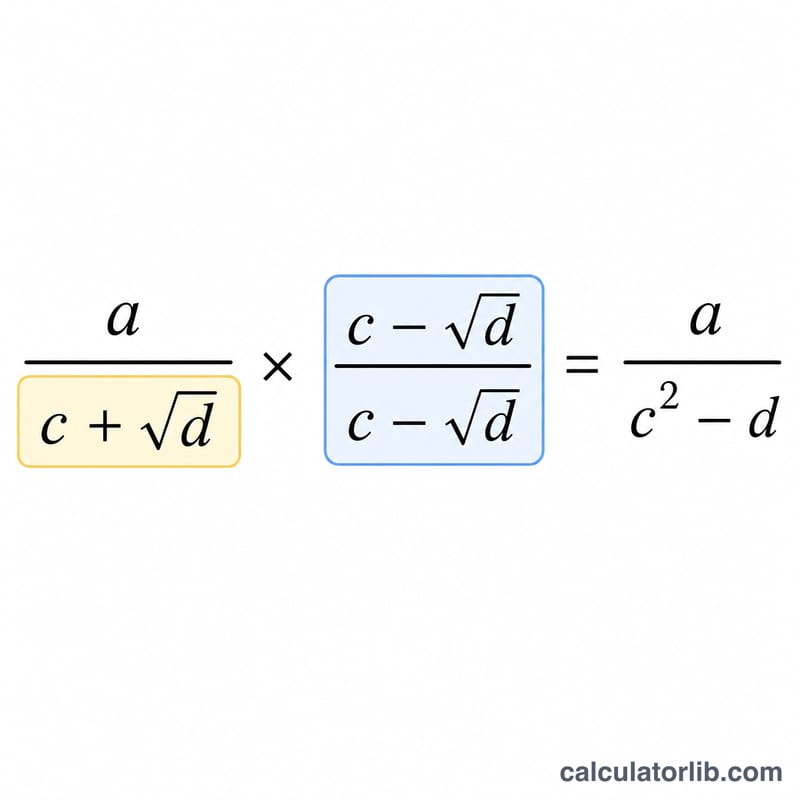
Worked Example
Take \(6/(1+\sqrt{3})\). The conjugate is \(1-\sqrt{3}\), and the new denominator is \(1^{2} - 3 = -2\). So the expression equals
$$\frac{6(1-\sqrt{3})}{-2} = -3(1-\sqrt{3}) = 3\sqrt{3} - 3 \approx 2.196.$$The calculator returns this decimal automatically.
FAQ
Why rationalize at all? It produces a standard form that is easier to compare, add, and grade, and historically made manual decimal estimation simpler.
What if \(c^{2} - d\) is negative? That is fine — the denominator is still rational; the sign just flips, as in the example above.
Does b have to be a perfect square? No. If b is a perfect square there is no radical to remove, but the method still works for any positive b.