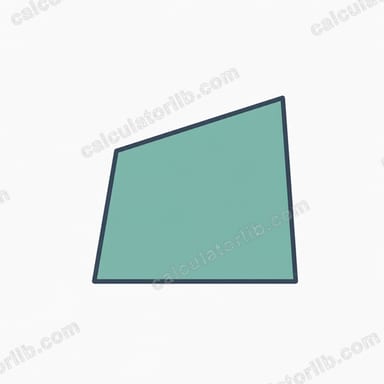

What is the Irregular Polygon Area Calculator?
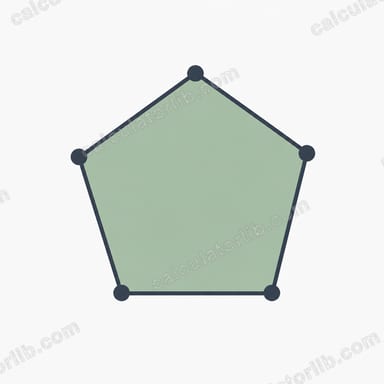
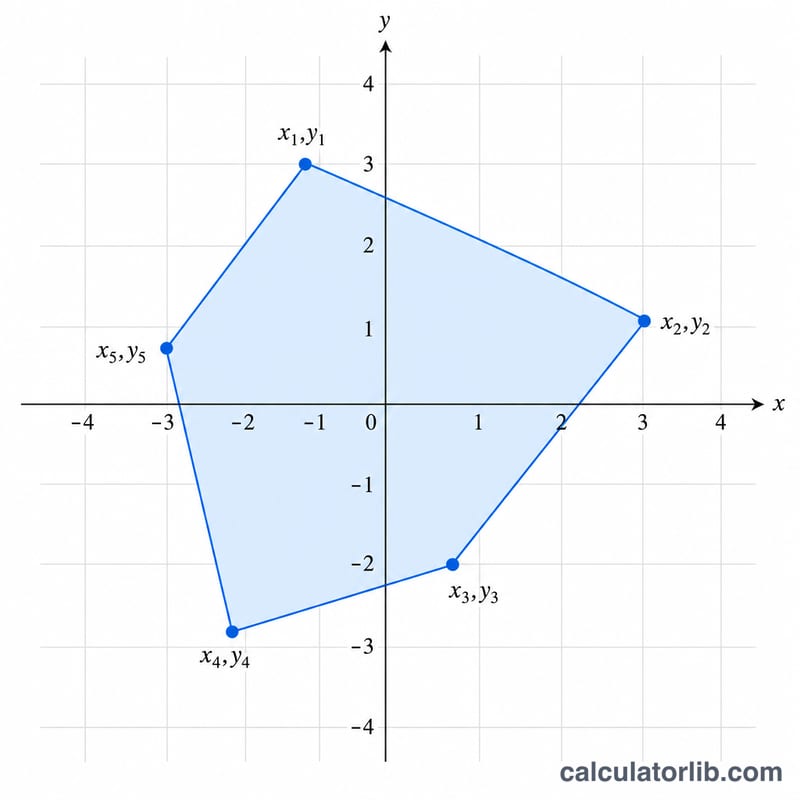
This tool computes the area of any simple (non-self-intersecting) polygon — regular or irregular — directly from the coordinates of its corners. It uses the Shoelace formula (also called the surveyor's formula or Gauss's area formula), a fast and exact method that works for triangles, quadrilaterals, pentagons, and any polygon with three or more vertices. It also reports the perimeter and the number of vertices you entered.
How to use it
List the (x, y) coordinate of each corner, one per line, written as x,y. Walk around the polygon in order — either clockwise or counter-clockwise — so that consecutive lines are adjacent vertices. You do not need to repeat the first point at the end; the calculator automatically closes the loop. Press calculate to get the enclosed area in square units.
The formula explained
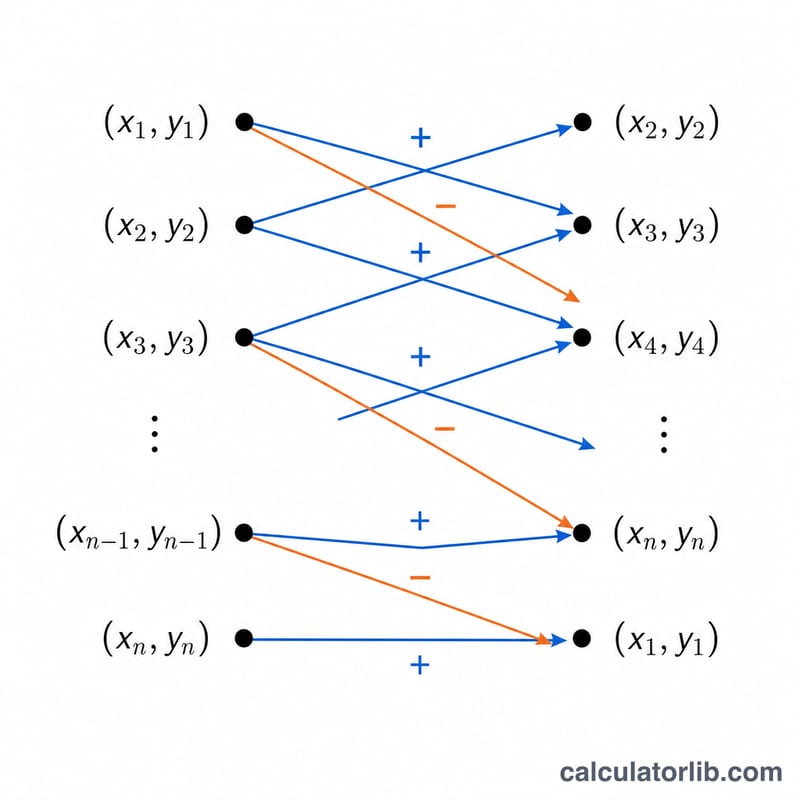
The Shoelace formula multiplies each vertex's x by the next vertex's y, subtracts the reverse cross-product, sums over all edges, takes the absolute value, and halves it: $$A = \frac{1}{2}\left| \sum_{i=1}^{n} \left( x_i\, y_{i+1} - x_{i+1}\, y_i \right) \right|$$ The name comes from the criss-cross pattern of multiplications, like lacing a shoe. The absolute value means the answer is correct regardless of winding direction.
Worked example
Consider a rectangle with corners (0,0), (4,0), (4,3), (0,3). The cross-products give \(0\cdot 0 - 4\cdot 0 = 0\), \(4\cdot 3 - 4\cdot 0 = 12\), \(4\cdot 3 - 0\cdot 3 = 12\), \(0\cdot 0 - 0\cdot 3 = 0\). Sum = 24, so $$A = \tfrac{1}{2}\cdot|24| = 12 \text{ square units}$$ — exactly base × height = \(4 \times 3\).
FAQ
Do the vertices need to be in order? Yes. The formula assumes consecutive points form the polygon's edges. Out-of-order points produce a self-intersecting shape and a wrong area.
Does direction matter? No. Clockwise gives a negative raw sum, counter-clockwise positive, but the absolute value makes the area identical either way.
What about concave polygons? The Shoelace formula handles concave (non-convex) polygons perfectly, as long as the edges do not cross each other.