What is the Irregular Trapezoid Area Calculator?
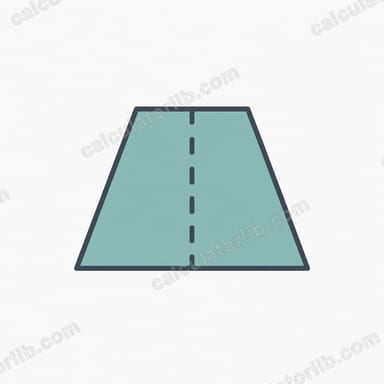
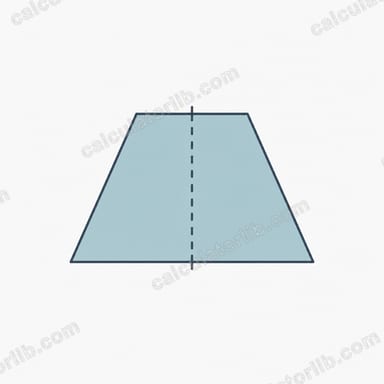
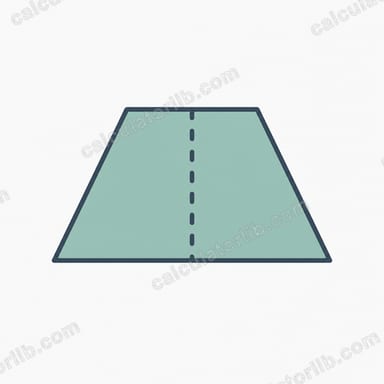
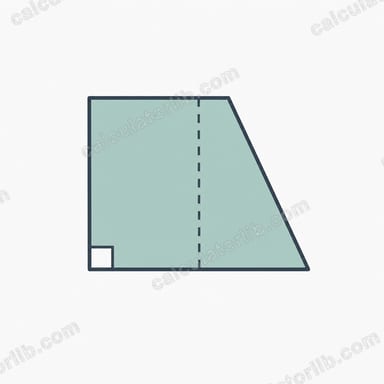
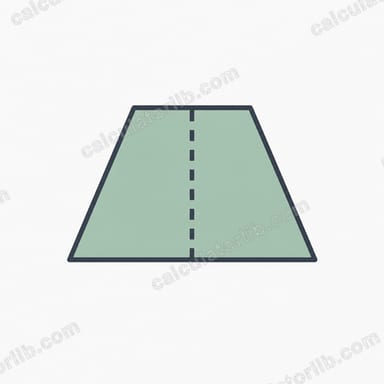
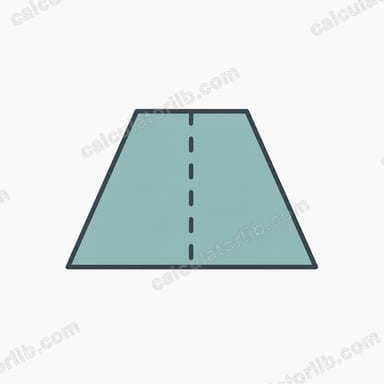
A trapezoid (trapezium) is a quadrilateral with one pair of parallel sides. Even when the trapezoid is irregular — meaning its legs are unequal and slanted — its area depends only on the two parallel sides and the perpendicular distance between them. This calculator finds that area instantly from sides a, b and height h.
How to use it
Enter the lengths of the two parallel sides (the top and bottom edges) and the height, which is the perpendicular distance between those parallel sides — not the slanted leg length. Use the same unit for all three inputs (cm, m, in, etc.) and the result will be in those units squared. Press calculate to see the area and the midline.
The formula explained
The area of any trapezoid is given by:
$$A = \frac{a + b}{2} \times h$$
The term \(\frac{a + b}{2}\) is the average of the two parallel sides, also called the midline or median. Multiplying that average width by the height gives the area, exactly as you would for a rectangle of equivalent average width.

Worked example
Suppose the parallel sides are \(a = 8\) and \(b = 5\), with height \(h = 4\). Then the midline is $$\frac{8 + 5}{2} = 6.5,$$ and the area is $$6.5 \times 4 = 26 \text{ square units.}$$

More Worked Examples
Example 1: Height found from a slanted leg
A trapezoid has parallel sides a = 12 m and b = 7 m. One slanted leg is 13 m long and sits 5 m horizontally from the end of the shorter base. The height is not given, so find it first.
- Height from the right triangle formed by the leg: \(h = \sqrt{13^2 - 5^2} = \sqrt{169 - 25} = \sqrt{144} = 12\) m.
- Midline: \(\frac{12 + 7}{2} = 9.5\) m.
- Area: \(A = 9.5 \times 12 = \) 114 m².
Here the offset of 5 m equals the full difference of the bases (12 − 7), so the other leg is perpendicular to the bases and is 12 m long.
Example 2: Mixed units
A trapezoid has a = 120 cm, b = 0.64 m and h = 50 cm. Convert everything to one unit before calculating.
- Convert: 0.64 m = 64 cm.
- Midline: \(\frac{120 + 64}{2} = 92\) cm.
- Area: \(A = 92 \times 50 = \) 4600 cm².
- Convert to square metres: 1 m² = 10,000 cm², so 4,600 cm² = 0.46 m².
Never mix units inside the formula. Convert lengths first, then convert the area if needed. Square units convert with the square of the length factor (100² = 10,000 for cm to m).
Key Terms and Definitions
- Parallel sides (bases), a and b: the two sides that never meet however far they are extended. The area formula uses their lengths.
- Legs: the two non-parallel sides. They can be equal (isosceles) or different lengths.
- Perpendicular height, h: the shortest distance between the two bases, measured at 90° to them. It is not the slant length of a leg, which is longer unless the leg is perpendicular to the bases.
- Midline (median): the segment joining the midpoints of the legs. It is parallel to the bases and has length \(\frac{a + b}{2}\), so \(A = \text{midline} \times h\).
- Trapezoid vs. trapezium: in US and Canadian usage, a trapezoid is a quadrilateral with a pair of parallel sides. In UK and most Commonwealth usage, that shape is called a trapezium, and trapezoid may mean a quadrilateral with no parallel sides. Check which convention your source uses.
- Irregular (scalene) trapezoid: a trapezoid whose legs have different lengths and whose base angles are not equal. The same formula applies, because only the bases and the perpendicular height matter.
Finding the Height from a Slanted Leg
When a problem gives leg lengths instead of the height, follow these steps.
- Find the difference of the bases: \(d = a - b\), with a the longer base.
- Split d into horizontal offsets: drop perpendiculars from the ends of the shorter base to the longer base. The offsets x and y satisfy \(x + y = d\). In an isosceles trapezoid, \(x = y = \frac{d}{2}\). In a scalene one, the offsets differ. If both legs c and e are known, then \(x = \frac{d^2 + c^2 - e^2}{2d}\) and \(y = d - x\).
- Apply Pythagoras to one right-triangle portion: \(h = \sqrt{c^2 - x^2}\). If you also know the other leg, check that \(\sqrt{e^2 - y^2}\) gives the same h.
- Plug h into the area formula: \(A = \frac{a + b}{2} \times h\).
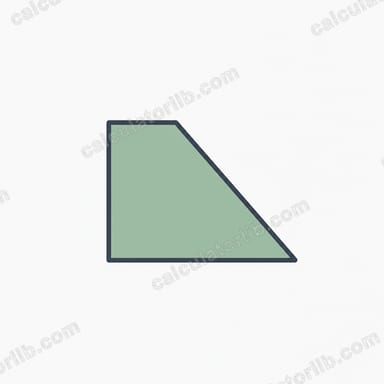
Right trapezoid: if one leg is perpendicular to both bases, that leg is the height (h = leg), so skip steps 1–3 and use the area formula directly. In that case the other leg is the hypotenuse with horizontal offset \(d = a - b\).
Example: a = 12, b = 7, leg = 13, offset = 5 gives \(h = \sqrt{169 - 25} = 12\) and \(A = 9.5 \times 12 = 114\).
FAQ
Does this work for irregular trapezoids? Yes. The formula only needs the two parallel sides and the perpendicular height, so unequal slanted legs do not change the result.
What if I only know the slant side length? You must convert it to the perpendicular height first; the slant length alone is not enough.
What units does the answer use? Whatever unit you used for the inputs, squared — e.g. centimeters give square centimeters.