
What Is a Trapezoid Area Calculator?
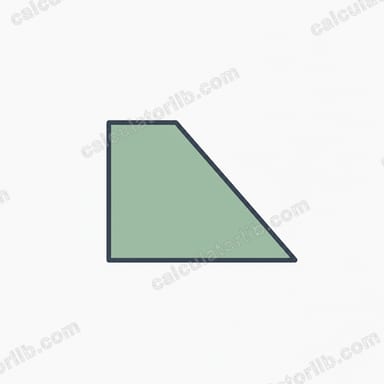
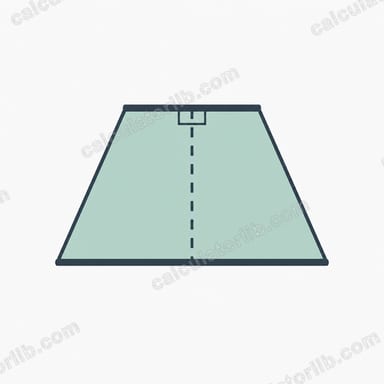
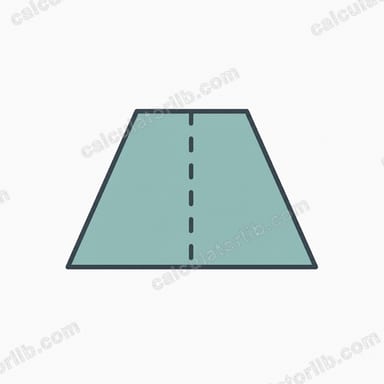
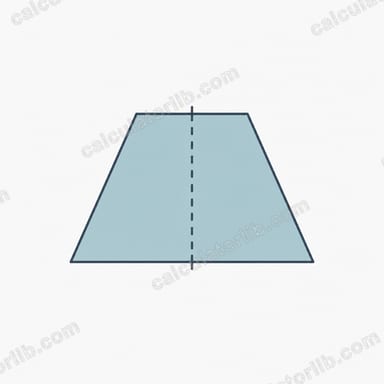
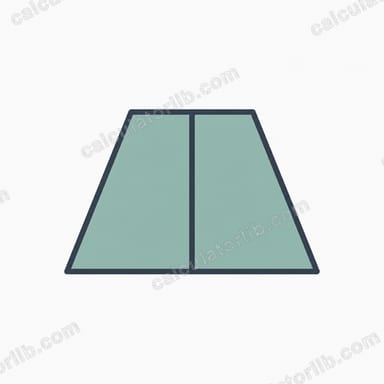
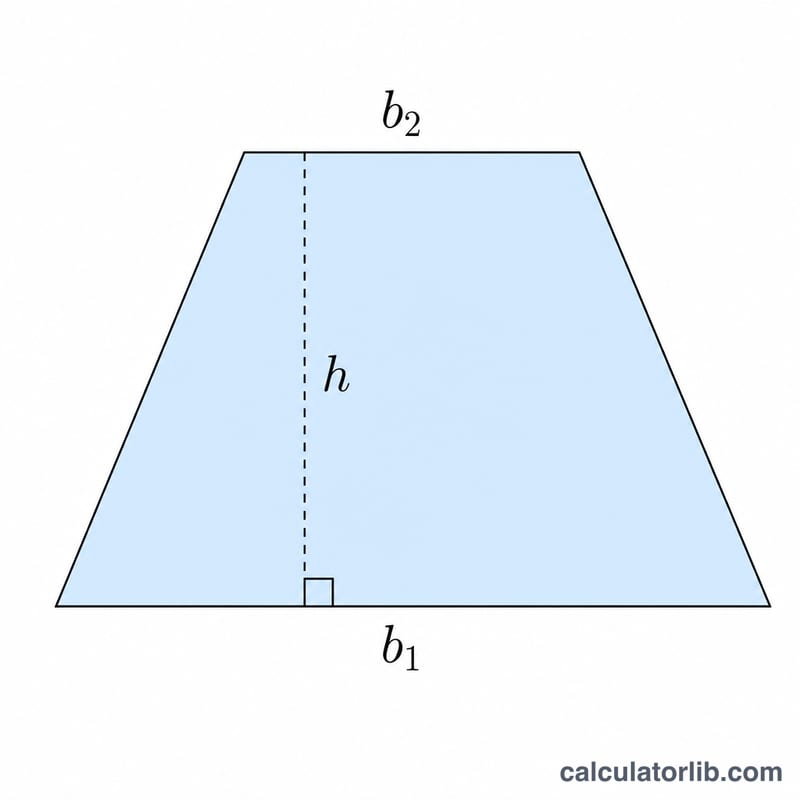
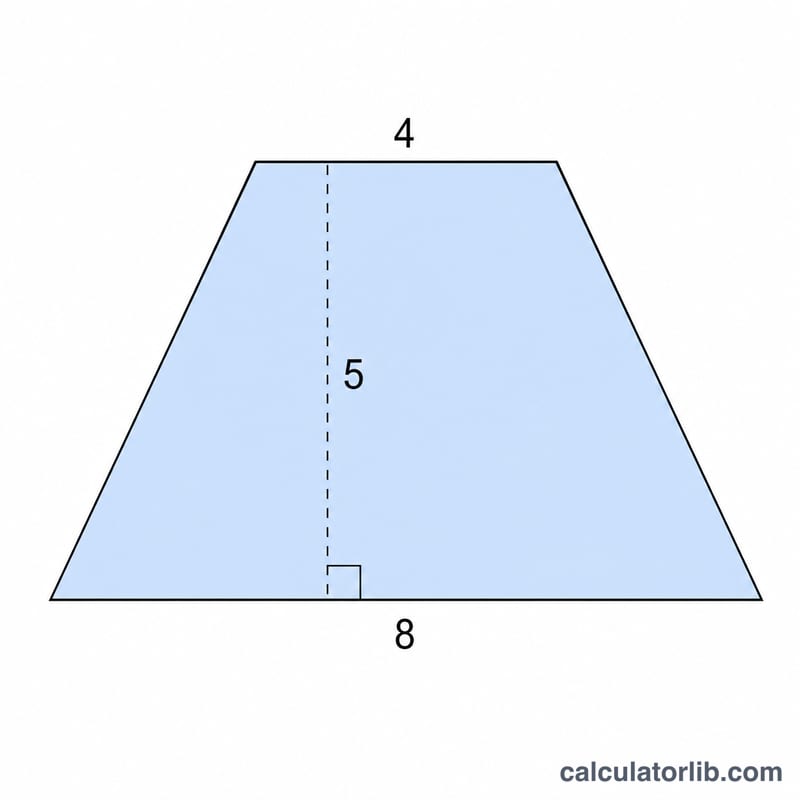
A trapezoid (or trapezium) is a four-sided shape with exactly one pair of parallel sides, called the bases. This calculator finds the enclosed area using the lengths of the two parallel bases and the perpendicular distance between them, known as the height. It works for any units — centimeters, inches, meters, feet — as long as you stay consistent; the result is in those units squared.
How to Use It
Enter the length of the first base (b₁), the length of the second base (b₂), and the height (h) — the straight-line distance between the two bases. Click calculate and the tool returns the area along with the midline (the average length of the two bases). Make sure the height is measured perpendicular to the bases, not along a slanted side.
The Formula Explained
The area of a trapezoid is given by $$A = \frac{1}{2}\left(b_1 + b_2\right) \cdot h$$ The expression \(\frac{b_1 + b_2}{2}\) is the average of the two parallel sides — the midline. Multiplying that average width by the height gives the area, exactly as you would for a rectangle whose width equals the midline. This is why a trapezoid with equal bases reduces to a rectangle.
Worked Example
Suppose \(b_1 = 8\), \(b_2 = 12\), and \(h = 5\). First add the bases: \(8 + 12 = 20\). Take half: \(20 \div 2 = 10\) (the midline). Multiply by the height: \(10 \times 5 = 50\). So the area is 50 square units.
Key Terms Defined
Understanding the area formula for a trapezoid is easier once the underlying vocabulary is clear. The terms below describe every part of a trapezoid that appears in the formula \(A = \frac{1}{2}(b_1 + b_2) \times h\).
- Trapezoid (trapezium)
- A four-sided polygon (quadrilateral) with at least one pair of parallel sides. In American English this shape is called a trapezoid; in British English it is a trapezium. (Confusingly, the two words have swapped meanings between the dialects, but the parallel-sides shape is what this calculator uses.)
- Base (b₁ and b₂)
- The two parallel sides of the trapezoid. They are conventionally labelled \(b_1\) and \(b_2\), and they generally have different lengths. Because addition is commutative, it does not matter which parallel side you call \(b_1\) and which you call \(b_2\) — the sum \(b_1 + b_2\) is the same either way.
- Parallel sides
- Two sides that run in exactly the same direction and never meet, no matter how far they are extended. The defining feature of a trapezoid is having one pair of parallel sides; these parallel sides are the bases used in the area formula.
- Height (perpendicular distance)
- The shortest distance between the two parallel bases, measured along a line perpendicular (at 90°) to both of them. The height \(h\) is not the length of a slanted side — it is the straight-up perpendicular gap between the bases.
- Midline (median)
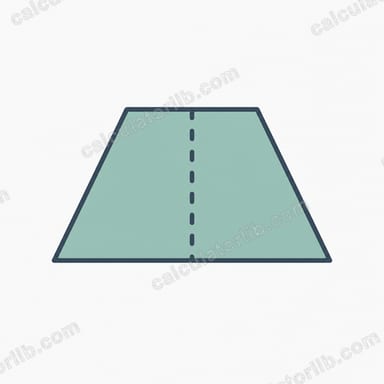
- The line segment that connects the midpoints of the two non-parallel sides. Its length equals the average of the bases, \(m = \frac{b_1 + b_2}{2}\). This lets the area be written compactly as \(A = m \times h\) — the midline times the height.
- Slant side (leg)
- Either of the two non-parallel sides of the trapezoid (also called the legs). Slant sides are not used in the basic area formula; only the parallel bases and the perpendicular height matter for computing area.
- Area (square units)
- The amount of two-dimensional space enclosed by the trapezoid. Area is always expressed in square units — square centimetres (cm²), square feet (ft²), square metres (m²), and so on — because two length measurements are multiplied together.
FAQ
Does it matter which base I call b₁ or b₂? No — addition is commutative, so swapping them gives the same area.
What if I only have the slant side length? You must use the perpendicular height, not the slant side. If you only know the slant length and an angle, compute the height first using trigonometry.
Can the two bases be equal? Yes; if \(b_1 = b_2\) the shape is a rectangle (or parallelogram) and the formula still gives the correct area.