
What is an isosceles right triangle?
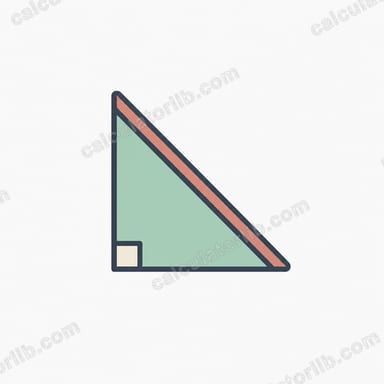
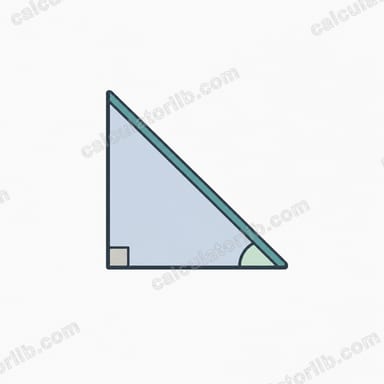
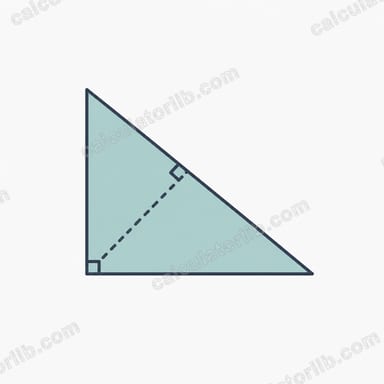
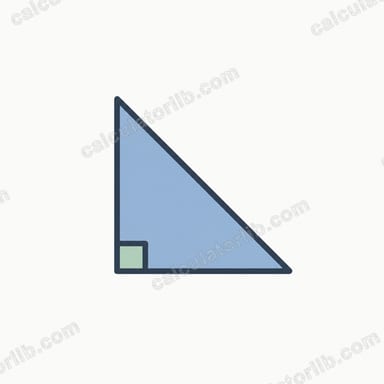
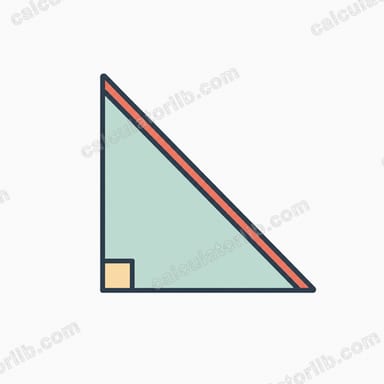
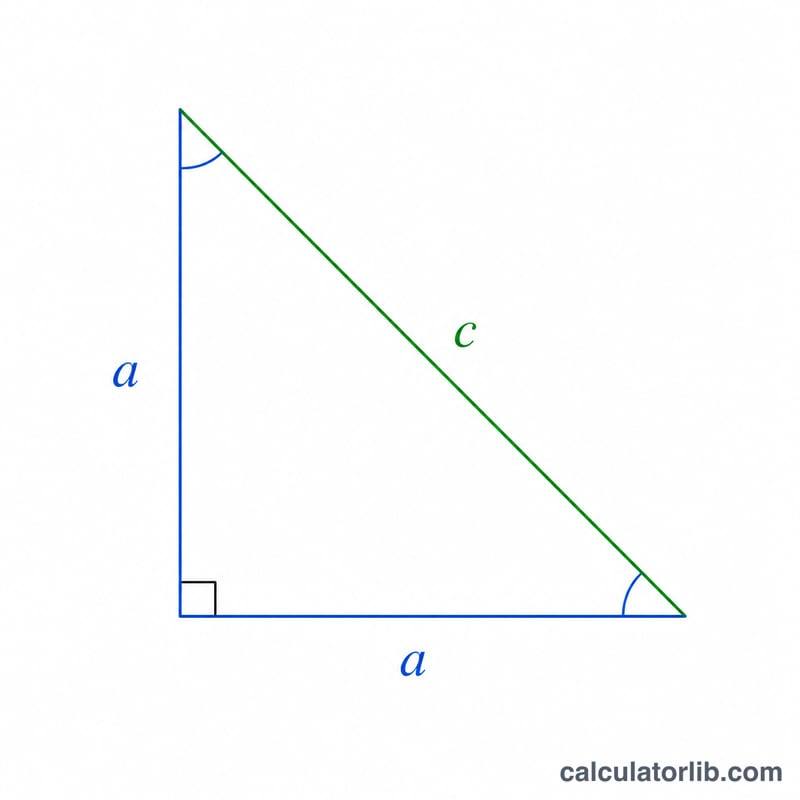
An isosceles right triangle (also called a 45-45-90 triangle) has two equal legs that meet at a 90° angle, with the two remaining angles each measuring 45°. Because the two legs are equal, the triangle is symmetric, and its longest side — the hypotenuse — has a fixed relationship to the legs. This calculator finds that hypotenuse from a single leg measurement.
How to use this calculator
Enter the length of one leg (the two equal sides) in any unit you like — centimeters, inches, meters, etc. The result is returned in the same unit. The calculator instantly displays the hypotenuse along with the triangle's area and perimeter so you have the full picture.
The formula explained
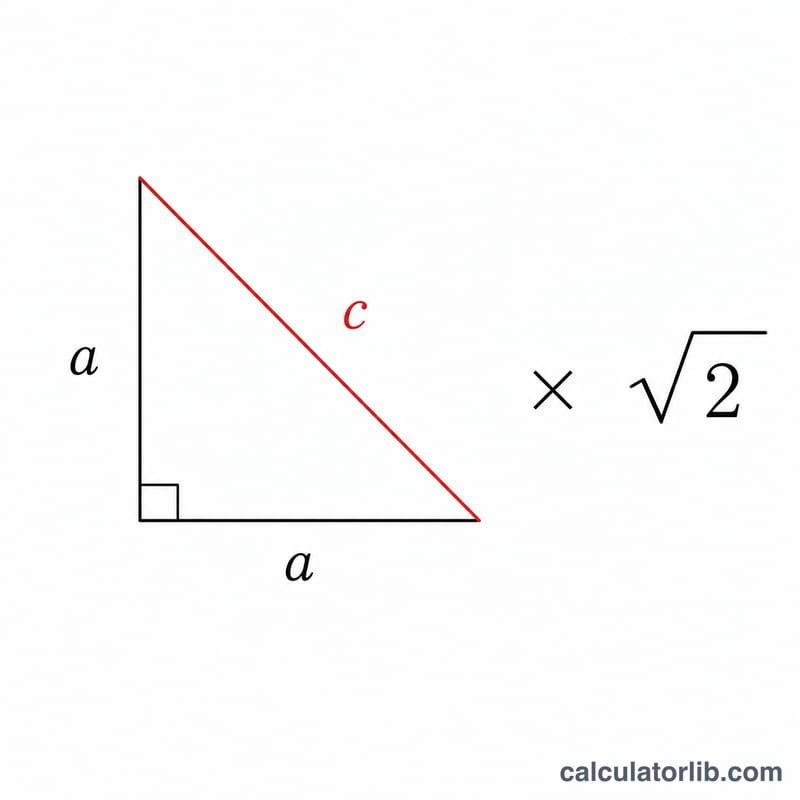
For a right triangle the Pythagorean theorem says \(c^2 = a^2 + b^2\). In an isosceles right triangle the two legs are equal (\(a = b\)), so $$c^2 = a^2 + a^2 = 2a^2.$$ Taking the square root gives \(c = a\sqrt{2}\), where \(\sqrt{2} \approx 1.41421356\). The area is simply \(\frac{1}{2} \times \text{base} \times \text{height} = \frac{a^2}{2}\), and the perimeter is \(2a + c\).
Worked example
Suppose each leg is 5 units long. Then the hypotenuse is $$c = 5 \times \sqrt{2} = 5 \times 1.41421356 \approx 7.0711 \text{ units}.$$ The area is \(\frac{5^2}{2} = 12.5\) square units, and the perimeter is \((2 \times 5) + 7.0711 = 17.0711\) units.
FAQ
Can I work backward from the hypotenuse to the leg? Yes — just divide the hypotenuse by \(\sqrt{2}\), or equivalently multiply by \(\frac{\sqrt{2}}{2} \approx 0.7071\).
Does the unit matter? No. The relationship is purely geometric, so whatever unit you enter for the leg is the unit of the hypotenuse and perimeter; the area is in those units squared.
Why is it always \(\sqrt{2}\)? Because the legs are equal, the ratio of hypotenuse to leg is constant for every 45-45-90 triangle, regardless of size.