
What this calculator does
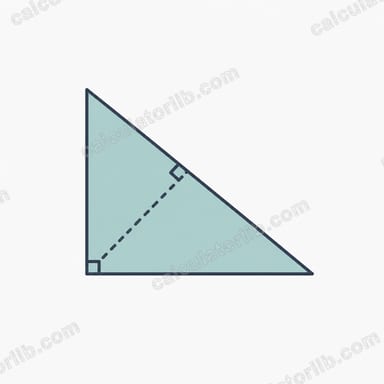
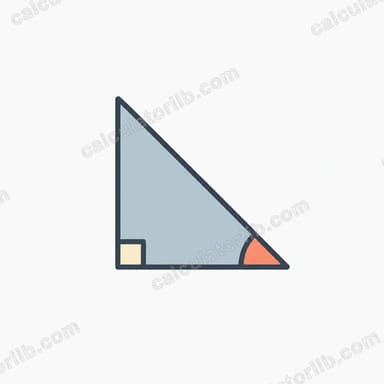
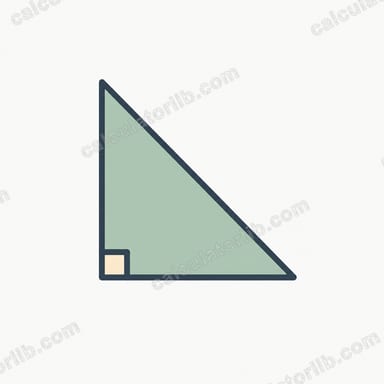
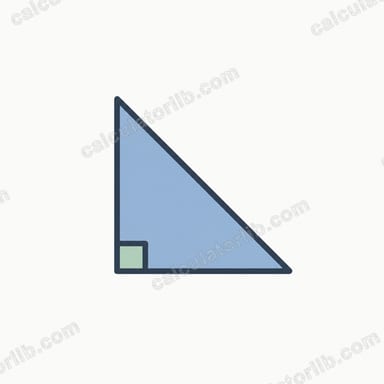
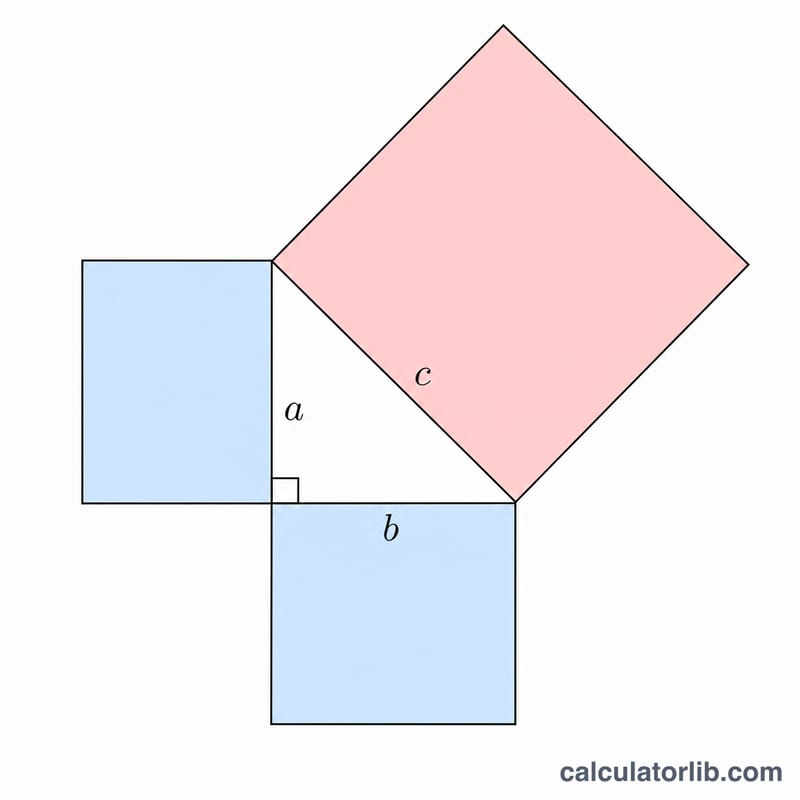
This tool tells you whether three given side lengths form a right triangle — a triangle containing a 90° angle. It uses the Pythagorean theorem, which states that in a right triangle the square of the longest side (the hypotenuse) equals the sum of the squares of the other two sides. The calculator automatically identifies the longest side, so you can enter your measurements in any order.
How to use it
Enter the three side lengths into the boxes labelled a, b and c. Units don't matter as long as all three use the same unit. Click calculate and you'll get a clear Yes/No verdict plus the underlying numbers: the detected hypotenuse, the sum of the two shorter sides squared, the hypotenuse squared, and the difference between them.
The formula explained
The Pythagorean theorem is written $$a^{2} + b^{2} = c^{2}$$ where \(c\) is the hypotenuse (always the longest side) and \(a\) and \(b\) are the two legs. If the two sides equal each other exactly, the angle opposite the longest side is precisely 90° and the triangle is right-angled. If \(a^{2} + b^{2}\) is greater than \(c^{2}\) the triangle is acute; if it is less, the triangle is obtuse.
Worked example
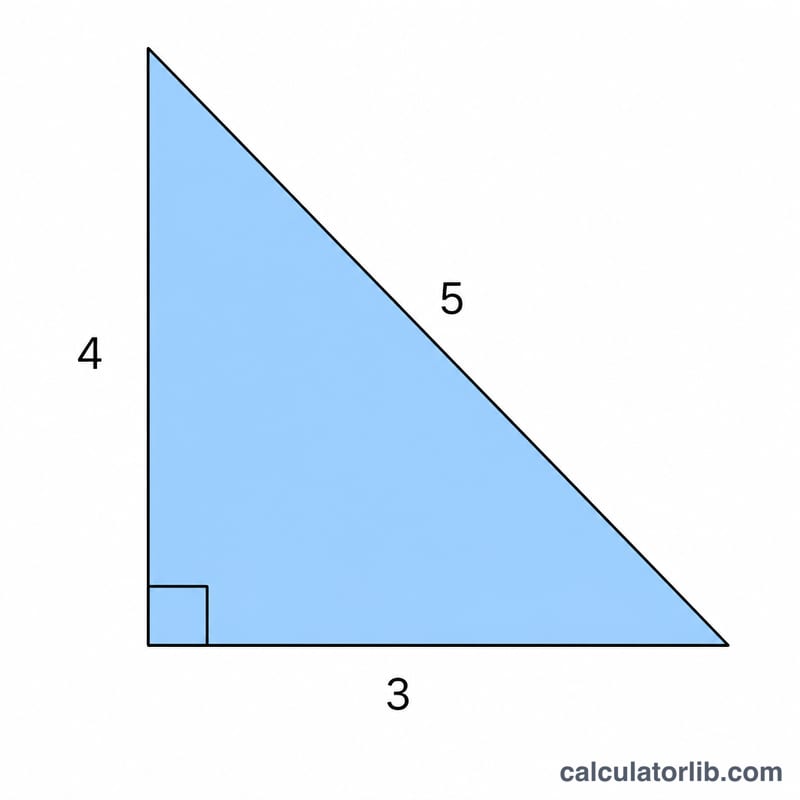
Take sides 3, 4 and 5. The longest side is 5, so \(c = 5\). Compute the legs: $$3^{2} + 4^{2} = 9 + 16 = 25$$ Compute the hypotenuse: $$5^{2} = 25$$ Since \(25 = 25\), the difference is 0 — this is a right triangle. The familiar 3-4-5 triple is the smallest set of whole numbers that does this.
FAQ
Does the order of the sides matter? No. The calculator finds the largest value and treats it as the hypotenuse automatically.
Why might a "perfect" triangle show a tiny non-zero difference? Rounded or measured inputs (like 1.41 instead of \(\sqrt{2}\)) won't satisfy the equation exactly. A small tolerance is applied so near-perfect cases still read as right triangles.
What if \(a^{2} + b^{2} \neq c^{2}\)? The triangle is not right-angled — it is either acute (sum larger) or obtuse (sum smaller).