
What it is
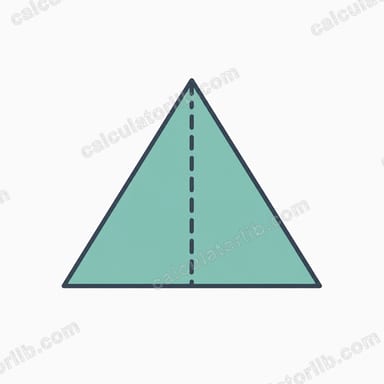
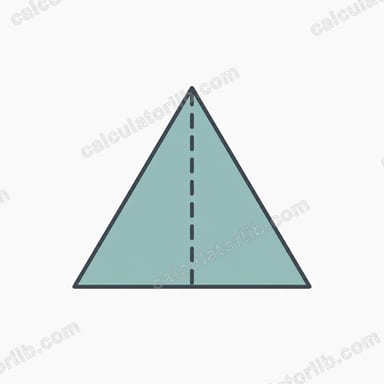
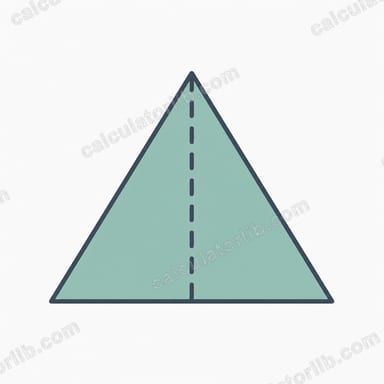
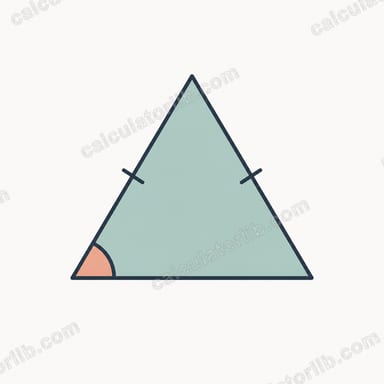
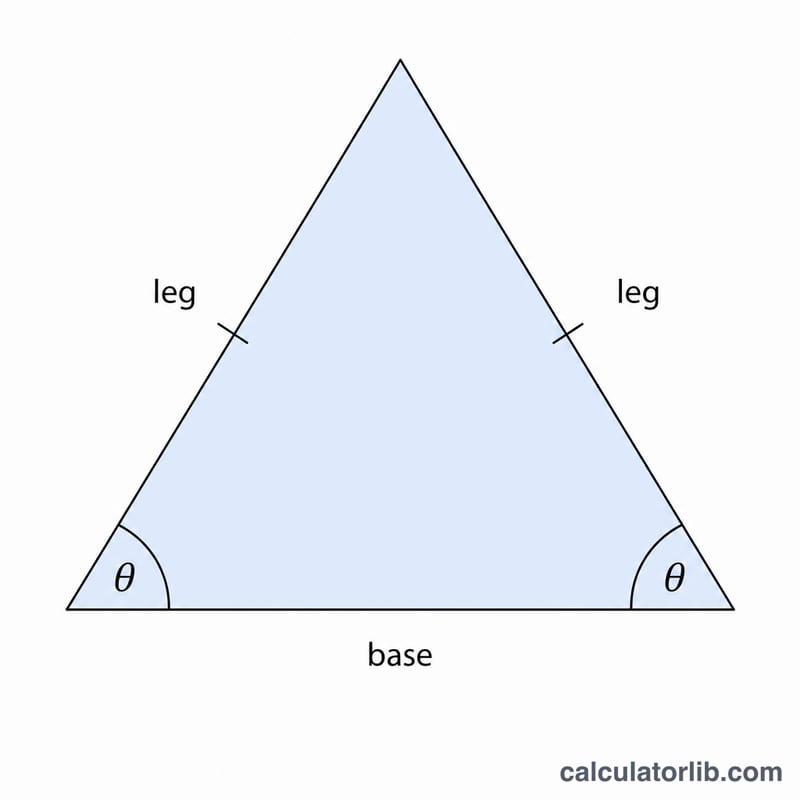
An isosceles triangle has two equal sides (the legs) and a third side (the base). The two angles at the base are equal. This calculator relates the base, the legs and the base angle θ, so you can find one missing side when you know the other side and the base angle.
How to use it
Choose whether you want to find a leg or the base. Enter the side you already know and the base angle in degrees, then read off the result. The tool also reports the apex angle, computed as 180° − 2θ.
The formula explained
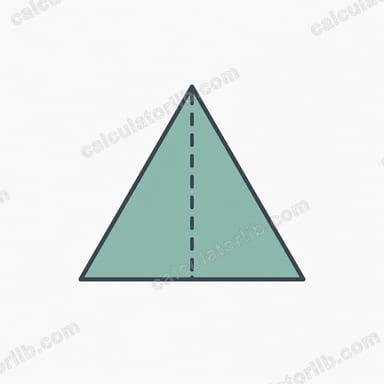
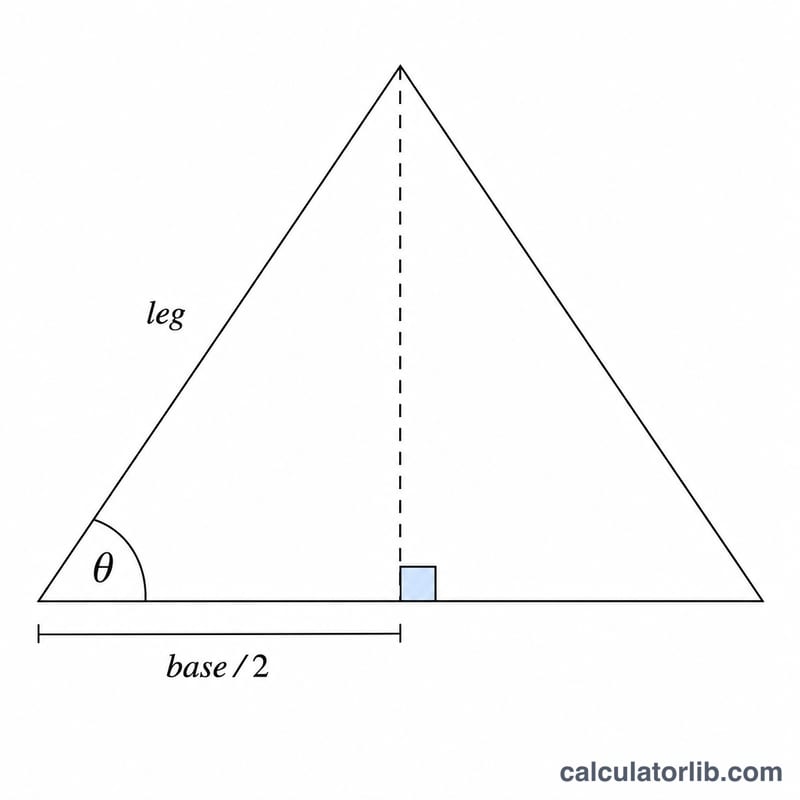
If you drop a perpendicular from the apex to the midpoint of the base, you split the triangle into two right triangles. Each has the base angle θ adjacent to half the base. Using cosine (adjacent ÷ hypotenuse), half the base equals leg·cos θ, so the full base is 2·leg·cos θ. Rearranging gives the leg as base ÷ (2·cos θ). The angle must be less than 90° for a valid triangle, since two base angles already account for 2θ of the 180° total.
$$\text{Base} = 2 \cdot \text{Leg} \cdot \cos\!\left(\text{Base Angle}\right)$$
$$\text{Leg} = \frac{\text{Base}}{2 \cdot \cos\!\left(\text{Base Angle}\right)}$$
Worked example
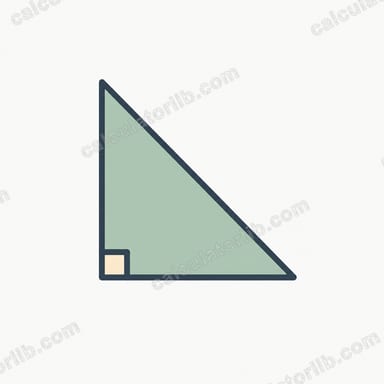
Suppose the base is 10 units and each base angle is 45°. Then $$\text{leg} = 10 \div (2 \times \cos 45°) = 10 \div (2 \times 0.70711) = 10 \div 1.41421 \approx 7.0711 \text{ units.}$$ The apex angle is \(180° - 2 \times 45° = 90°\), confirming a right isosceles triangle.
FAQ
Why must the angle be under 90°? Two equal base angles plus the apex must sum to 180°, so each base angle must be less than 90°.
Can I use radians? Enter the angle in degrees; the calculator converts internally.
What if I know the height instead? This tool uses the base angle. If you have the height, first find the angle with arctangent before using it here.